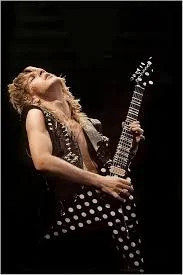
Randy Rhoads — £500 · Sweet Spot Tone
Randy Rhoads's crushing and technically demanding tone took shape during the decade of guitar virtuosity and arena rock and remains one of the most sought-after sounds on guitar. Randy Rhoads fused classical music training with heavy metal technique in a career cut short at 25. His polka-dot Flying V and precise, technically exacting vibrato brought a new vocabulary to rock guitar — every solo was composed, not improvised, with controlled aggression and melodic intent. At the £500 · Sweet Spot mark — the sweet spot — enough to get genuinely close to the sound without breaking the bank — the build centres on a Epiphone Explorer running through a Boss Katana 50 MkII, totalling ~£448.
Build Randy Rhoads's £500 · Sweet Spot Rig
2 pieces · Total ~$569
What guitar does Randy Rhoads use?
Randy Rhoads is primarily associated with lp style guitars. At a £500 budget, Epiphone Explorer delivers the essential tonal character.
What to Buy
£500 · Sweet Spot — Complete Gear List
Why This Rig Works
How Randy Rhoads's gear choices create the signature tone
Epiphone Explorer
The Epiphone Explorer provides the tonal foundation for the entire rig — its character shapes everything that follows.
Boss Katana 50 MkII
Its 'Brown' amp character at low gain is an excellent approximation of the Fender-style clarity that Hendrix, Mayer, Gilmour and SRV all relied on. Built-in effects mean you're a few knob turns away from the right tone.
The Combined Tone
Karl Sandoval polka-dot Flying V or Les Paul Custom into a Marshall JMP (100W) with an MXR Distortion+ pushing the front end. High gain but not sloppy — Rhoads' technical precision comes through even at high volumes. An Electro-Harmonix flanger adds movement on some solos.
Tone Tips
Getting the Sound Right
- On the Boss Katana 50 MkII: use the Brown channel — the closest model to a Marshall-voiced preamp at this price. Set character to 8, gain to 5. For Randy Rhoads's lead volume jump, use the Boost mode rather than adding a separate boost pedal.
- Classical vibrato: uniform, even oscillation — practise with a metronome until it's consistent
- MXR Distortion+ before the Marshall: adds saturation and tightens the low end
- String bends are precise — Rhoads always bent exactly in tune, practise with a tuner
- Legato passages (hammer-ons / pull-offs) from classical influence — smooth, even velocity
- Flying V bridge humbucker: focused, tight low end ideal for precise metal riffing
- A Les Paul's humbucker output into a Marshall DSL is a self-contained amp distortion system — try the sound without any drive pedals first. Most players add overdrive before fully exploring what the amp alone can do
Avoid These Pitfalls
Common Mistakes When Chasing This Tone
- Not exploring the Marshall DSL alone before adding pedals — a Les Paul or humbucker guitar into a British amp is already a near-complete overdrive system. Adding drive pedals on top is often unnecessary and muddies the amp's natural character
- Leaving the wah pedal engaged but stationary between rocking it — a cocked wah (fixed position, not moving) acts as a midrange filter that changes the core tone. Either rock it expressively or bypass it completely; a cocked wah changes the sound in ways that are often unintended
- Setting the amp bass too high — the inherent warmth of mahogany means you need less bass EQ than with a Strat. Starting at 5 rather than 7 prevents low-end mud.
- Scooping the mids on a Marshall-style amp — the upper midrange emphasis is what makes British amps cut through. Mid-scoop EQ sounds good alone but disappears in a band mix.
- Using too much gain on the drive pedal — pedal-driven tone works best with the amp providing some character and the pedal adding focus and saturation, not replacing the amp entirely.
Budget Alternatives
Same Tone, Different Budget
FAQ
Randy Rhoads Tone — Common Questions
Randy Rhoads is primarily associated with lp style guitars. At a £500 budget, Epiphone Explorer delivers the essential tonal character.
Randy Rhoads's amp is british crunch voiced — clean to moderate gain. At the £500 level, Boss Katana 50 MkII is the closest match.
Yes — £500 covers a real guitar and amp in the right tonal family. This rig totals £448 and captures the essential character. The guitar and amp account for 80% of the tone; pedals are secondary at this budget.
Randy Rhoads's tone is defined by classical-influenced, precise, melodic. The combination of lp guitar and british crunch amp creates a sound that is immediately recognisable.
Randy Rhoads's gain approach is pedal-driven — distortion pedals into a relatively clean amp. The pedal defines the distortion character. At £500, this is replicated through Boss Katana 50 MkII.
Randy Rhoads — £500 · Sweet Spot Complete Rig
~£448Guitar
Epiphone Explorer
Amp
Boss Katana 50 MkII
Tone Match
Closest Real-World Tone Match
If you like Randy Rhoads's tone, these players use a similar approach — same gear philosophy, comparable sound characteristics.
Related Tones