RockHard Rock1960s–present
Pete Townshend — £2,500 · Premium Rig
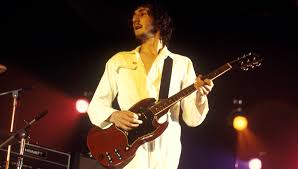
Gibson SG Special or Hamer guitar into Marshall Super Lead stacks at maximum volume. Very high amp gain from sheer volume, not pedals. Townshend's open-chord rock voicings and windmill strumming create percussive attacks that cut through even the loudest drum kit. Feedback is a compositional tool.
Signal Path
Signal Chain
Full signal path
GuitarGibson SG
EQEmpress ParaEQ
DistDS-1
AmpMarshall DSL100H
Full Gear List
£2,500 · Premium — Complete Rig

£££ Pro-Level$888

££ Mid-Range$316
£ Budget$62

Tone Tips
Getting the Sound Right
- Windmill strumming: lock elbow and rotate the full arm from the shoulder — dramatic arc
- Power chords with open top strings ring beneath — creates a fuller sound than muted power chords
- Guitar at full volume into a loud Marshall — power tube saturation is the gain source
- Open-chord voicings: G5 with open D and G strings ringing, D/F# with open strings
- Aggressive right-hand strumming using the full weight of the arm, not just the wrist
- Feedback: hold the guitar close to the amp cone and let standing waves develop
- Pete rarely plays lead — his value is in the rhythm; chord choices carry the melody
- Auto-Swell: strum a chord and fade up the guitar volume after picking for a smooth swell
Avoid These Pitfalls
Common Mistakes When Chasing This Tone
- Scooping mids on the Marshall Super Lead with humbuckers — the mid-forward character of British amps with humbuckers is the central sound of classic rock. A mid scoop removes the fundamental voice of the combination
- Adding too much bass on the amp — the lightweight SG body has natural mid-forward resonance. Adding bass makes the tone muddy rather than heavier.
- Using a high-gain distortion pedal instead of amp gain — British crunch amps have a specific harmonic character when driven from their own gain stage. A pedal changes this character.
- Playing at bedroom volume expecting amp-driven tone — the power-tube saturation that defines this gain structure only occurs when the amp is working at substantial output. This is not replicable at low volumes.
- No noise gate at high gain — self-noise at high gain levels is constant and distracting. A gate is not optional for this style.
- Setting gain to maximum — above 8 on most amp channels, note separation degrades and riffs lose definition. The loudness feels greater but the clarity goes down.
Tone Profile
Pete Townshend's Sound
Gibson SG Special or Hamer guitar into Marshall Super Lead stacks at maximum volume. Very high amp gain from sheer volume, not pedals. Townshend's open-chord rock voicings and windmill strumming create percussive attacks that cut through even the loudest drum kit. Feedback is a compositional tool.