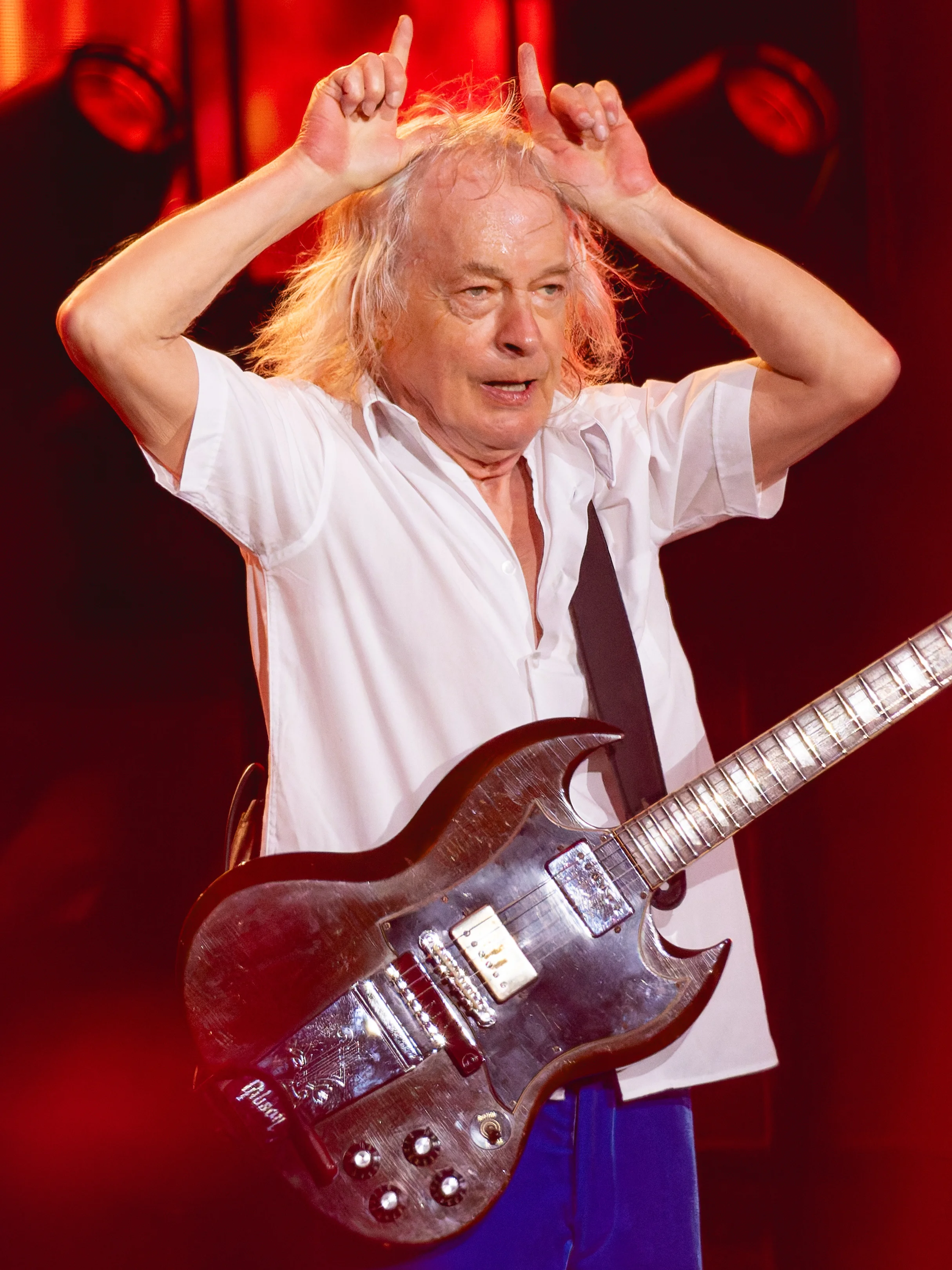
Sound Like Angus Young
During the era that defined hard rock and blues-rock, Angus Young redefined what heavy and assertive electric guitar could sound like — and their influence on hard rock has never faded. Angus Young's AC/DC tone is the purest expression of a humbucker meeting a pushed Marshall — no effects, no pedals, just raw power. His SG through a cranked Super Lead delivers explosive crunch that has powered some of the best-selling rock albums ever made. Whether you're starting out or ready to invest, the rig guides below cover every budget from £200 to £2,500.
Quick Answer
To sound like Angus Young, start with a Epiphone SG Special into a Boss Katana 100 MkII, with a Xotic EP Booster as your key effect.
Tone Analysis
Angus Young's Guitar Tone — In Depth
Tone Philosophy
Angus Young's philosophy is maximalism in its purest form: the biggest possible guitar sound from the most direct possible signal path, performed with complete physical commitment. Everything about AC/DC's approach eliminates complexity in favour of impact. No effects pedals. No rack systems. A Gibson SG, a cable, a Marshall amplifier. The school uniform is not a gimmick — it is a statement about the music's relationship to adolescent energy and the refusal of grown-up complexity.
The Signature Sound
The AC/DC rhythm tone — Back in Black, Highway to Hell, Whole Lotta Rosie — is a Gibson SG through a Marshall Super Lead or JTM45, run at high volume. The SG's bridge humbucker and the Marshall's output transformer under saturation create the characteristic bark and attack. The lead tone adds slightly more gain, sometimes from a Schaffer-Vega wireless unit used as a signal booster that pushed the Marshall harder than a direct cable connection.
Key Gear
The 1968 Gibson SG Standard with Jaydee modification has been his primary guitar for most of AC/DC's career. The Schaffer-Vega wireless transmitter, discovered in the 1970s, became an integral tone component — the transmitter's circuit added drive and EQ colouring that the band came to depend on, to the point that Angus used a Schaffer-Vega Replica (SVR) pedal to simulate the effect when wireless technology changed.
Playing Approach
Young's stage presence — the duck walk, the constant motion, the school uniform — is inseparable from the musical approach. He plays rhythm and lead simultaneously in a way that makes AC/DC function as a power trio in practice, even with rhythm guitarist Malcolm providing the foundation. His improvised solos are blues-based but played with rock energy — pentatonic vocabulary at volume.
Legacy
AC/DC's consistency and longevity — over 50 years of essentially the same musical approach — is itself a philosophical statement. Young's refusal to evolve the formula, his commitment to the idea that rock and roll is fundamentally a rhythm-and-blues exercise played very loud, has produced one of the most recognisable sounds in popular music.
Budget Comparison
Pick Your Budget Level
£500 · Sweet Spot
~£487
- GuitarEpiphone SG Special
- BoostXotic EP Booster
- AmpBoss Katana 100 MkII
£1,000 · Pro-Level
~£857
- GuitarEpiphone SG Standard
- AmpMarshall DSL40CR
- EQMXR M108S 10-Band EQ
£2,500 · Premium
~£2397
- GuitarGibson SG Junior
- BoostPaul Cochrane Timmy
- AmpMarshall DSL100H
Shop Now
Buy the Key Gear — £500 Sweet Spot
Guitar, amp and essential effects for the authentic Angus Young sound. The guitar and amp together account for 80% of the tone.
Complete the Rig
Essentials Every Guitarist Needs
These aren't exciting — but every rig needs them. Buy once, sorted forever.
Tone Profile
Angus Young's Sound
Gibson SG bridge humbucker into a Marshall 1959 Super Lead at full volume — the power tubes saturating under load create natural, punchy crunch with strong midrange. No effects in the signal path at all. The Schaffer-Vega wireless system Angus used in the 1970s acted as a subtle buffer and boost; modern setups compensate with the guitar's volume knob.
Modeling Amps
Get Angus Young's Tone on Your Modeler
Targeting Marshall (Plexi / JCM800). Use these amp models and IRs as your starting point — dial in from there using the knob settings above.
Low master, drive at 6–7 for Plexi crunch; Brit 2204 for JCM800 lead
Keep presence at 5, let the amp breathe — avoid over-EQing
Song Match
Which Angus Young Songs Suit Your Amp
Tone Match
Closest Real-World Tone Match
If you like Angus Young's tone, these players use a similar approach — same gear philosophy, comparable sound characteristics.
Weekly Tone Tips
One setting, one artist insight, one gear pick. No noise.