Blues-RockBlues1960s–1990s
Rory Gallagher — £500 · Sweet Spot Rig
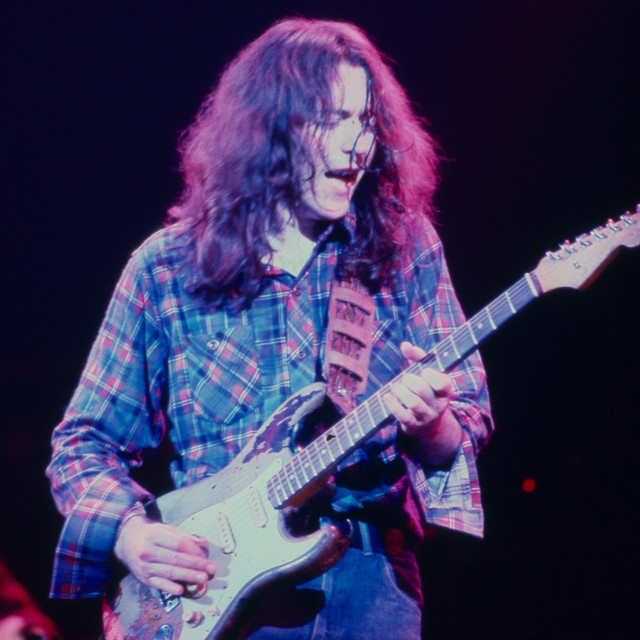
Heavily worn 1961 Fender Stratocaster into a Marshall Super Lead or Vox AC30, sometimes with a Rangemaster treble booster. The worn guitar has developed its own resonance over decades. An Ampeg Jet tape echo or treble booster are occasional additions. Gallagher's tone is characterised by his aggressive, physical pick attack.
Signal Path
Signal Chain
Full signal path
GuitarCV Strat
ODJoyo Vintage
AmpKatana 50
Full Gear List
£500 · Sweet Spot — Complete Rig
££ Mid-Range$380

£ Budget$37
Tone Tips
Getting the Sound Right
- Pick hard with a heavy attack — Gallagher's aggression comes from the right hand
- Middle or bridge pickup on the Strat for the raw, cutting lead tones
- Amp slightly breaking up, not high-gain — the dirt is on the edge of clean
- Treble booster before the amp sharpens pick attack and drives harmonic content
- Simple pentatonic and blues-scale vocabulary played with conviction — not complex runs
- Vibrato is expressive and physical — Gallagher would physically shake the neck
- Country and Celtic music influences emerge in some chord choices — maj6, add9 shapes
- Dobro and acoustic playing were integral to his sets — not just electric blues
Avoid These Pitfalls
Common Mistakes When Chasing This Tone
- Setting the TS9 gain above 5 into a clean amp — at high gain settings the TS becomes a distortion pedal that colours the tone heavily. Below 4, it's a boost and focus pedal. Single coils into a TS above 5 gets nasal and harsh
- Leaving the wah pedal engaged but stationary between rocking it — a cocked wah (fixed position, not moving) acts as a midrange filter that changes the core tone. Either rock it expressively or bypass it completely; a cocked wah changes the sound in ways that are often unintended
- Using a humbucker guitar as a substitute — the quack, string noise, and bright attack of single coils are irreplaceable. No amount of EQ on a humbucker produces the same result.
- Scooping the mids on a Marshall-style amp — the upper midrange emphasis is what makes British amps cut through. Mid-scoop EQ sounds good alone but disappears in a band mix.
- Using a distortion pedal to replace amp saturation — amp-driven tone has a specific feel (dynamics, touch sensitivity, natural compression) that pedal distortion cannot replicate. The source of gain matters.
- Setting gain too high on the overdrive pedal — most overdrive pedals are most useful at gain settings of 2-5, where they add character without dominating the tone. High gain settings on an OD pedal become a distortion, not an overdrive.
- Using a humbucker where single coils are needed — the quack, string definition, and high-frequency air of single coils cannot be EQ'd into a humbucker
- Adding a compressor before the amp "for more tone" — it kills the natural attack variation that defines the style. Blues tone is uncompressed and dynamic.
Tone Profile
Rory Gallagher's Sound
Heavily worn 1961 Fender Stratocaster into a Marshall Super Lead or Vox AC30, sometimes with a Rangemaster treble booster. The worn guitar has developed its own resonance over decades. An Ampeg Jet tape echo or treble booster are occasional additions. Gallagher's tone is characterised by his aggressive, physical pick attack.