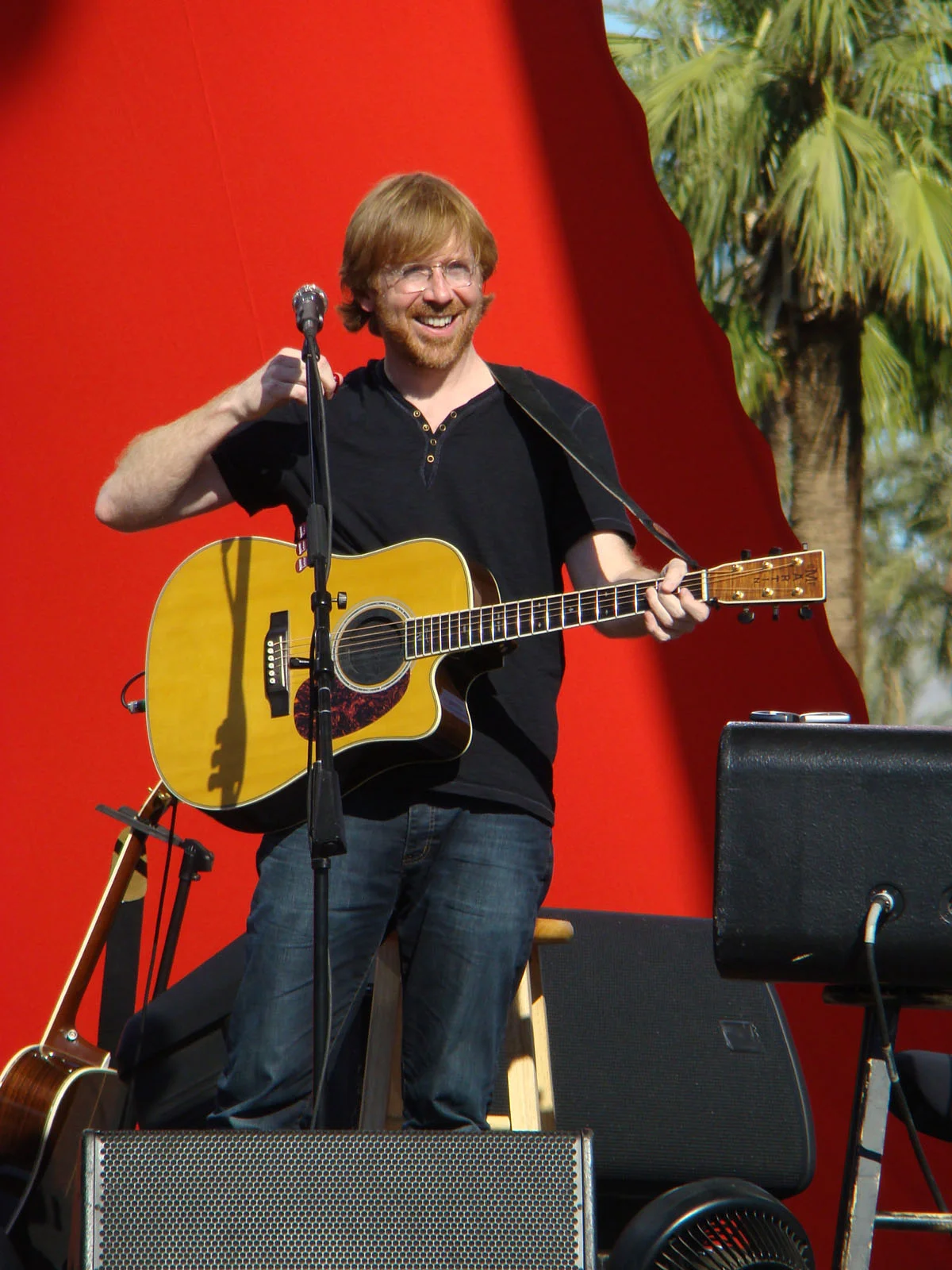
Trey Anastasio — £2,500 · Premium Rig
Anastasio runs a hollow-body guitar (bridge pickup, often a Bill Lawrence-style humbucker) into a Ross compressor and a Tube Screamer stacked into clean Fender-voiced amps, letting amp headroom and pedal grind do the talking rather than high-gain distortion. The amp is set fairly clean with mids pushed, treble moderate, and a touch of natural breakup. A short slap-back to medium analog delay and subtle reverb glue the lead lines together.
Signal Path
Signal Chain
Full signal path
Full Gear List
£2,500 · Premium — Complete Rig


Tone Tips
Getting the Sound Right
- Stack a Ross-style compressor BEFORE a Tube Screamer — comp first smooths attack, then the TS9 adds the singing midrange. Set compressor sustain around 2 o'clock, level to unity.
- Set the Tube Screamer with Drive at 9–10 o'clock, Tone at noon, Level high — you want a mid hump and light grit, not a wall of distortion.
- Run a clean Fender amp: Treble 6, Bass 4, Middle pushed to 7–8, volume high enough for slight natural breakup. Trey lives in the mids.
- Favour the bridge humbucker for solos but roll the guitar volume back to 7 for cleaner rhythm comping — touch dynamics are everything.
- Use a hollow or semi-hollow body for that woody, vocal sustain — solid-body strats sound too tight for his airy jam tone.
- Add a Klon-style transparent overdrive AFTER the Tube Screamer as a clean boost for solos — gain low, output high.
- Set delay to a medium 350–450ms with 2–3 repeats and low mix for ambience, not slapback — it should sit under the notes.
- Practise 'machine-gun' rapid alternate picking and Phish-style call-and-response licks — the tone serves the phrasing.
Avoid These Pitfalls
Common Mistakes When Chasing This Tone
- Setting the TS9 gain above 5 into a clean amp — at high gain settings the TS becomes a distortion pedal that colours the tone heavily. Below 4, it's a boost and focus pedal. Single coils into a TS above 5 gets nasal and harsh
- Leaving the wah pedal engaged but stationary between rocking it — a cocked wah (fixed position, not moving) acts as a midrange filter that changes the core tone. Either rock it expressively or bypass it completely; a cocked wah changes the sound in ways that are often unintended
- Leaving the guitar volume at 10 — single coil brightness at full volume can be harsh. Rolling back to 8-9 tames the top end without killing output.
- Running multiple pedals into the input — boutique amps are designed for the natural guitar signal. Too many pedals before the input changes the input impedance and alters the amp's response.
- Setting the boost level too high relative to the base tone — a boost for solos should raise the presence of the guitar, not cause a volume jump that overwhelms the mix. Level matching matters.
- Not setting delay to song tempo — a delay that doesn't match the song tempo creates a rhythmic clash that builds and becomes increasingly obvious. Tap the tempo every time.
- Ignoring the room or PA system — prog guitar changes tone dramatically in different acoustic environments. Dialling in EQ in isolation gives a different result than through a full PA.
- Adding too many pedals — complex rigs with multiple switches require full attention to operate. Start with less and add only when a specific gap is identified.
Tone Profile
Anastasio's Sound
Anastasio runs a hollow-body guitar (bridge pickup, often a Bill Lawrence-style humbucker) into a Ross compressor and a Tube Screamer stacked into clean Fender-voiced amps, letting amp headroom and pedal grind do the talking rather than high-gain distortion. The amp is set fairly clean with mids pushed, treble moderate, and a touch of natural breakup. A short slap-back to medium analog delay and subtle reverb glue the lead lines together.