Blues-RockSouthern Rock1980s–present
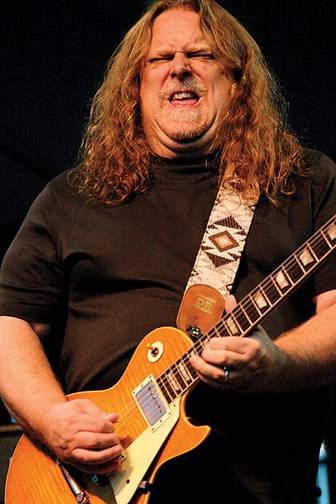
Warren Haynes — £1,000 · Pro-Level Rig
Gibson Les Paul Standard into a Marshall and Mesa Boogie run together (wet/dry). High but not extreme gain — the tone is warm and thick with strong natural harmonics. Haynes' wide, slow vibrato and dynamic picking attack (from soft to very hard) create enormous expressive range.
Signal Path
Signal Chain
Full signal path
GuitarLP Std
AmpMarshall DSL40CR
Full Gear List
£1,000 · Pro-Level — Complete Rig

Tone Tips
Getting the Sound Right
- Wide vibrato starting slow and widening — inspired by BB King but applied to Les Paul tone
- Attack hard, then soften: dig in on the first note of a phrase, relax through it
- Bridge pickup for aggressive lead work; neck pickup for smoother, more vocal tones
- Les Paul volume knob between 7–10 controls the gain going into the amp
- Blues scale with added major 3rd (Mixolydian crossover) gives the Southern rock flavour
- Haynes' rhythm playing uses strong chord embellishments — add 9ths and 7ths to power chords
- Amp EQ: bass 6, mid 7, treble 6 — warmer Marshall voicing, not bright metal tone
- Note bends followed by held vibrato are the core expressive technique
Avoid These Pitfalls
Common Mistakes When Chasing This Tone
- Running the JCM800's gain channel at maximum — above 8 on most high-gain channels, palm mutes lose note separation and become an indistinct wall. The target is the minimum gain for the target saturation, not maximum
- Leaving the wah pedal engaged but stationary between rocking it — a cocked wah (fixed position, not moving) acts as a midrange filter that changes the core tone. Either rock it expressively or bypass it completely; a cocked wah changes the sound in ways that are often unintended
- Setting the amp bass too high — the inherent warmth of mahogany means you need less bass EQ than with a Strat. Starting at 5 rather than 7 prevents low-end mud.
- Scooping the mids on a Marshall-style amp — the upper midrange emphasis is what makes British amps cut through. Mid-scoop EQ sounds good alone but disappears in a band mix.
- Setting the boost level too high relative to the base tone — a boost for solos should raise the presence of the guitar, not cause a volume jump that overwhelms the mix. Level matching matters.
- Setting gain too high on the overdrive pedal — most overdrive pedals are most useful at gain settings of 2-5, where they add character without dominating the tone. High gain settings on an OD pedal become a distortion, not an overdrive.
- Too many repeats at high mix — more than 3 repeats makes the delay effect accumulate and overwhelm the dry guitar signal. Keep it to 2-3 repeats at a subtle mix level.
- Choosing a pick that is too heavy — thin to medium picks give edge noise and articulation that heavier picks smooth away. That edge is part of the sound.
Tone Profile
Warren Haynes's Sound
Gibson Les Paul Standard into a Marshall and Mesa Boogie run together (wet/dry). High but not extreme gain — the tone is warm and thick with strong natural harmonics. Haynes' wide, slow vibrato and dynamic picking attack (from soft to very hard) create enormous expressive range.