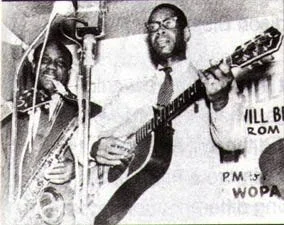
Elmore James — £200 · Beginner Rig
Elmore James's tone is driven and electric — a resonator or semi-hollow guitar with strings tuned to open D, running through a small tweed amp pushed hard into breakup. The slide is applied aggressively, with the amp providing natural compression and harmonic overtones. The riff is always the point: the three-note "Dust My Broom" pattern descends from a high bend and is struck with force. No clean headroom, no reverb tank — just the amp on the edge of its envelope and a lot of attack from the pick.
Signal Path
Signal Chain
Full signal path
Full Gear List
£200 · Beginner — Complete Rig


Tone Tips
Getting the Sound Right
- Tune to open D for the "Dust My Broom" riff
- Play the slide hard and with attitude — Elmore was not subtle
- Let the amp clip naturally — push the volume control past 6
- Vibrato at the end of slide phrases adds emotional weight
- Use heavy picks or bare fingers for attack
- Open D tuning (DADF#AD) is the primary Elmore James tuning — the open strings form a D major chord, allowing a powerful chord barre at each fret. The tonic chord is the full open strings, the IV chord is the 5th fret barre, and the V chord is the 7th fret barre
- The Dust My Broom signature riff in open D: play high string at fret 2, then slide from fret 5 to 7 on strings 1-3, then release back to fret 5 — this is the complete Elmore James signature move. Execute it with a bottleneck slide and add wide vibrato at the top of each slide
- Vocal lines and guitar phrases share the same rhythmic duration — James's phrases are built to the length of a vocal breath. Count how many beats each vocal phrase occupies, then construct guitar phrases of the same length in the spaces between the vocal lines
Avoid These Pitfalls
Common Mistakes When Chasing This Tone
- Using the same amp EQ as for a solid-body guitar — semi-hollow guitars have natural warmth that makes amp bass and treble settings behave differently. Start flat and adjust from there.
- Playing a vintage-voiced amp at low volume — the warmth and bloom of these amps comes from the power tubes working. At low volume the tone is flat and uninspiring compared to the amp's potential.
- Clean amp at too low a volume — even a clean amp provides warmth and tonal character that the pedal sits in. An amp at minimum volume has no character for the pedal to interact with.
- Setting gain too high on the overdrive pedal — most overdrive pedals are most useful at gain settings of 2-5, where they add character without dominating the tone. High gain settings on an OD pedal become a distortion, not an overdrive.
- Adding reverb heavily — early Chicago electric blues was relatively dry. Excessive reverb washes out the rawness that defines the genre.
- Using high-output pickups — original Chicago tone used lower-output single coils. High-output pickups hit the amp too hard and compress the dynamic range.
Tone Profile
Elmore's Sound
Elmore James's tone is driven and electric — a resonator or semi-hollow guitar with strings tuned to open D, running through a small tweed amp pushed hard into breakup. The slide is applied aggressively, with the amp providing natural compression and harmonic overtones. The riff is always the point: the three-note "Dust My Broom" pattern descends from a high bend and is struck with force. No clean headroom, no reverb tank — just the amp on the edge of its envelope and a lot of attack from the pick.