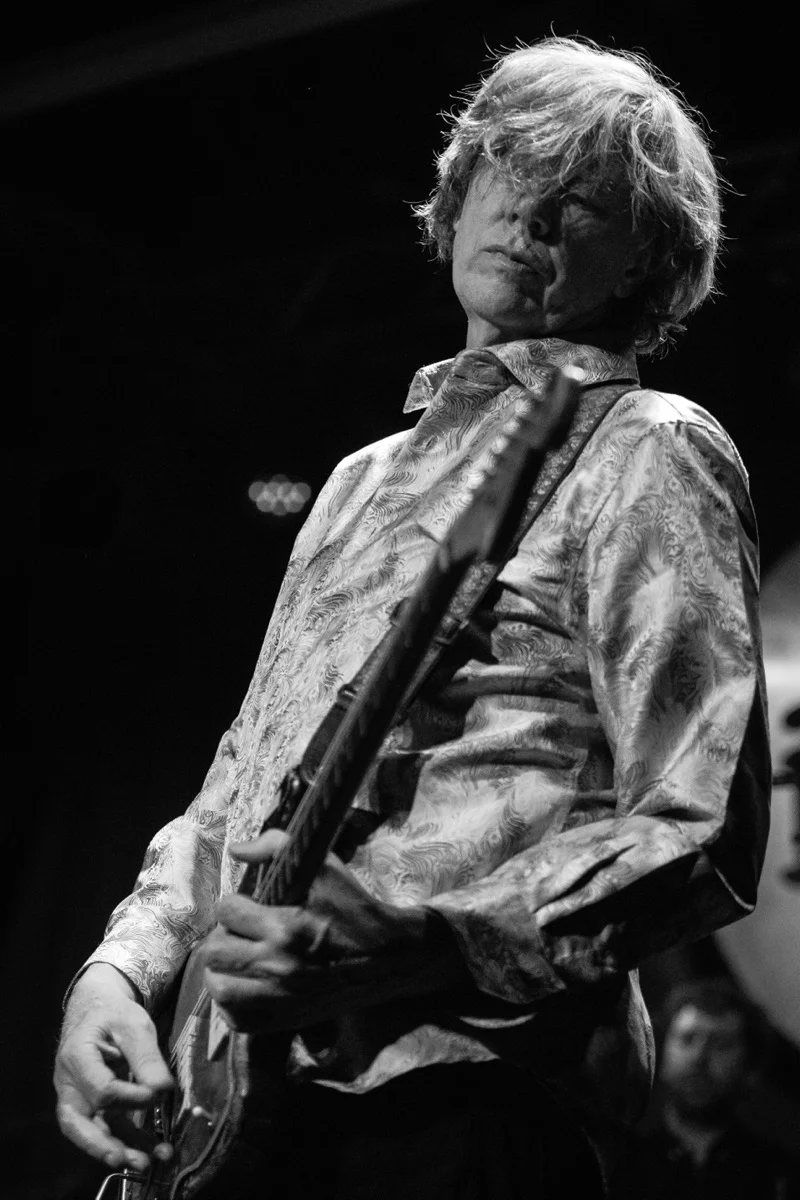
Thurston Moore — £2,500 · Premium Tone
Thurston Moore's abrasive and deliberately harsh tone took shape during the decade of guitar virtuosity and arena rock and remains one of the most sought-after sounds on guitar. Thurston Moore of Sonic Youth built a guitar language from custom tunings, extended techniques and noise sculptures — proving that the electric guitar could be a sound-design tool as much as a melody instrument. At the £2,500 · Premium mark — a premium build targeting the most accurate recreation possible — the build centres on a Fender Player Jaguar running through a Marshall DSL40CR, with Friedman BE-OD Deluxe and Electro-Harmonix Big Muff Pi completing the signal chain, totalling ~£2494.
Build Thurston Moore's £2,500 · Premium Rig
6 pieces · Total ~$3,167
What guitar does Thurston Moore use?
Thurston Moore is primarily associated with offset style guitars. At a £2,500 budget, Fender Player Jaguar delivers the essential tonal character.
What to Buy
£2,500 · Premium — Complete Gear List
Can't find one? See alternatives:
Why This Rig Works
How Thurston Moore's gear choices create the signature tone
Fender Player Jaguar
The Fender Player Jaguar provides the tonal foundation for the entire rig — its character shapes everything that follows.
- DistortionFriedman BE-OD Deluxe
- Lead Fuzzenormous four-transistor sustain wall
- ChorusStrymon Ola Chorus
- DelayWalrus Audio Fundamental Delay
Marshall DSL40CR
The Marshall DSL40CR converts the guitar signal into audible sound and adds its own tonal character — EQ shaping, natural gain, and the overall feel of the final tone.
The Combined Tone
Multiple guitars tuned to custom open and detuned tunings through a Fender Twin Reverb or Marshall. No traditional overdrive — the distortion comes from the amp pushed hard, feedback, and prepared guitar techniques (sticks, drumsticks and other objects on the strings). The tone is deliberately raw and unpredictable.
Tone Tips
Getting the Sound Right
- The Marshall DSL40CR delivers power-tube saturation at master volume 6–7 — this compression and sag is what separates amp-driven tone from pedal tone. Set the master first, then dial back the channel gain to taste rather than the other way around.
- Custom alternate tunings are essential — Moore frequently uses open and modified tunings. CGDGBD, GGDDGG and other non-standard configurations create the resonant, clashing intervals
- The Twin Reverb runs clean but loud — the distortion comes from the amp working hard, not from pedals
- Duet guitar approach with Lee Ranaldo — Sonic Youth always had two guitarists with complementary or deliberately clashing roles. Study how the two parts interact
- Alternate tunings in Sonic Youth are specific to each song and cannot be generalised — each tuning was chosen to make a specific chord shape possible that gives the song its harmonic character. Transcribe the tuning for each song individually before attempting to learn the parts
- Extended technique including bowing with a cello bow and using a screwdriver as a slide is compositional — these tools produce sounds the guitar cannot make conventionally and are used where those specific sounds are needed. Approach them as additional instruments rather than guitar effects
- The core Sonic Youth tone in the EVOL and Sister era came from loud clean amps with very little signal processing — the noise and feedback were recorded as music rather than treated as problems. At high volume, a standard guitar and amp produce this texture naturally. The 'technique' is simply turning up
Avoid These Pitfalls
Common Mistakes When Chasing This Tone
- Placing a tuner or buffered pedal before the Big Muff — most fuzz circuits (especially germanium ones) are sensitive to the impedance of the signal feeding them. A buffered pedal before the fuzz changes how the guitar volume knob responds. Run fuzz first in the chain
- Using the Big Muff into a driven amp with the sustain above 8 — at high sustain into a driven amp the signal becomes a thick, undefined wall of fuzz with no note definition. Keep the amp channel clean
- Putting fuzz after other pedals (especially wah or overdrive) — most fuzz circuits are sensitive to input impedance. Wah before fuzz is fine; overdrive into fuzz creates unpredictable gating.
- Trying to stay clean under the effects — the genre requires the guitar signal to be consumed by the effects layer. A clearly audible dry signal breaks the aesthetic.
- Excessive pedal board complexity that requires constant attention — shoegaze tone should loop on and then be left while you play. Too many controls breaks the immersive quality.
Budget Alternatives
Same Tone, Different Budget
FAQ
Thurston Moore Tone — Common Questions
Thurston Moore is primarily associated with offset style guitars. At a £2,500 budget, Fender Player Jaguar delivers the essential tonal character.
Thurston Moore's amp is high gain voiced — clean to moderate gain. At the £2,500 level, Marshall DSL40CR is the closest match.
The £2,500 tier uses Thurston Moore's actual gear choices or direct equivalents. Total: £2,494. The tonal step up from £1,000 is real but diminishing — worth it for regular performers and studio work.
Thurston Moore's essential pedals include Distortion, Fuzz. At the £2,500 tier: Friedman BE-OD Deluxe, Electro-Harmonix Big Muff Pi, Strymon Ola Chorus. Distortion is the most important pedal — the others add nuance.
Thurston Moore's tone is defined by sonic-youth, alternate-tunings, noise-rock. The combination of offset guitar and high gain amp creates a sound that is immediately recognisable.
Thurston Moore's gain approach is pedal-driven — distortion pedals into a relatively clean amp. The pedal defines the distortion character. At £2,500, this is replicated through Marshall DSL40CR paired with Friedman BE-OD Deluxe.
Thurston Moore — £2,500 · Premium Complete Rig
~£2494Guitar
Fender Player Jaguar
Distortion
Friedman BE-OD Deluxe
Fuzz
Electro-Harmonix Big Muff Pi
Chorus
Strymon Ola Chorus
Amp
Marshall DSL40CR
Delay
Walrus Audio Fundamental Delay
Tone Match
Closest Real-World Tone Match
If you like Thurston Moore's tone, these players use a similar approach — same gear philosophy, comparable sound characteristics.
Related Tones