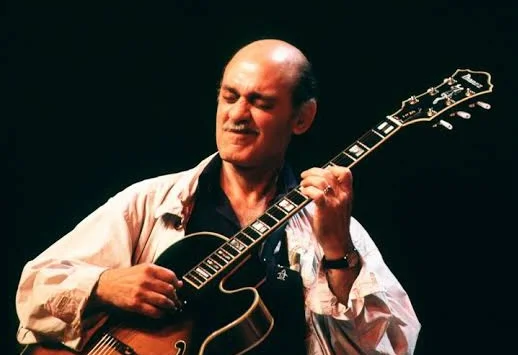
Joe Pass
Joe Pass was the most technically complete bebop jazz guitarist of his generation — equally authoritative as a soloist, accompanist, or duo partner, and the pioneer of solo chord-melody jazz guitar performance as a complete concert form. His 1973 solo album Virtuoso demonstrated that a single guitar could perform jazz standards without any accompaniment, providing melody, harmony, and implied rhythm simultaneously through chord-melody arrangement technique. His recordings with Ella Fitzgerald and Oscar Peterson are among the finest jazz small-group documents. The Gibson ES-175 is his defining instrument.
Full-spectrum jazz guitar on the Gibson ES-175 — in solo performance, the guitar provides melody, harmony, and walking bass simultaneously through chord-melody technique that rivals a piano trio in harmonic completeness. In ensemble, the comping voicings are precise, harmonically rich, and rhythmically sensitive. The tone is warm and round — always neck pickup, always clean.
Signal Chain Order
Why Joe Pass's Rig Works
Pass's chord-melody technique — playing a song's melody, harmony, and implied walking bass line simultaneously on a single guitar — is only possible because of his unusual command of both plectrum and fingerstyle technique, switching between them as needed within a single performance. A pick alone can't easily play a bass note, a chord, and a melody note all in the same moment, but his fingerstyle facility lets him distribute those different musical roles across his picking hand's fingers independently, similar in principle to how a pianist's two hands divide labor.
The ES-175's warm, focused tone through a completely clean Polytone amp is essential groundwork for this technique to succeed as solo performance — with no bass player or drummer to fill in gaps, every element of the arrangement (bass, harmony, melody) has to be clearly audible and distinct, and a cleaner, more transparent amplification chain preserves that separation far better than a more colored or saturated tone would.
His Virtuoso album proved that a single guitarist could perform full jazz standards with genuine harmonic and rhythmic completeness, rivaling a full piano trio — that achievement depends entirely on the guitar and amp staying out of the way, letting the technique itself (not tonal processing or studio trickery) carry the entire musical weight of standards like "Night and Day" performed completely alone.
Guitars
Gibson ES-175
1962–1994Pass's definitive instrument — his 1962 Gibson ES-175 is as identified with him as any guitarist's signature guitar. The ES-175's floating humbucker, single cutaway, and laminated spruce top produce his characteristically warm, focused jazz tone. He uses it for his entire career from the Prestige sessions onward.
Amplifiers
Polytone Minibrute
1973–1994The Polytone is Pass's primary amp — clean, warm, focused solid-state amplification for the jazz guitar context. No distortion, no effects: pure guitar-into-amp clarity.
Effects Pedals
Key Albums & Tone
"Night and Day", "How High the Moon", "Cherokee", "Have You Met Miss Jones" — the solo album that defined solo jazz guitar performance as a complete art form. ES-175 through Polytone, alone: melody, chord, and walking bass simultaneously.
Guitar and voice duo — Pass accompanies Fitzgerald alone through a set of jazz standards. The definitive jazz guitar accompaniment record.
Frequently Asked Questions
What guitar does Joe Pass use?
Gibson ES-175. Pass's definitive instrument — his 1962 Gibson ES-175 is as identified with him as any guitarist's signature guitar. The ES-175's floating humbucker, single cutaway, and laminated spruce top produce his characteristically warm, focused jazz tone. He uses it for his entire career from the Prestige sessions onward.
What amp does Joe Pass use?
Polytone Minibrute. The Polytone is Pass's primary amp — clean, warm, focused solid-state amplification for the jazz guitar context. No distortion, no effects: pure guitar-into-amp clarity.
What pedals does Joe Pass use?
Joe Pass does not use effects pedals.
What is Joe Pass's signature sound?
Full-spectrum jazz guitar on the Gibson ES-175 — in solo performance, the guitar provides melody, harmony, and walking bass simultaneously through chord-melody technique that rivals a piano trio in harmonic completeness. In ensemble, the comping voicings are precise, harmonically rich, and rhythmically sensitive. The tone is warm and round — always neck pickup, always clean.
About This Data
Gear information for Joe Pass is compiled from live performance footage, rig-rundown interviews, manufacturer and signature-model documentation, and cross-referenced guitar press coverage — not a single source. Where accounts conflict (a common issue with decades-old gear history), we favour the version corroborated by the most independent sources and note genuine ambiguity in the text rather than presenting a guess as settled fact.
This page is maintained by Alex Hall, last reviewed July 2026. Spotted something out of date or inaccurate? Let us know — corrections are usually made within a few days.