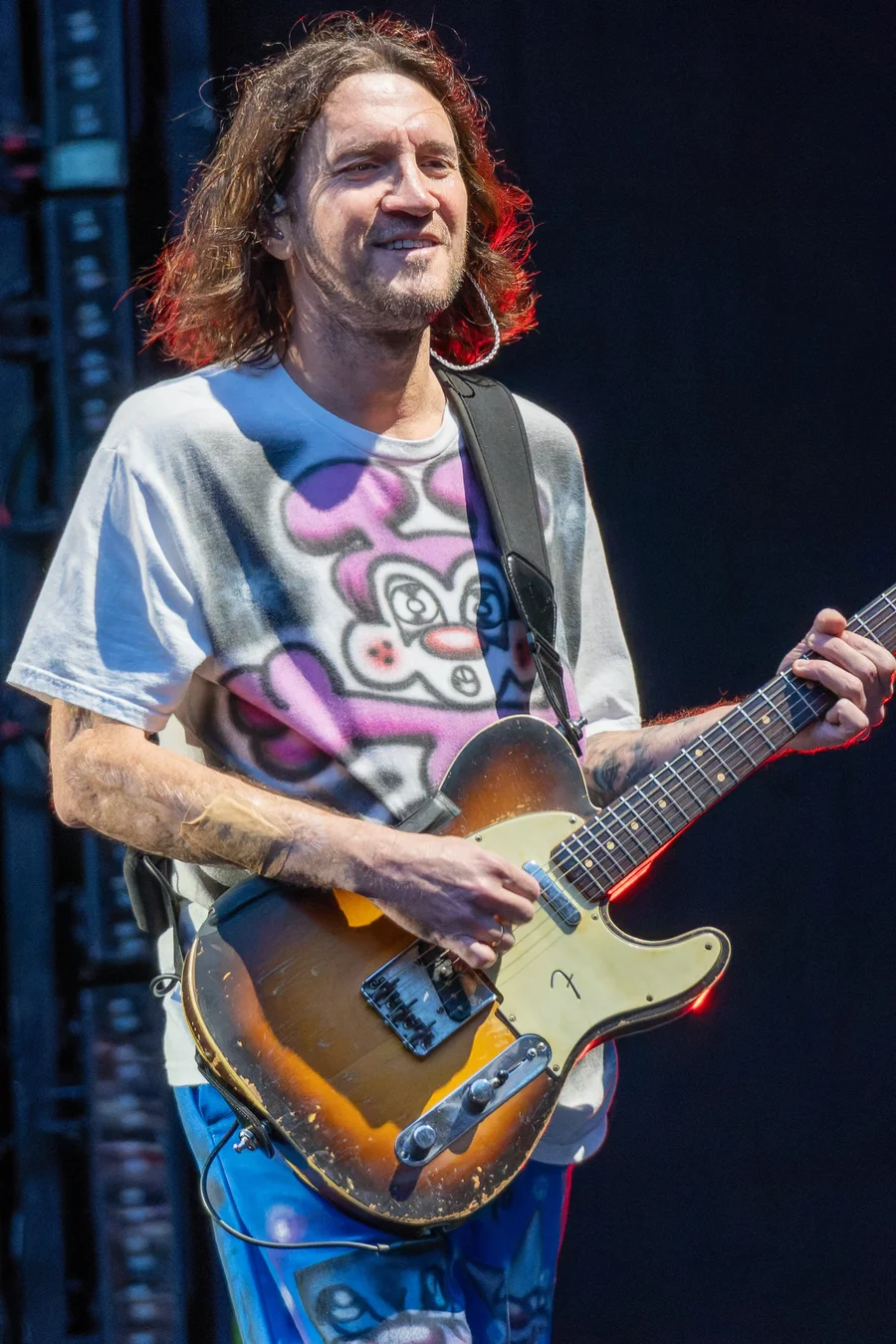
John Frusciante
John Frusciante is the primary guitarist of the Red Hot Chili Peppers and one of the most influential rock guitarists of the 1990s and 2000s. His rhythm playing — tight, funky, and incredibly precise — drove RHCP's biggest commercial records, while his lead tone on Californication and By the Way elevated him into a different class of guitar expressiveness. He has also released over a dozen solo albums that span ambient electronic music, classical composition, and raw acoustic recordings. His extended departure from the Chili Peppers (1992–1998) is well documented; his return produced some of the most celebrated rock albums of the 2000s.
1962 Fender Stratocaster into a Marshall Plexi or JMP — the thin, cutting single-coil sound of the original Strat pickups against British valve crunch produces the signature RHCP guitar tone: bright, articulate funk rhythm playing that cuts through the mix without muddiness, and expressive lead playing with wide vibrato and heavy feedback at volume.
Signal Chain Order
Why Frusciante's Rig Works
The 1962 Stratocaster's single-coil pickups are doing precise, deliberate work in a funk-rock context most listeners associate with humbucker-driven rhythm tones — single coils have a naturally thinner, brighter, more scooped midrange than a humbucker, and that thinness is exactly what lets Frusciante's tight, percussive funk rhythm chords carve out their own frequency space against Flea's prominent, midrange-heavy bass and Chad Smith's drums without the two instruments fighting for the same sonic real estate.
Running two amps for two distinct jobs — the Marshall JMP for crunch and lead, the Fender Twin Reverb's clean headroom for rhythm — rather than one versatile channel-switching amp reflects how differently those two roles need to behave. Funk-influenced rhythm playing depends on a clean, percussive attack where every muted chord stays distinct; lead playing benefits from the Marshall's natural compression and sustain. Splitting these across two purpose-built amps avoids the compromises a single do-everything amp setting would force.
The Electro-Harmonix Small Clone chorus placed early in the chain, always with full depth engaged for certain songs, isn't a subtle coloring effect here — at full depth and a slow rate, it creates a pronounced, almost underwater pitch-modulation shimmer (most audible on "Under the Bridge") that's structurally part of the song's identity rather than incidental atmosphere, which is why reproducing that specific tone requires matching the pedal's extreme setting rather than a gentler, more typical chorus application.
Guitars
Fender Stratocaster (1962)
1990–presentPrimary guitar on most RHCP recordings and solo work. 1962 original with reverse headstock on one primary instrument. Alder body, rosewood fretboard, original pre-CBS pickups.
Full specs & buy →Fender Telecaster
1995–2002Used on Californication and Blood Sugar Sex Magik for specific tonal passages where the Tele's midrange character suited the song.
Full specs & buy →Gibson SG Standard
1999–2006Used on By the Way and Stadium Arcadium for the darker humbucking character on heavier tracks.
Full specs & buy →Fender John Frusciante Stratocaster
Discontinued Fender signature model — based on his 1962 Strat spec with specific pickup and hardware choices.
Full specs & buy →Amplifiers
Marshall JMP Master Volume 2203
1990–2007Primary amp on Blood Sugar Sex Magik and Californication. 100W with master volume — run with the preamp gain high but master low for controlled volume at studios, higher for live.
Fender Twin Reverb
1990–presentClean platform used alongside the Marshall. The Twin's clean headroom is where the RHCP rhythm sound sits — Marshall for crunch and lead, Twin for clean funk rhythm.
Amp guide →Marshall Plexi Super Lead
1999–2006Used on Californication and By the Way — the vintage Plexi's compression and harmonic character suits the melodic lead playing on those albums.
Mesa Boogie Mark I
1991–1993Used on Blood Sugar Sex Magik recording sessions for certain heavier passages.
Effects Pedals
Boss DS-2 Turbo Distortion
Primary distortion pedal — the raw, slightly edgy DS-2 character is all over Blood Sugar Sex Magik lead passages. Mode II for the more aggressive setting.
Electro-Harmonix Small Clone Chorus
The defining RHCP modulation — full-depth chorus creates the signature underwater shimmer of "Under the Bridge". Depth switch on, Rate at slow setting.
MXR Phase 90
Phase used for specific songs — swirling, psychedelic character for guitar intros and interludes.
Pedal guide →Electro-Harmonix Holy Grail Reverb
Spring reverb emulation for live performance — adds depth to clean Strat passages without washing out the attack.
Dunlop Cry Baby Wah
Funk rhythm wah — essential to the RHCP rhythm guitar language. "Can't Stop" uses it as a rhythmic tool for the choppy funk passages.
Pedal guide →DOD FX69 Grunge
1991–1993Used on Blood Sugar Sex Magik sessions for extreme distortion passages alongside the DS-2.
Key Albums & Tone
"Under the Bridge" clean intro and "Give It Away" funk rhythm — the two poles of the Frusciante guitar vocabulary in one album.
Return album after six years away — "Californication" intro shows the 1961 Strat tone at its most pure; "Scar Tissue" for the melodic lead at its most emotional.
The most layered RHCP production — "Can't Stop" for the DS-2 funk crunch rhythm. Frusciante sang harmonies on most tracks as well as playing guitar.
"Dani California" — the most Hendrix-influenced guitar performance on a RHCP record. SG and Strat both used across the double album.
Frequently Asked Questions
What guitar does John Frusciante use?
Fender Stratocaster (1962) and Fender Telecaster. Primary guitar on most RHCP recordings and solo work. 1962 original with reverse headstock on one primary instrument. Alder body, rosewood fretboard, original pre-CBS pickups.
What amp does John Frusciante use?
Marshall JMP Master Volume 2203 and Fender Twin Reverb. Primary amp on Blood Sugar Sex Magik and Californication. 100W with master volume — run with the preamp gain high but master low for controlled volume at studios, higher for live.
What pedals does John Frusciante use?
John Frusciante uses Boss DS-2 Turbo Distortion, Electro-Harmonix Small Clone Chorus, MXR Phase 90 and more.
What is Frusciante's signature sound?
1962 Fender Stratocaster into a Marshall Plexi or JMP — the thin, cutting single-coil sound of the original Strat pickups against British valve crunch produces the signature RHCP guitar tone: bright, articulate funk rhythm playing that cuts through the mix without muddiness, and expressive lead playing with wide vibrato and heavy feedback at volume.
About This Data
Gear information for John Frusciante is compiled from live performance footage, rig-rundown interviews, manufacturer and signature-model documentation, and cross-referenced guitar press coverage — not a single source. Where accounts conflict (a common issue with decades-old gear history), we favour the version corroborated by the most independent sources and note genuine ambiguity in the text rather than presenting a guess as settled fact.
This page is maintained by Alex Hall, last reviewed July 2026. Spotted something out of date or inaccurate? Let us know — corrections are usually made within a few days.