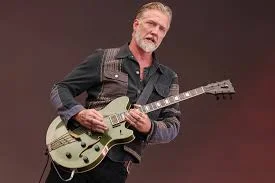
Josh Homme
Josh Homme is the founder, guitarist, and primary songwriter of Queens of the Stone Age — the Palm Desert, California band that made stoner rock commercially viable without diluting its weight. Homme's previous band Kyuss essentially invented the desert rock genre in the early 1990s. His guitar tone is one of the most distinctive in modern rock: impossibly heavy but clear, with a rhythmic precision and a swagger that few players achieve. QOTSA's 'Songs for the Deaf' (2002) is a defining rock album of the 2000s.
Gibson SG or semi-hollow through a Supro combo or cranked Vox — a warm, heavy, almost psychedelic crunch that has more in common with 1970s hard rock than modern metal. The tone is midrange-forward and rich, without the scooped aggression of metal. Rhythm playing has an almost mechanical locked-in groove.
Signal Chain Order
Why Josh Homme's Rig Works
Keeping the midrange boosted rather than scooped is the single decision most responsible for why QOTSA sounds heavy without sounding like conventional metal. Scooped-mid tones (the standard in thrash and groove metal) hollow out the frequency range that carries most of a riff's harmonic character, producing a tight, percussive but comparatively thin sound; Homme's mid-forward Vox and Supro settings keep that harmonic body intact, giving the tone a warmer, almost 1970s hard-rock richness even at genuinely heavy volume and gain.
The original Kyuss-era choice of cheap Dan Electro guitars through tiny, low-headroom Supro combos with the bass cranked wasn't an aesthetic accident — small combo amps naturally compress and saturate at much lower volumes than a full-size amp, and running the bass control high pushes that compression into the low frequencies specifically, producing the thick, murky, desert-rock low end that became foundational to the entire genre. A bigger, cleaner amp at the same volume simply wouldn't compress the same way.
Homme's famously mechanical, locked-in rhythmic precision depends on the SG's midrange character staying consistent and predictable across the neck — a scooped or overly bright tone tends to emphasize small inconsistencies in a rhythm part's timing and attack, while a warmer, mid-forward tone smooths those micro-variations slightly, supporting the impression of an almost robotic tightness that's central to QOTSA's groove.
Guitars
Gibson SG Standard
1995–presentPrimary guitar throughout QOTSA — the SG's midrange character and mahogany body resonance are fundamental to the Homme tone. Humbucker pickups for thickness without metal precision.
Full specs & buy →Gibson ES-335
2000–presentUsed for semi-hollow warmth on specific QOTSA tracks — the 335's body resonance adds complexity to cleaner passages.
Full specs & buy →Dan Electro (various)
1993–1998Kyuss era — the cheap Dan Electros through tiny Supro combos with the bass turned up became the template for desert rock tone. An unconventional choice that defined a genre.
Amplifiers
Supro 1690T Coronado
1993–2000The Kyuss era amp — a tiny vintage American combo amp run into saturation. The Supro's limited headroom and distinctive character is credited as the foundation of desert rock tone. Run with bass cranked.
Vox AC30
2000–presentQOTSA primary — the Class A EL84 character provides warmth and a natural compression that complements the SG's midrange. Run at natural breakup for rhythm tone.
Amp guide →Orange AD30
2005–presentAlongside the Vox for extra British warmth — Orange's Class A character layers well with the Vox in a multi-amp setup for studio overdubs.
Effects Pedals
Electro-Harmonix Big Muff Pi
1995–presentDesert rock fuzz — used for heaviest passages in both Kyuss and QOTSA. The Big Muff's roaring sustain into a Supro or Vox defines the genre's extremes.
Pedal guide →ProCo RAT2
2002–presentQOTSA lead tones — the RAT's LM308 chip character provides a different harmonic texture from the Big Muff. Used for tight, articulate lead lines.
Pedal guide →MXR Phase 90
1995–presentDesert rock phaser — slow, hypnotic phasing on cleaner passages. The Phase 90's organic sweep adds movement without sounding like a modern chorus.
Pedal guide →Boss DD-3T Digital Delay
2000–presentLive delay — used for spaciousness on lead lines and select rhythm passages.
Pedal guide →Key Albums & Tone
"The Lost Art of Keeping a Secret" — QOTSA's commercial breakthrough. SG into Vox, with the grove-metal rhythm precision that became their trademark.
"No One Knows" and "Go with the Flow" — peak QOTSA tone. The rhythm guitar is impossibly locked-in and heavy without being metal.
More melodic and layered — Homme's guitar sits within a broader sonic palette. "I Sat by the Ocean" shows his cleaner playing.
"The Way You Used to Do" — Mark Ronson production shifts the guitar texture toward a more rhythmic, dance-influenced register.
Frequently Asked Questions
What guitar does Josh Homme use?
Gibson SG Standard and Gibson ES-335. Primary guitar throughout QOTSA — the SG's midrange character and mahogany body resonance are fundamental to the Homme tone. Humbucker pickups for thickness without metal precision.
What amp does Josh Homme use?
Supro 1690T Coronado and Vox AC30. The Kyuss era amp — a tiny vintage American combo amp run into saturation. The Supro's limited headroom and distinctive character is credited as the foundation of desert rock tone. Run with bass cranked.
What pedals does Josh Homme use?
Josh Homme uses Electro-Harmonix Big Muff Pi, ProCo RAT2, MXR Phase 90 and more.
What is Josh Homme's signature sound?
Gibson SG or semi-hollow through a Supro combo or cranked Vox — a warm, heavy, almost psychedelic crunch that has more in common with 1970s hard rock than modern metal. The tone is midrange-forward and rich, without the scooped aggression of metal. Rhythm playing has an almost mechanical locked-in groove.
About This Data
Gear information for Josh Homme is compiled from live performance footage, rig-rundown interviews, manufacturer and signature-model documentation, and cross-referenced guitar press coverage — not a single source. Where accounts conflict (a common issue with decades-old gear history), we favour the version corroborated by the most independent sources and note genuine ambiguity in the text rather than presenting a guess as settled fact.
This page is maintained by Alex Hall, last reviewed July 2026. Spotted something out of date or inaccurate? Let us know — corrections are usually made within a few days.