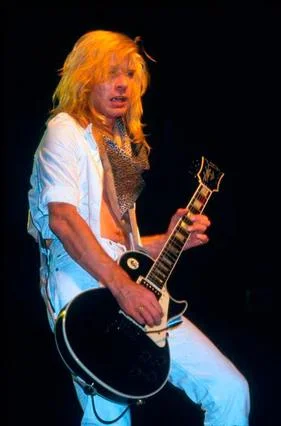
Steve Clark
Steve Clark was the lead guitarist of Def Leppard from the band's formation in Sheffield in 1977 until his death in 1991. Known within the band as 'the Riff Master', he contributed the defining guitar hooks and riffs across Def Leppard's most commercially successful period: Pyromania (1983) and Hysteria (1987). His partnership with Phil Collen created the archetypal twin-lead guitar sound of melodic hard rock: harmonised leads, intricate counterpoint rhythm parts, and a tonal consistency that producer Mutt Lange layered into the dense, polished sound of both albums. The Gibson Les Paul Custom through a Marshall Super Lead defines his tone.
Warm, melodic heavy metal lead guitar through Marshall — Clark's tone prioritises warmth and singing sustain over aggressive gain. The Les Paul Custom's three pickups provide tonal variety, and his phrasing is melodic and blues-influenced despite the hard rock context. The twin-guitar interplay with Phil Collen is perfectly balanced: neither player dominates, each serving the harmonic whole.
Signal Chain Order
Why Steve Clark's Rig Works
The balanced twin-lead partnership with Phil Collen depends on both guitarists' tones being warm and complementary rather than each fighting for dominance — Clark's mid-forward Marshall setting, avoiding a harsher, more scooped high-gain voicing, is specifically what lets his harmonized lines with Collen blend into a unified whole rather than reading as two competing lead tones layered on top of each other.
Using the MXR Distortion+ as a low-gain boost rather than a primary distortion source, functioning the same way it does in Randy Rhoads's rig, lets Clark push the already-driven Plexi harder for solos without introducing a second, different-sounding gain stage — this keeps his lead tone tonally continuous with his rhythm tone, just louder and more saturated, rather than sounding like a switch to an entirely different distortion character.
Producer Mutt Lange's meticulous layering approach on Pyromania and Hysteria placed enormous demands on tonal consistency across many guitar overdubs — Clark's Les Paul Custom's high output and the Marshall's reliable, repeatable saturation character gave Lange a dependable sonic building block to layer precisely, take after take, which is essential to how those famously dense, polished productions were actually constructed in the studio.
Guitars
Gibson Les Paul Custom
1978–1991Clark's defining guitar — a black Les Paul Custom that appears on every Def Leppard album from On Through the Night through Hysteria. The three-humbucker configuration provides significant output that pushes the Marshall into warm saturation. His Custom is one of the most recognisable guitars in melodic hard rock.
Gibson Les Paul Standard
1978–1988Various LP Standards used alongside the Custom — the Standard's two-pickup configuration and slightly brighter character for specific songs.
Amplifiers
Marshall Super Lead 100W "Plexi"
1978–1985Clark's primary amp through the Pyromania and early Hysteria period — the Plexi at high volume with the Les Paul's high output creates the warm, harmonically rich saturation of his lead tone.
Marshall JCM800
1983–1991The JCM800 used through the Hysteria period alongside or replacing the Plexi — the JCM800's preamp gain provides a slightly different saturation character suited to the polished Mutt Lange production aesthetic.
Effects Pedals
MXR Distortion+
1980–1991Lead boost into the Marshall — the Distortion+ pushes the amp harder for solos, adding compression and sustain. Set for low distortion with high output — acting as a clean boost rather than standalone distortion.
Boss CE-2 Chorus
1983–1991CE-2 chorus for the shimmering quality of clean rhythm passages — the Def Leppard Hysteria-era clean guitar sound is defined partly by heavy chorus use on chord passages.
Key Albums & Tone
"Rock of Ages", "Photograph", "Too Late for Love" — the commercial breakthrough. Clark and Collen's twin-lead interplay at its most effective. The Plexi-driven Les Paul tone is warm and sustaining beneath Mutt Lange's dense production. "Rock of Ages" synth intro then full guitar attack is one of hard rock's great openings.
"Pour Some Sugar on Me", "Love Bites", "Animal" — the biggest-selling hard rock album of its decade. Clark's guitar is meticulously layered in Mutt Lange's production — every tone, every harmony, every rhythm part is precisely placed. The JCM800/Les Paul combination is at the centre of it all.
Frequently Asked Questions
What guitar does Steve Clark use?
Gibson Les Paul Custom and Gibson Les Paul Standard. Clark's defining guitar — a black Les Paul Custom that appears on every Def Leppard album from On Through the Night through Hysteria. The three-humbucker configuration provides significant output that pushes the Marshall into warm saturation. His Custom is one of the most recognisable guitars in melodic hard rock.
What amp does Steve Clark use?
Marshall Super Lead 100W "Plexi" and Marshall JCM800. Clark's primary amp through the Pyromania and early Hysteria period — the Plexi at high volume with the Les Paul's high output creates the warm, harmonically rich saturation of his lead tone.
What pedals does Steve Clark use?
Steve Clark uses MXR Distortion+, Boss CE-2 Chorus.
What is Steve Clark's signature sound?
Warm, melodic heavy metal lead guitar through Marshall — Clark's tone prioritises warmth and singing sustain over aggressive gain. The Les Paul Custom's three pickups provide tonal variety, and his phrasing is melodic and blues-influenced despite the hard rock context. The twin-guitar interplay with Phil Collen is perfectly balanced: neither player dominates, each serving the harmonic whole.
About This Data
Gear information for Steve Clark is compiled from live performance footage, rig-rundown interviews, manufacturer and signature-model documentation, and cross-referenced guitar press coverage — not a single source. Where accounts conflict (a common issue with decades-old gear history), we favour the version corroborated by the most independent sources and note genuine ambiguity in the text rather than presenting a guess as settled fact.
This page is maintained by Alex Hall, last reviewed July 2026. Spotted something out of date or inaccurate? Let us know — corrections are usually made within a few days.