Rig Builder
Budget Rig Breakdown
Signal Chain
Essentials
Complete Your Rig
The accessories every serious guitarist needs — cables, strings, and the rest.
Ernie Ball Power Slinky Strings (11-48)
Heavier gauge for drop tunings and tighter pick attack — standard for modern metal.
ISP Decimator II Noise Gate
Essential for high-gain amps and extended-range guitars. No noise gate — no clean metal tone.
Planet Waves American Stage Guitar Cable 10ft
Solderless ends and lifetime warranty. The cable most session guitarists trust.
Boss TU-3 Chromatic Tuner Pedal
The professional standard for live tuning. True bypass, powers other pedals, ultra-accurate.
Levy's M8 Guitar Strap
Quality leather strap used by touring guitarists. Genuine comfort for 3-hour sets.
Technique
Key Tone Tips
- The tone is mid-forward Marshall crunch, not extreme metal — Ace played Les Paul through a warm Marshall on medium gain. Modern metal high-gain settings are wrong for this style
- Les Paul bridge pickup for the main solo tone — the humbucker warmth and sustain are characteristic
- Pentatonic minor in the blues-rock tradition — most leads are purely pentatonic minor, with occasional major pentatonic inflections for the "happy" passing notes
- The "Shock Me" solo uses controlled feedback as a note — aim the headstock at the amp speaker and find the resonant frequency for the desired pitch
- Moderate pick attack — not aggressive or heavy. Ace's playing is expressive rather than forceful
- Study "Detroit Rock City," "Deuce," and "Love Gun" for the rhythm guitar approach — simple, driving rhythms with Les Paul body and weight
- Vibrato is blues-influenced, medium speed and width — not the very fast metal vibrato or the very slow classical vibrato
- The overall approach is "accessible blues-rock with showmanship" — the technical level is intentionally within reach of most players
- Play with conviction over precision — KISS is more about the performance feeling than perfect technique. Selling the note matters as much as hitting it
- Use the Les Paul's neck pickup for the warm, round sustain tone of Frehley's melodic solos — the neck pickup through a Marshall gives the vocal, singing quality that is characteristic of his slower phrased lead work over hard rock backing
- Pinch harmonics on string bends add the high-pitched squeal to solo peaks — practice the pick angle and thumb position independently before combining at speed. The technique requires the thumb flesh to contact the string immediately after the pick strikes
- The phrasing is emotionally direct rather than technically complex — Frehley's solos are built from simple pentatonic phrases delivered with conviction. Focus on the feel and timing of each note rather than filling every bar with movement
Background
About Ace Frehley's Sound
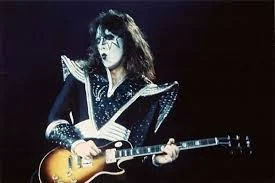
Ace Frehley of KISS was the "Space Ace" — his Les Paul into Marshall tone and bluesy, pentatonic lead style defined classic hard rock guitar for a generation. More technically bluesy than metal, more musical than his flamboyant stage persona suggested.
Tone History
Ace Frehley's Tone Evolution
Ace Frehley built one of rock's most recognisable rhythm guitar tones — a Les Paul through a Marshall with no pedals, bright attack and heavy mids, perfectly suited to KISS's anthemic hard rock. His simplicity was his superpower: everything came from the hands and the amp volume.
Full timeline: 3 eras →Song Breakdowns
Ace Frehley Song Rigs
Rock and Roll All Nite
Dressed to Kill · 1975
The definitive party anthem guitar tone — simple, driving, massive. Ace Fre…
Detroit Rock City
Destroyer · 1976
Opening riff perfection — a driving, palm-muted descent that establishes th…
Shock Me
Love Gun · 1977
Ace Frehley's self-written KISS track and perhaps his most complete guitar …