Rig Builder
Budget Rig Breakdown
Signal Chain


Essentials
Complete Your Rig
The accessories every serious guitarist needs — cables, strings, and the rest.
Ernie Ball Regular Slinky Strings (10-46)
The balance between bending ease and tone — standard gauge for blues and classic rock.
Dunlop Tortex Standard Pick 0.73mm (Pack of 12)
Medium-gauge picks used by blues and rock guitarists for attack and warmth.
Planet Waves American Stage Guitar Cable 10ft
Solderless ends and lifetime warranty. The cable most session guitarists trust.
Boss TU-3 Chromatic Tuner Pedal
The professional standard for live tuning. True bypass, powers other pedals, ultra-accurate.
Levy's M8 Guitar Strap
Quality leather strap used by touring guitarists. Genuine comfort for 3-hour sets.
Technique
Key Tone Tips
- Extreme string bends: Guy bends 2–3 whole steps — use .009s and build finger strength gradually
- Play up the neck (above the 12th fret) more than most blues players — high register wails
- Amp barely breaking up: single coil bite on the edge of clean is the foundation
- Walk away from the amp during solos for feedback — then come back for different feedback notes
- Dramatic range: whisper-quiet phrases immediately followed by screaming high-register attacks
- Right-hand muting varies throughout a phrase — Guy creates internal dynamics mid-sentence
- Chicago shuffle rhythm: learn the Albert Collins stop-time groove that underpins the style
- BB King influence: use single-note lines with intent, not busy pentatonic runs
- Study "Stone Crazy" and "Damn Right I've Got The Blues" for the full spectrum
- Guy plays at aggressive volume by design — his dynamic approach requires a loud amp to produce the natural harmonic complexity and sustain. At bedroom volumes, use a compressor before the amp to simulate the sustain that stage volume creates, then remove the compressor when playing loud
- The Stratocaster bridge pickup at full tone creates the intentional stinging edge — do not roll the tone knob. The almost harsh upper-mid content is what cuts through a band. Rolling it off removes the defining character in the name of smoothness
- Behind-the-nut bends create a pitch-raise that the tremolo bridge cannot — grabbing the strings between the nut and the headstock and pulling produces a wide pitch rise that sounds like a full-body string deflection. It was part of Guy's vocabulary before floating tremolo guitars became standard
Background
About Buddy Guy's Sound
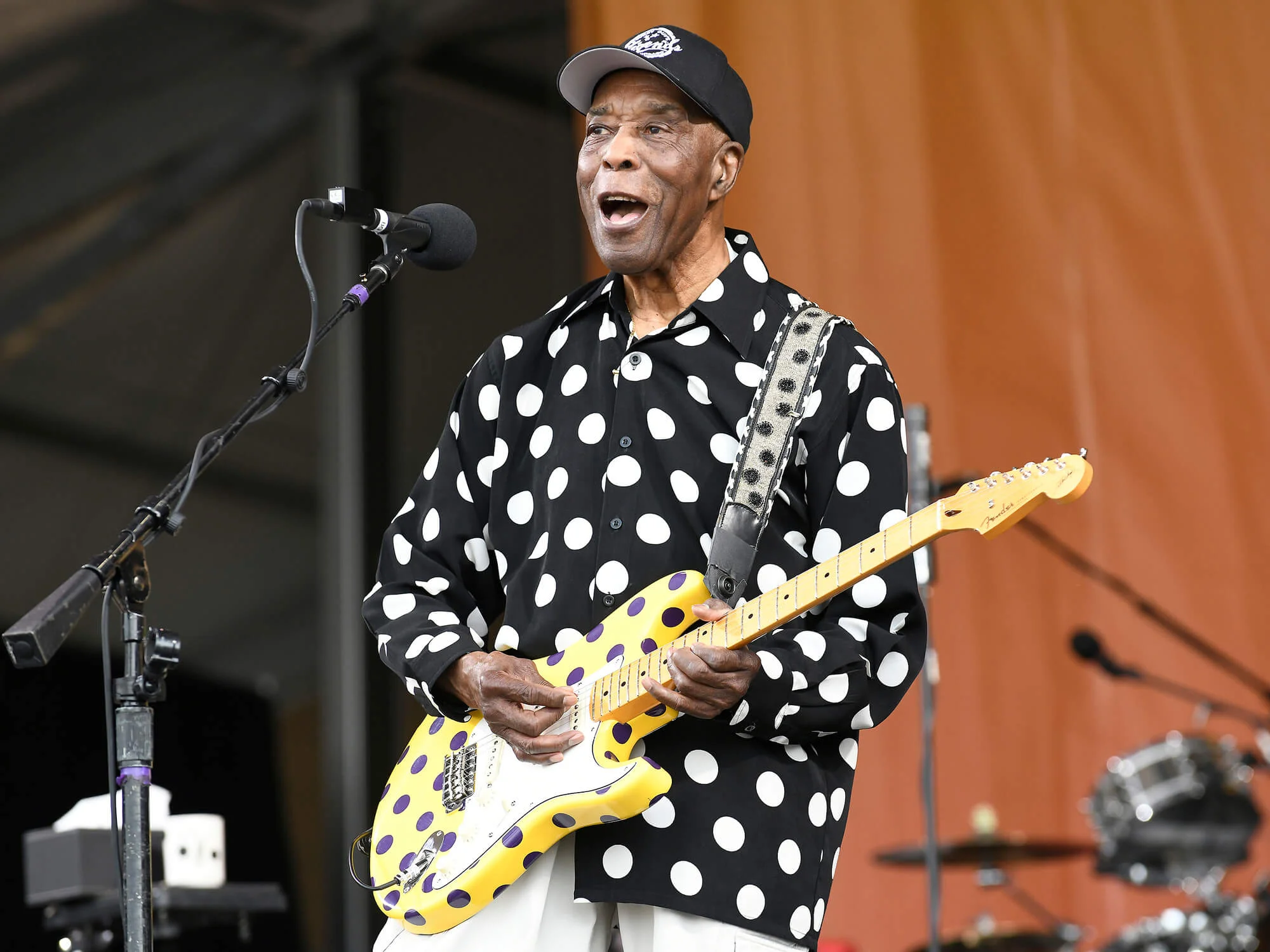
Buddy Guy is the most electrifying live blues performer alive — his polka-dot Stratocaster through a Fender Super Reverb delivers raw Chicago blues with extreme string bends, feedback and technique that influenced Jimi Hendrix, Eric Clapton and Stevie Ray Vaughan before they ever played a note.
Tone History
Buddy Guy's Tone Evolution
Buddy Guy was the most aggressive and technically adventurous Chicago blues guitarist of the 1960s — Jimi Hendrix publicly credited him as a primary influence. His polka-dot Stratocaster through a cranked Fender created feedback and extreme sustain that anticipated psychedelic rock by years. His work ethic on stage — sometimes playing from the audience at the end of a 100-foot guitar cable — established the theatrical side of electric blues.
Full timeline: 3 eras →Song Breakdowns
Buddy Guy Song Rigs
Damn Right, I've Got the Blues
Damn Right, I've Got the Blues · 1991
Buddy Guy's commercial comeback at age 55 — a Stratocaster into a Fender Ba…
Stone Crazy
Stone Crazy! · 1981
Earlier Buddy Guy through a rougher, more vintage-flavoured setup — a small…
Feels Like Rain
Damn Right, I've Got the Blues · 1991
The most blues-standard performance on the album — a slow, heartfelt ballad…