Song Rig
Boom Boom
John Lee Hooker · Boom Boom (single) · 1961
Tone Overview
What Makes This Sound Unique
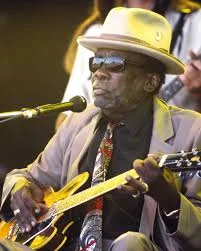
The most recognisable boogie guitar tone in blues history — John Lee's Gibson semi-hollow into a small combo amp produces a thick, warm, percussive rhythm guitar sound that sits far back in the frequency spectrum compared to Elmore James's bright slide tone. Round and dark, centred in the low mids.
Signal Chain
- 1Gibson ES-125 (neck pickup, full volume)
- 2Fender Bassman or small Fender combo
Amp Settings
High bass, low treble — the opposite of Elmore James's slide tone. John Lee's boogie rhythm needs warmth and thump, not brightness and cut. The neck pickup and bass-heavy EQ produce the round, warm tone.
Technique
How to Play It
Foot-tapping as part of the rhythmic foundation — John Lee literally tapped his foot during recordings as a percussion element. The guitar uses a simple boogie bass pattern with single-chord rhythm work that repeats hypnotically.
Budget Alternative
Achievable With
ES-335, Epiphone Casino, or any semi-hollow guitar (neck pickup) → Fender Blues Junior or Blues Deluxe with bass at 8 → no distortion pedals. The roundness comes from the neck pickup and warm amp, not gain.
Your Gear
Adapt to My Amp
More from John Lee Hooker
Other Song Rigs
I'm in the Mood
I'm in the Mood (single) · 1951
An early recording that captures John Lee's raw, unpolished electric style — a s…
View rig →Crawlin' King Snake
Crawlin' King Snake (single) · 1949
One of John Lee's earliest recordings — the tone is almost acoustic-adjacent, wi…
View rig →Boogie Chillen
Modern Records Singles · 1948
The most important John Lee Hooker recording — the 1948 electric boogie that def…
View rig →Dimples
Vee-Jay Records Singles · 1956
Hooker's most catchy and commercial blues — a driving rhythm that became a stapl…
View rig →One Bourbon, One Scotch, One Beer
Mojo Boogie · 1966
Hooker's most recognisable standard — a slow, heavy blues that has been covered …
View rig →