Song Rig
I'm in the Mood
John Lee Hooker · I'm in the Mood (single) · 1951
Tone Overview
What Makes This Sound Unique
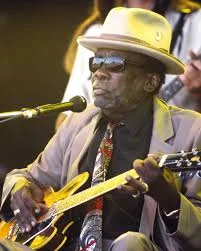
An early recording that captures John Lee's raw, unpolished electric style — a single amplified guitar with no studio polish, just a man and his instrument. The tone is even rawer than the later recordings, with audible hum, minimal treble, and the full character of a small single-coil into an early amplifier.
Signal Chain
- 1Early hollow-body or archtop electric guitar (single-coil)
- 2Small early 1950s combo amplifier
Amp Settings
Minimal settings — the tone of the era was determined by the instrument and amp rather than EQ adjustment. The hum and buzz of the single-coil in a small amp is part of the character, not a flaw to be fixed.
Technique
How to Play It
John Lee's 'talking' style — interspersing lyrics, humming, and grunts with guitar phrases rather than separating vocal and instrumental sections. The guitar follows the emotional arc of the lyrics rather than a predetermined structure.
Budget Alternative
Achievable With
Semi-hollow or hollow-body guitar (neck pickup) → small 5W combo (Fender Champ, Epiphone Valve Junior) → no pedals. Embrace the hum — single-coil pickups at 50–60Hz are part of the authenticity.
Your Gear
Adapt to My Amp
More from John Lee Hooker
Other Song Rigs
Boom Boom
Boom Boom (single) · 1961
The most recognisable boogie guitar tone in blues history — John Lee's Gibson se…
View rig →Crawlin' King Snake
Crawlin' King Snake (single) · 1949
One of John Lee's earliest recordings — the tone is almost acoustic-adjacent, wi…
View rig →Boogie Chillen
Modern Records Singles · 1948
The most important John Lee Hooker recording — the 1948 electric boogie that def…
View rig →Dimples
Vee-Jay Records Singles · 1956
Hooker's most catchy and commercial blues — a driving rhythm that became a stapl…
View rig →One Bourbon, One Scotch, One Beer
Mojo Boogie · 1966
Hooker's most recognisable standard — a slow, heavy blues that has been covered …
View rig →