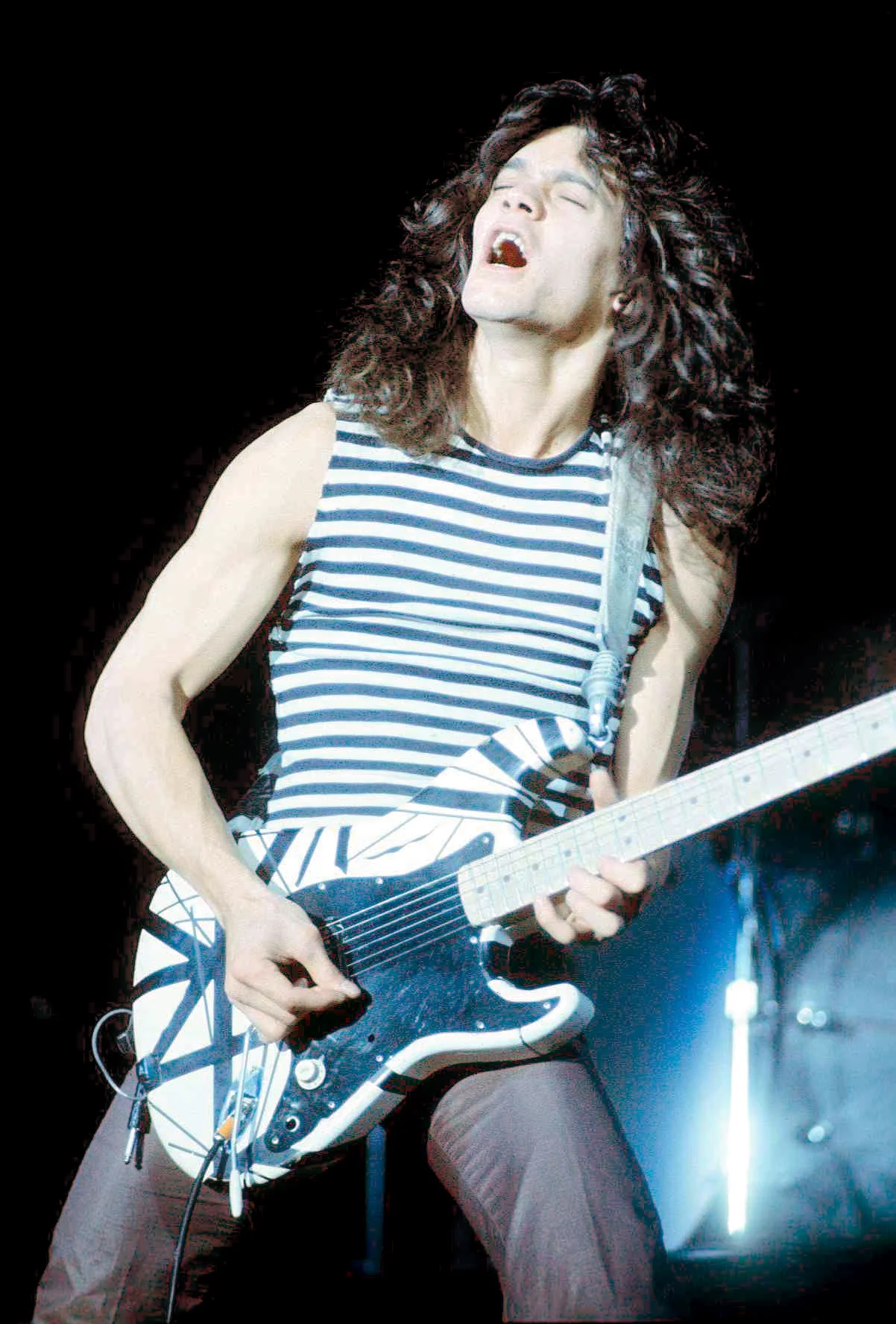
Sound Like Eddie Van Halen
Eddie Van Halen stands as one of hard rock's most enduring tonal references — heavy and assertive by nature and endlessly studied. Eddie Van Halen's "brown sound" reset the entire guitar world's expectations — a humbucker-loaded Frankenstrat through a modified Marshall Plexi, delivering warm, full saturation rather than harsh gain. His two-handed tapping, explosive picking attack and whammy bar technique defined an era. These complete rig guides at four budget levels show exactly what gear it takes to get there.
Quick Answer
To sound like Eddie Van Halen, start with a Ibanez RG421 EX into a Boss Katana 50 MkII.
Tone Analysis
Eddie Van Halen's Guitar Tone — In Depth
Tone Philosophy
Eddie Van Halen built his own guitars and modified his own amplifiers before he was famous. He was an engineer as much as a musician, and his obsession with tone was inseparable from his obsession with technique. The "brown sound" — the particular warm, harmonically rich overdrive that defined early Van Halen records — was not available as a commercial product. He created it through a combination of modified amplifiers, reduced speaker voltage, and specific guitar construction. His philosophy was that the equipment should serve the technique, not define its limits.
The Signature Sound
The brown sound is built on a modified Marshall plexi (specifically a 1968 Super Lead), internally modified to change the gain structure, with the speaker power reduced through a variac (a variable voltage transformer) to approximately 90 volts rather than the standard 117 volts. This reduced voltage causes the power amp tubes to run hotter and saturate more readily. The result is a particular quality of distortion — warm, harmonically complex, less harsh than a standard Marshall — that became the reference for 1980s rock guitar tone.
Key Gear
His iconic guitar, known as the "Frankenstrat," was a custom-built instrument assembled from Charvel parts with a single DiMarzio humbucker in the bridge position. Later the EVH Wolfgang and various signature models replicated key elements of this construction. His amplifier relationship evolved from the modified Marshall through Peavey (the 5150 amplifier, designed in collaboration and now badged as the EVH 5150) — one of the most influential high-gain amplifiers ever produced. The Dunlop MXR Phase 90 phaser (on Running With the Devil and others) and the Eventide H910 Harmonizer (on Mean Street) were key effects.
Playing Approach
The two-hand tapping technique that Eruption introduced to mainstream rock was not invented by Van Halen — it had precedents. But he was the first to demonstrate it to a mass audience at a level of speed, accuracy, and musicality that made it impossible to dismiss as a novelty. Beyond tapping, his rhythm playing was equally sophisticated — his strumming technique on the right hand produced a particular percussive quality, and his use of the tremolo arm was more physically expressive than any rock player before him.
Legacy
Few guitarists have had as immediate and as large an influence on their contemporaries as Eddie Van Halen did with Eruption in 1978. Within months of the record's release, guitar magazines were running transcriptions and tutorials, and a generation of players was reconfiguring their technique around what they had heard. The 1980s shred movement — Paul Gilbert, Steve Vai, Joe Satriani, Yngwie Malmsteen — would not exist in its particular form without his example.
Budget Comparison
Pick Your Budget Level
£1,000 · Pro-Level
~£1007
- GuitarEVH Wolfgang Standard
- AmpBoss Katana 100 MkII
- PhaserMXR M101 Phase 90
£2,500 · Premium
~£2476
- GuitarIbanez RG550 Genesis Collection
- ModulationMXR M101 Phase 90
- AmpMarshall DSL100H
- DelayWalrus Audio Fundamental Delay
Shop Now
Buy the Key Gear — £500 Sweet Spot
Guitar, amp and essential effects for the authentic Eddie Van Halen sound. The guitar and amp together account for 80% of the tone.
Complete the Rig
Essentials Every Guitarist Needs
These aren't exciting — but every rig needs them. Buy once, sorted forever.
Tone Profile
Eddie Van Halen's Sound
Single humbucker (bridge) into a modified Marshall Super Lead — the combination is surprisingly warm and full, not harsh. Van Halen's amp was dialled with the gain relatively moderate; the volume and pickup output did the heavy lifting. A Phase 90 adds subtle movement; an Echoplex served as a preamp boost and added a touch of slapback warmth.
Modeling Amps
Get Eddie Van Halen's Tone on Your Modeler
Targeting Marshall (Plexi / JCM800). Use these amp models and IRs as your starting point — dial in from there using the knob settings above.
Low master, drive at 6–7 for Plexi crunch; Brit 2204 for JCM800 lead
Keep presence at 5, let the amp breathe — avoid over-EQing
Song Match
Which Eddie Van Halen Songs Suit Your Amp
Tone Match
Closest Real-World Tone Match
If you like Eddie Van Halen's tone, these players use a similar approach — same gear philosophy, comparable sound characteristics.
Weekly Tone Tips
One setting, one artist insight, one gear pick. No noise.