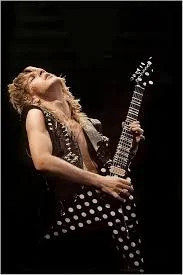
Sound Like Randy Rhoads
Randy Rhoads is one of the most recognisable voices in metal — a crushing and technically demanding player who shaped the sound of the decade of guitar virtuosity and arena rock. Randy Rhoads fused classical music training with heavy metal technique in a career cut short at 25. His polka-dot Flying V and precise, technically exacting vibrato brought a new vocabulary to rock guitar — every solo was composed, not improvised, with controlled aggression and melodic intent. Below are complete rig guides at four budget levels, so you can start building their sound whether you're just starting out or ready to invest in the full setup.
Quick Answer
To sound like Randy Rhoads, start with a Epiphone Explorer into a Boss Katana 50 MkII.
Tone Analysis
Randy Rhoads's Guitar Tone — In Depth
Tone Philosophy
Randy Rhoads brought formal music education — he had trained as a classical guitarist and music theory student — to heavy metal guitar at a time when the genre was developing its technical vocabulary. His work on Blizzard of Ozz and Diary of a Madman with Ozzy Osbourne demonstrated that classical harmonic concepts could coexist with heavy metal energy without either diluting the other.
The Signature Sound
The Blizzard of Ozz tone is a 1974 Les Paul Custom or a custom Polka Dot Flying V through a Marshall JMP Super Lead amplifier, with an MXR Distortion+ providing additional gain and compression. Crazy Train's opening riff and Mr. Crowley's solo are the primary tonal references. The combination of Marshall and Distortion+ produces a compressed, articulate distortion with good note definition at high gain.
Key Gear
His custom Polka Dot Flying V (built by Karl Sandoval) and a white Les Paul Custom were his primary guitars. The MXR Distortion+ and an MXR Phase 90 were his main pedals. Marshall Super Lead amplifiers provided the amplification.
Playing Approach
Rhoads studied classical guitar with Renee Waise Cannon during the Ozzy era and incorporated classical technique (classical-position picking angle, specific finger independence exercises) into his metal playing. The arpeggiated harmonics in the Crazy Train intro and the classical-derived compositions in his solos reflect this.
Legacy
Rhoads died in a plane accident in 1982 at age 25. In three years of recording with Ozzy, he produced two albums that changed what heavy metal guitar could do technically and compositionally. His influence on the next generation of metal guitarists — Jason Becker, Marty Friedman, the neo-classical players — is foundational.
Budget Comparison
Pick Your Budget Level
£1,000 · Pro-Level
~£946
- GuitarJackson JS32 Rhoads
- AmpMarshall DSL40CR
- DistortionMXR Distortion+ M104
- WahDunlop GCB95 Cry Baby Wah
£2,500 · Premium
~£2466
- GuitarDean ML Select
- DistortionMXR Distortion+ M104
- ModulationStrymon Mobius
- AmpMarshall DSL100H
Shop Now
Buy the Key Gear — £500 Sweet Spot
Guitar, amp and essential effects for the authentic Randy Rhoads sound. The guitar and amp together account for 80% of the tone.
Complete the Rig
Essentials Every Guitarist Needs
These aren't exciting — but every rig needs them. Buy once, sorted forever.
Tone Profile
Randy Rhoads's Sound
Karl Sandoval polka-dot Flying V or Les Paul Custom into a Marshall JMP (100W) with an MXR Distortion+ pushing the front end. High gain but not sloppy — Rhoads' technical precision comes through even at high volumes. An Electro-Harmonix flanger adds movement on some solos.
Modeling Amps
Get Randy Rhoads's Tone on Your Modeler
Targeting Marshall (Plexi / JCM800). Use these amp models and IRs as your starting point — dial in from there using the knob settings above.
Low master, drive at 6–7 for Plexi crunch; Brit 2204 for JCM800 lead
Keep presence at 5, let the amp breathe — avoid over-EQing
Song Match
Which Randy Rhoads Songs Suit Your Amp
Tone Match
Closest Real-World Tone Match
If you like Randy Rhoads's tone, these players use a similar approach — same gear philosophy, comparable sound characteristics.
Weekly Tone Tips
One setting, one artist insight, one gear pick. No noise.