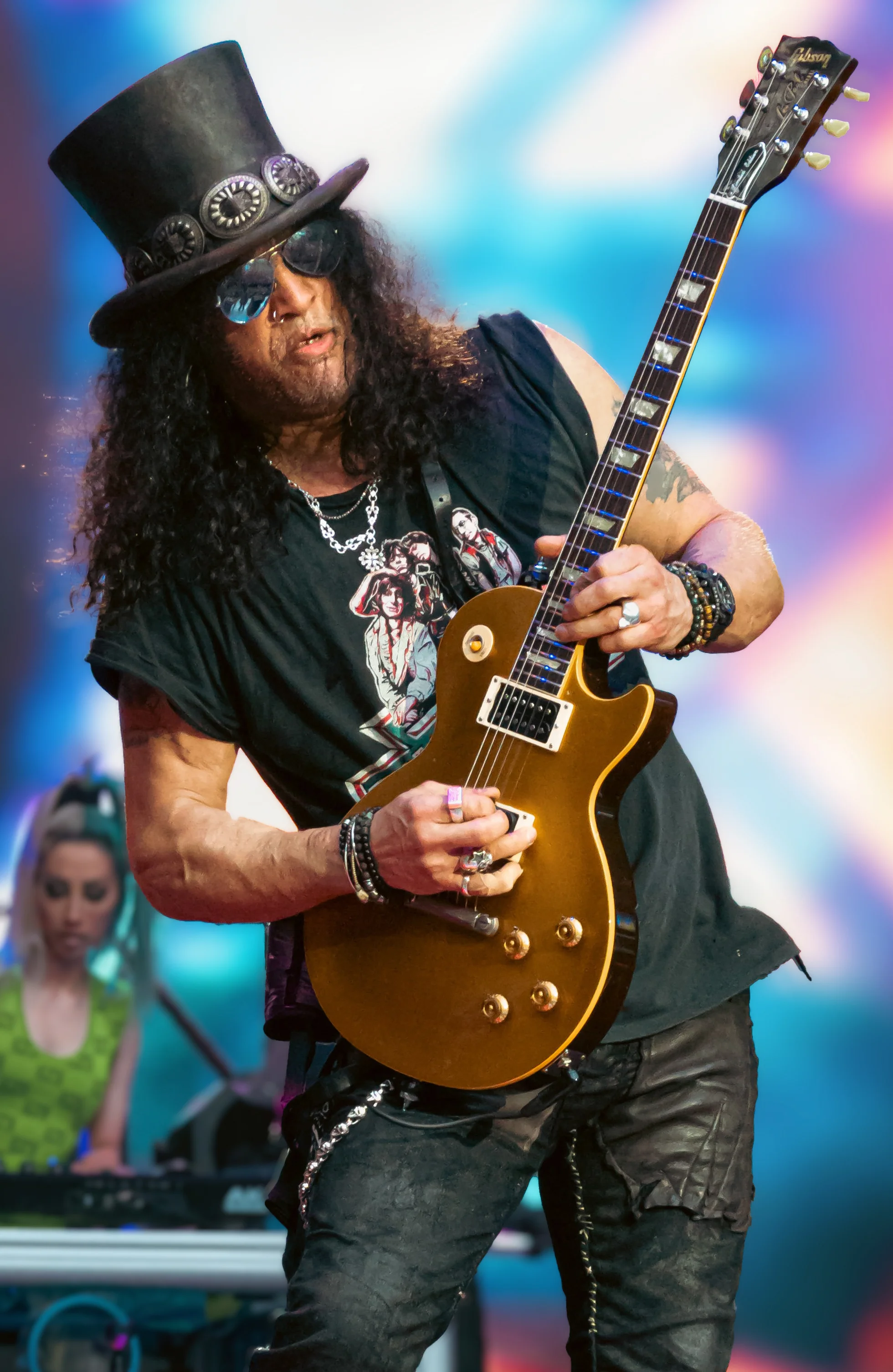
Sound Like Slash
During the decade of guitar virtuosity and arena rock, Slash redefined what heavy and assertive electric guitar could sound like — and their influence on hard rock has never faded. Slash's tone is the gold standard of hard rock — a Les Paul into a Marshall, saturated with crunch and singing with natural sustain. Raw, aggressive and always musical. Whether you're starting out or ready to invest, the rig guides below cover every budget from £200 to £2,500.
Quick Answer
To sound like Slash, start with a Epiphone Les Paul Standard into a Boss Katana 50 MkII, with a Joyo Vintage Overdrive as your key effect.
Tone Analysis
Slash's Guitar Tone — In Depth
Tone Philosophy
Slash's approach to guitar tone is classical in the most straightforward sense: maximum signal from the instrument, into the amplifier, with the amplifier doing the work. The Guns N' Roses era rig was notable for its simplicity — a Les Paul, a Marshall JCM800, occasionally a Boss SD-1 as a boost. No complex effects chain, no rack gear, no elaborate switching system. The philosophical commitment was to the direct connection between the player and the amplifier, with the equipment's natural character allowed to define the sound rather than being processed or refined out of existence.
The Signature Sound
The Appetite for Destruction lead tone — the solos on Welcome to the Jungle, Sweet Child O' Mine, and Paradise City — is one of the most recognised sounds in rock. A Gibson Les Paul (actually a Kris Derrig replica of a 1959 Les Paul Standard) through a Marshall JCM800 2203 at high volume, occasionally with the SD-1 set as a boost rather than an overdrive source. The PAF-style humbuckers in the Les Paul produce a full, warm signal that the Marshall amplifies into controlled, sustaining saturation. The result has a thickness and body that brighter, single-coil approaches cannot match.
Key Gear
Beyond the Les Paul and JCM800, the Dunlop Cry Baby wah is Slash's most-used effect — appearing on Welcome to the Jungle's opening riff (used as a sweeping filter), multiple solos, and live lead passages. A Boss SD-1 Super Overdrive used as a boost (gain at minimum, level high) tightens the Marshall's low end and adds definition to the lead tone. The Dunlop AFD100 signature amplifier, designed in collaboration with Slash, specifically replicates the sound of the Appetite sessions and is the most direct modern access point to his signature tone.
Playing Approach
Slash plays with significant picking aggression. His right-hand motion is large and physical — using the full arm rather than just the wrist — which gives his picking a driving quality. His vibrato on lead notes is wide and fast, applied immediately rather than after the note establishes itself. This creates an urgent, expressive quality in his lead lines. His rhythm playing is predominantly downstroke-heavy, which adds the forward-driving quality to Guns N' Roses' rhythm guitar work that alternate picking would not produce in the same way.
Legacy
Slash's role in popularising the Les Paul-through-Marshall combination for a generation of rock players who came of age in the early 1990s is difficult to overstate. Appetite for Destruction was the most commercially successful debut album in history at the time of its release, which means his tone was heard by an enormous audience. The subsequent wave of classic rock revival bands and hard rock players who cite him as a primary influence extends through multiple subsequent generations.
Budget Comparison
Pick Your Budget Level
£500 · Sweet Spot
~£507
- GuitarEpiphone Les Paul Standard
- OverdriveJoyo Vintage Overdrive
- AmpBoss Katana 50 MkII
£1,000 · Pro-Level
~£819
- GuitarEpiphone Les Paul Standard
- AmpMarshall DSL20CR
- DistortionBoss DS-1 Distortion
- EQMXR M108S 10-Band EQ
£2,500 · Premium
~£2496
- GuitarGibson Les Paul Junior
- WahDunlop GCB95 Cry Baby Wah
- OverdriveAnalogman Modded TS9
- AmpMarshall DSL100H
Shop Now
Buy the Key Gear — £500 Sweet Spot
Guitar, amp and essential effects for the authentic Slash sound. The guitar and amp together account for 80% of the tone.
Complete the Rig
Essentials Every Guitarist Needs
These aren't exciting — but every rig needs them. Buy once, sorted forever.
Tone Profile
Slash's Sound
Humbucker-loaded Les Paul into a cranked Marshall — thick midrange saturation, singing sustain and a warm but aggressive attack. No scooped mids: Slash's tone is all about that mid-forward Marshall crunch.
Modeling Amps
Get Slash's Tone on Your Modeler
Targeting Marshall (Plexi / JCM800). Use these amp models and IRs as your starting point — dial in from there using the knob settings above.
Low master, drive at 6–7 for Plexi crunch; Brit 2204 for JCM800 lead
Keep presence at 5, let the amp breathe — avoid over-EQing
Song Match
Which Slash Songs Suit Your Amp
Tone Match
Closest Real-World Tone Match
If you like Slash's tone, these players use a similar approach — same gear philosophy, comparable sound characteristics.
Weekly Tone Tips
One setting, one artist insight, one gear pick. No noise.