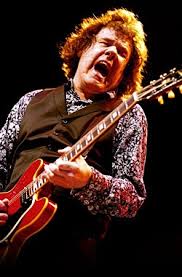
Blues-RockHard Rock1970s–2010s
Gary Moore — £1,000 · Pro-Level Rig
Gibson Les Paul Standard (including Peter Green's original 1959 burst for a period) into a Marshall 100W. The tone is thick, hot and articulate — mid-heavy with aggressive pick attack and dramatic sustained vibrato. No heavy effects; the emotion is entirely in the hands.
Signal Path
Signal Chain
Full signal path
GuitarLP Std
ODBoss SD-1
AmpMarshall DSL40CR
Full Gear List
£1,000 · Pro-Level — Complete Rig
£££ Pro-Level£399

£££ Pro-Level£499

Tone Tips
Getting the Sound Right
- Wide, slow-starting vibrato that gradually increases in width — mimics a singer's natural swell
- Extreme string bends — Moore bent strings further than almost any other player
- Bridge pickup for scorching leads; neck pickup for smoother, BB King-influenced phrases
- Boss SD-1 as clean boost (gain low, level high) — pushes amp into natural saturation
- Marshall EQ: bass 6, mid 7, treble 6 — mid-forward, not scooped
- Pick hard and then control the note — dynamics come from attack, not the amp
- Blues phrasing over hard rock backing creates the emotional tension central to Moore's style
- Tremolo arm for occasional dive bomb effects — but used sparingly vs pure vibrato
Avoid These Pitfalls
Common Mistakes When Chasing This Tone
- Not exploring the JCM800 alone before adding pedals — a Les Paul or humbucker guitar into a British amp is already a near-complete overdrive system. Adding drive pedals on top is often unnecessary and muddies the amp's natural character
- Leaving the wah pedal engaged but stationary between rocking it — a cocked wah (fixed position, not moving) acts as a midrange filter that changes the core tone. Either rock it expressively or bypass it completely; a cocked wah changes the sound in ways that are often unintended
- Expecting a Les Paul to sound like a Strat with EQ adjustments — the mahogany body, set neck, and humbuckers produce a fundamentally different character that cannot be EQ'd away.
- Scooping the mids on a Marshall-style amp — the upper midrange emphasis is what makes British amps cut through. Mid-scoop EQ sounds good alone but disappears in a band mix.
- Using too much gain on the drive pedal — pedal-driven tone works best with the amp providing some character and the pedal adding focus and saturation, not replacing the amp entirely.
- Setting gain too high on the overdrive pedal — most overdrive pedals are most useful at gain settings of 2-5, where they add character without dominating the tone. High gain settings on an OD pedal become a distortion, not an overdrive.
- Too many repeats at high mix — more than 3 repeats makes the delay effect accumulate and overwhelm the dry guitar signal. Keep it to 2-3 repeats at a subtle mix level.
- Ignoring the guitar volume knob — rolling back to 6-7 is your rhythm setting; 10 is for leads. Most players leave it at 10 and miss the entire dynamic vocabulary.
Tone Profile
Gary Moore's Sound
Gibson Les Paul Standard (including Peter Green's original 1959 burst for a period) into a Marshall 100W. The tone is thick, hot and articulate — mid-heavy with aggressive pick attack and dramatic sustained vibrato. No heavy effects; the emotion is entirely in the hands.