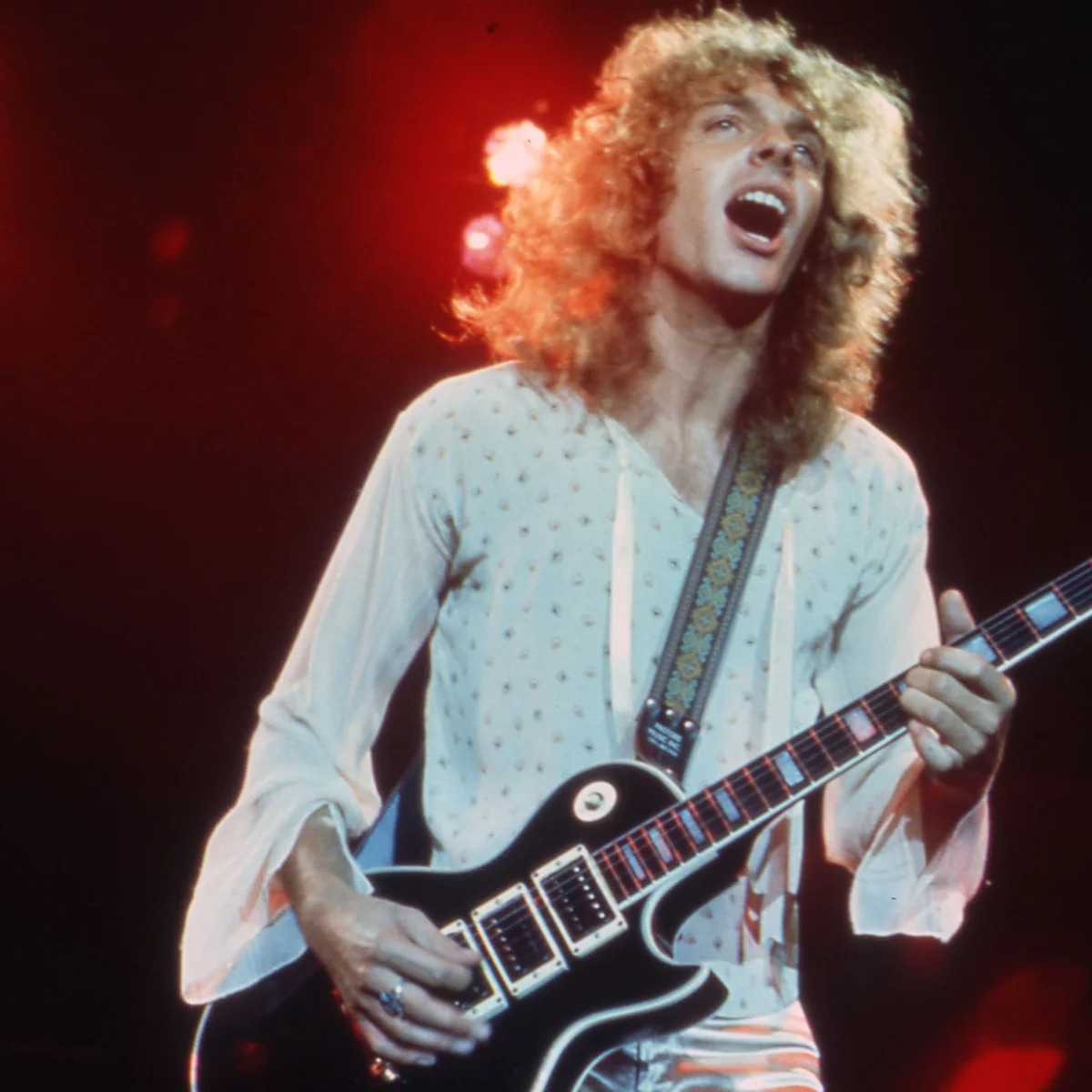
Peter Frampton — £500 · Sweet Spot Rig
Gibson Les Paul into a Marshall Super Lead. The Heil Talk Box is a speaker that pumps the guitar signal into a tube inserted in Frampton's mouth — he shapes vowels with his lips while the amp plays. The result is a "wah-wah" effect produced by a human vocal tract rather than a pedal. Without the talk box, his base tone is warm, mid-heavy blues-rock.
Signal Path
Signal Chain
Full signal path
Full Gear List
£500 · Sweet Spot — Complete Rig

Tone Tips
Getting the Sound Right
- Talk box setup: speaker in a small enclosure → plastic tube → your mouth. Sing no note — just shape vowels
- Vowel shapes: "ah" for open tone, "wah" for forward peak, "oo" for dark, scooped tone
- A Dunlop Cry Baby Wah is the accessible alternative — approximates the talk box filter
- Les Paul bridge pickup for the base tone — warm but with enough bite to drive the talk box
- Marshall gain: moderate, not extreme — the talk box needs a clear signal to articulate well
- Play slow, melodic lines through the talk box — fast runs muddy the vowel articulation
- Frampton's non-talk-box playing is rooted in slow, emotive blues phrasing
- The "baby I love your way" clean chord work: open chord shapes, gentle picking, clean amp
Avoid These Pitfalls
Common Mistakes When Chasing This Tone
- Not exploring the Marshall Super Lead alone before adding pedals — a Les Paul or humbucker guitar into a British amp is already a near-complete overdrive system. Adding drive pedals on top is often unnecessary and muddies the amp's natural character
- Leaving the wah pedal engaged but stationary between rocking it — a cocked wah (fixed position, not moving) acts as a midrange filter that changes the core tone. Either rock it expressively or bypass it completely; a cocked wah changes the sound in ways that are often unintended
- Expecting a Les Paul to sound like a Strat with EQ adjustments — the mahogany body, set neck, and humbuckers produce a fundamentally different character that cannot be EQ'd away.
- Scooping the mids on a Marshall-style amp — the upper midrange emphasis is what makes British amps cut through. Mid-scoop EQ sounds good alone but disappears in a band mix.
- Using a distortion pedal to replace amp saturation — amp-driven tone has a specific feel (dynamics, touch sensitivity, natural compression) that pedal distortion cannot replicate. The source of gain matters.
- Setting gain too high on the overdrive pedal — most overdrive pedals are most useful at gain settings of 2-5, where they add character without dominating the tone. High gain settings on an OD pedal become a distortion, not an overdrive.
- Moving the wah too fast — wah is a filter effect that needs time to sweep through its range musically. Fast rocking produces a quacking sound; musical use is slower and more deliberate.
- Ignoring the guitar volume knob — rolling back to 6-7 is your rhythm setting; 10 is for leads. Most players leave it at 10 and miss the entire dynamic vocabulary.
Tone Profile
Peter Frampton's Sound
Gibson Les Paul into a Marshall Super Lead. The Heil Talk Box is a speaker that pumps the guitar signal into a tube inserted in Frampton's mouth — he shapes vowels with his lips while the amp plays. The result is a "wah-wah" effect produced by a human vocal tract rather than a pedal. Without the talk box, his base tone is warm, mid-heavy blues-rock.