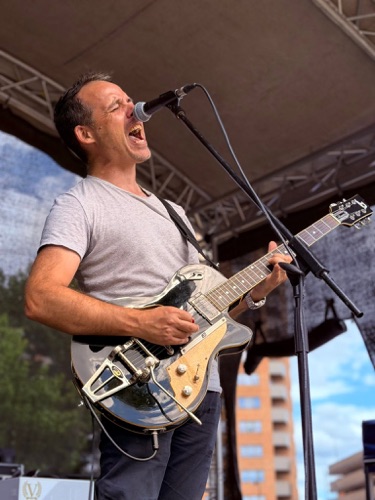
Alex Hall — £1,000 · Pro-Level Tone
Alex Hall's distinctive and influential tone took shape during a defining era for electric guitar and remains one of the most sought-after sounds on guitar. Alex Hall is the guitarist and vocalist of Light for Vandals. His rig pairs Duesenberg offset guitars with British-voiced boutique amps, keeping the amp near edge-of-breakup and building gain, texture and dynamics almost entirely through the pedalboard. At the £1,000 · Pro-Level mark — a serious investment that brings you within touching distance of the real thing — the build centres on a Fender Player Telecaster running through a Boss Katana 100 MkII, with JHS Morning Glory V4 completing the signal chain, totalling ~£1,097.
Build Alex Hall's £1,000 · Pro-Level Rig
3 pieces · Total ~$1,393
What guitar does Alex Hall use?
Alex Hall uses a alternative rock-oriented guitar. At the £1,000 tier, Fender Player Telecaster covers the fundamentals.
What to Buy
£1,000 · Pro-Level — Complete Gear List
Can't find one? See alternatives:
Why This Rig Works
How Alex Hall's gear choices create the signature tone
Fender Player Telecaster
Where the Squier approximates the Tele voice, the Player Telecaster *is* the Tele voice. Noticeably more articulate and dynamic, with the bridge pickup delivering the iconic snap and cut that defines the instrument.
JHS Morning Glory V4
JHS Morning Glory V4 — overdrive coloring added to the signal.
Boss Katana 100 MkII
The extra headroom lets you push the clean channel harder before it breaks up, essential for loud-amp technique. More speaker excursion gives a fuller, more three-dimensional clean.
The Combined Tone
Duesenberg into a Victory or Zinky amp kept clean-to-crunchy, with drive built in stages — a transparent Klone-style boost for low-gain push, a Rothwell Hellbender for grittier crunch when a section needs it. A Greer Fish Press keeps picking dynamics even ahead of the drive stages, a Boss GE-7 shapes or corrects the amp's voicing room to room, and a Red Witch Violetta plus the HX Stomp handle delay, modulation and any texture the amp and pedals alone can't cover. A Digitech Drop is on hand for down-tuned sections without a guitar change, and a Vox wah stays in reach for expressive lead lines.
Tone Tips
Getting the Sound Right
- On the Boss Katana 100 MkII: use the Brown channel — the closest model to a Marshall-voiced preamp at this price. Set character to 8, gain to 5. For Alex Hall's lead volume jump, use the Boost mode rather than adding a separate boost pedal.
- Keep the amp near edge-of-breakup and let pedals build the gain in stages, rather than relying on one high-gain channel
- Run a transparent Klone-style boost for low-gain push before reaching for a dedicated distortion — it adds volume and clarity without changing the amp's character
- A multi-effects unit like the HX Stomp is most useful for the effects you'd otherwise need several pedals for — modulation, ambience and time-based textures — while drive and dynamics stay on dedicated analog pedals
- Keep a pitch-drop pedal (Digitech Drop) on the board for down-tuned sections rather than swapping guitars mid-set
- A compressor before the your amp evens out single-coil picking dynamics for techniques like chicken-picking — set the attack to medium (not fast) so the initial pick click still passes through before compression engages
Avoid These Pitfalls
Common Mistakes When Chasing This Tone
- Leaving the wah pedal engaged but stationary between rocking it — a cocked wah (fixed position, not moving) acts as a midrange filter that changes the core tone. Either rock it expressively or bypass it completely; a cocked wah changes the sound in ways that are often unintended
- Placing a high-ratio compressor before a drive pedal — heavy compression removes the pick attack variation that the drive pedal responds to. The result is a flat, lifeless driven tone that has no feel
- Using too much distortion for the heavy sections — the aggressive quality of alt-rock overdrive often comes from fuzz and Big Muff-style pedals into clean amps, not from high-gain metal tones.
- Ignoring alternative tunings — many of the most iconic riffs and chord voicings in the genre are impossible in standard tuning.
Budget Alternatives
Same Tone, Different Budget
FAQ
Alex Hall Tone — Common Questions
Alex Hall uses a alternative rock-oriented guitar. At the £1,000 tier, Fender Player Telecaster covers the fundamentals.
Alex Hall's amp tone suits the alternative rock genre approach. At £1,000, Boss Katana 100 MkII provides authentic results.
The £1,000 tier adds noticeably better build quality and tonal nuance over the £500 rig. This build totals £1,097 with Fender Player Telecaster, Boss Katana 100 MkII, 1 effect. This is the tier where the tone becomes genuinely convincing for gigging and recording.
Duesenberg into a Victory or Zinky amp kept clean-to-crunchy, with drive built in stages — a transparent Klone-style boost for low-gain push, a Rothwell Hellbender for grittier crunch when a section needs it. This character comes from the guitar pickup type, amp voicing, and playing technique working together.
Alex Hall — £1,000 · Pro-Level Complete Rig
~£1,097Guitar
Fender Player Telecaster
Amp
Boss Katana 100 MkII
Overdrive
JHS Morning Glory V4
Tone Match
Closest Real-World Tone Match
If you like Alex Hall's tone, these players use a similar approach — same gear philosophy, comparable sound characteristics.