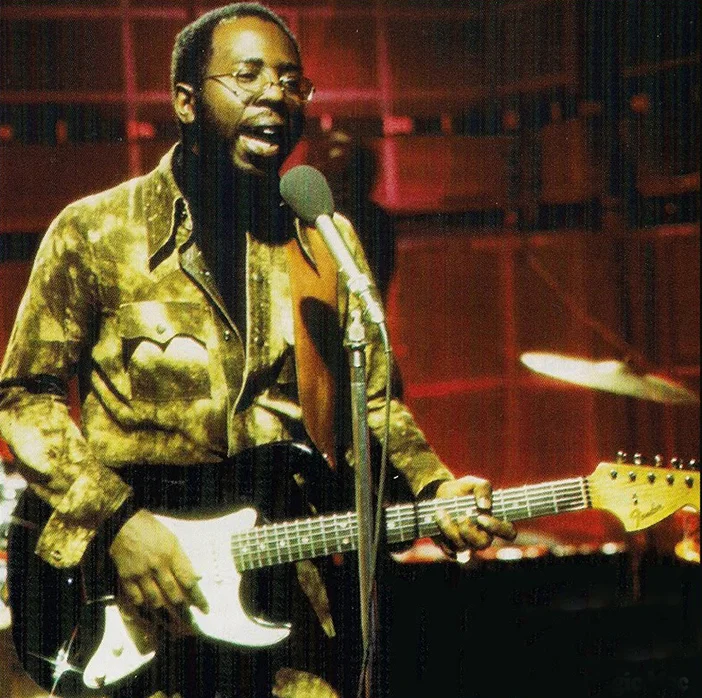
Curtis Mayfield — £2,500 · Premium Tone
Curtis Mayfield's emotive and richly toned tone took shape during the golden age of electric guitar innovation and remains one of the most sought-after sounds on guitar. Curtis Mayfield was as much a guitar innovator as a singer-songwriter — his open Eb minor tuning created a falsetto-voiced guitar sound that matched the upper register of his singing, producing the intimate, conversational guitar tone of "People Get Ready," "Move On Up" and "Superfly." At the £2,500 · Premium mark — a premium build targeting the most accurate recreation possible — the build centres on a Gretsch G5420T Electromatic running through a Fender '65 Twin Reverb, totalling ~£2498.
Build Curtis Mayfield's £2,500 · Premium Rig
2 pieces · Total ~$3,172
What guitar does Curtis Mayfield use?
Curtis Mayfield is primarily associated with hollow style guitars. At a £2,500 budget, Gretsch G5420T Electromatic delivers the essential tonal character.
What to Buy
£2,500 · Premium — Complete Gear List
Why This Rig Works
How Curtis Mayfield's gear choices create the signature tone
Gretsch G5420T Electromatic
The Gretsch G5420T Electromatic provides the tonal foundation for the entire rig — its character shapes everything that follows.
Fender '65 Twin Reverb
The Fender '65 Twin Reverb converts the guitar signal into audible sound and adds its own tonal character — EQ shaping, natural gain, and the overall feel of the final tone.
The Combined Tone
Fender Stratocaster in open Eb minor tuning (D#-G#-D#-G#-B-D#) into a clean amplifier. The tuning is a cornerstone of his style — it allows open-string drone notes under fretted chord shapes. The tone is clean, bright and vocal. A capo is used on various frets to change key while maintaining the open tuning shapes.
Tone Tips
Getting the Sound Right
- The Fender '65 Twin Reverb stays cleaner longer than a Marshall-style amp — push it with a low-gain overdrive (gain at 2–3, level up) rather than cranking its own gain. Set treble at 6, bass at 4, and let the guitar's volume knob handle the dynamics.
- Open Eb minor tuning is mandatory — standard tuning produces completely different sounds. Tune to D#-G#-D#-G#-B-D# (open Eb minor chord)
- Capo moves the key while preserving the fingering shapes — Mayfield used a capo on frets 1-5 frequently to transpose the open tuning to different keys
- Jazz chord substitutions appear in sophisticated progressions — Mayfield's chord work goes beyond simple soul changes to include jazz-influenced voice leading
- The open F# tuning (F#-A#-C#-F#-A#-F#) is essential for Mayfield's chord voicings — standard tuning cannot produce the spread voicings and bass-melody combinations fundamental to his sound. With a capo at the first or second fret, this tuning creates the bright, ringing upper-register chordal texture
- The guitar functions as harmonic texture rather than melody or rhythm — Mayfield's parts sit in the inner voice of the arrangement between the bass and the vocal, filling harmonic space. Understanding the guitar's role as a chordal voice, not a lead, changes how to approach the parts
- Gospel chord movement (IV-I and parallel major-minor shifts) is the harmonic language — Mayfield brought church harmony into secular soul music. Study 'People Get Ready' and 'Move On Up' for how the guitar voices lead chord substitutions that give the music its emotional depth beyond standard blues changes
Avoid These Pitfalls
Common Mistakes When Chasing This Tone
- Playing at high volume without managing feedback — hollow-body guitars are acoustically live and will feedback freely at stage volumes. Amp positioning and pickup height affect this dramatically.
- Setting bass too high on a Fender spring reverb amp — at high bass settings the reverb tank produces a "booming" quality that muddies the tone. Start with bass at 4-5.
- Adding compression to fix flat clean tone — a flat, lifeless clean tone usually means the amp gain or presence is wrong, not that compression is needed. Compression on a flat tone just makes it louder.
- Using too much reverb — classic rock is relatively dry. A small room reverb is acceptable; a large hall wash is not appropriate for the genre.
- Setting gain too high on a Tube Screamer boost — the OD pedal should act as a preamp push (gain at 2-3), not add its own substantial distortion character on top of the amp.
Budget Alternatives
Same Tone, Different Budget
FAQ
Curtis Mayfield Tone — Common Questions
Curtis Mayfield is primarily associated with hollow style guitars. At a £2,500 budget, Gretsch G5420T Electromatic delivers the essential tonal character.
Curtis Mayfield's amp is clean fender voiced — clean to moderate gain. At the £2,500 level, Fender '65 Twin Reverb is the closest match.
The £2,500 tier uses Curtis Mayfield's actual gear choices or direct equivalents. Total: £2,498. The tonal step up from £1,000 is real but diminishing — worth it for regular performers and studio work.
Curtis Mayfield's tone is defined by soul-fingerstyle, open-tuning-capo, funk-soul. The combination of hollow guitar and clean fender amp creates a sound that is immediately recognisable.
Curtis Mayfield's gain approach is very clean — minimal distortion even at volume. The tone comes from the amp's natural warmth. At £2,500, this is replicated through Fender '65 Twin Reverb.
Curtis Mayfield — £2,500 · Premium Complete Rig
~£2498Guitar
Gretsch G5420T Electromatic
Amp
Fender '65 Twin Reverb
Tone Match
Closest Real-World Tone Match
If you like Curtis Mayfield's tone, these players use a similar approach — same gear philosophy, comparable sound characteristics.
Related Tones