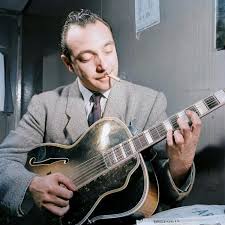
Django Reinhardt — £1,000 · Pro-Level Tone
At £1,000 · Pro-Level, Django Reinhardt's nuanced and harmonically sophisticated tone is more accessible than most players expect. Rooted in a defining era for electric guitar, their sound — Django Reinhardt was the first European jazz master — his Gypsy jazz style, developed after losing the use of two fingers in a caravan fire, combined virtuoso speed with a deeply swinging feel that transcended his physical limitation. — starts with Ibanez AF75 Artcore and Fender Blues Junior IV, totalling ~£1,048. That combination captures the defining characteristics without the premium price tag.
Build Django Reinhardt's £1,000 · Pro-Level Rig
2 pieces · Total ~£1,048
What guitar does Django Reinhardt use?
Django Reinhardt is primarily associated with gypsy jazz style guitars. At a £1,000 budget, Ibanez AF75 Artcore delivers the essential tonal character.
What to Buy
£1,000 · Pro-Level — Complete Gear List
Technique Guide
Django's tone is technique-driven, not gear-driven
Django Reinhardt played a Selmer-Maccaferri acoustic guitar with an oval or D-shaped sound hole, occasionally through a small amplifier in later sessions. His tone came entirely from right-hand technique — an aggressive, upward rest-stroke attack — using only two fully-functioning fretting fingers after a fire injury destroyed the ring and little fingers of his fretting hand.
Strings
Silk and steel or light bronze acoustic strings (0.011–0.052). The Selmer guitar's oval sound hole creates distinctive projection and treble bite compared to standard round-hole acoustics.
Technique Highlights
- Upward rest-stroke picking for aggressive attack and projection
- Chord-melody: bass notes + chord stabs woven around melody notes
- Heavy use of diminished 7th and dominant 7th chord voicings
- Vibrato produced by fretting-hand motion, not whammy or pedal
- Two-finger left-hand technique — adapt standard fingerings accordingly
- La pompe rhythm (2-beat chop) is the rhythmic foundation of the style
Tone Tips
Getting the Sound Right
- Rest stroke technique: the pick follows through and rests on the next string after plucking. This produces the sharp, percussive attack characteristic of Gypsy jazz
- A very heavy pick (1.5mm or thicker) is used — the thick pick and rest stroke combine for the snappy attack
- Two-finger fretting: Django used only his first finger and third finger (his second and fourth fingers were paralysed). Practise with only these two fingers to understand how his vocabulary was shaped by this constraint
- The Gypsy jazz rhythm ("la pompe") is a specific staccato rhythm pattern — downstroke on beat 1 followed by a silent muted upstroke on the "and," then a chord stab on beats 2 and 4
- Sweep arpeggios are fundamental — Django's fast arpeggios use economy picking (sweeping in one direction) across multiple strings
- Chromatic passing notes between chord tones — minor second approach notes before landing on a chord tone produce the bebop-flavoured chromatic runs
- The Selmer guitar sound is specific and distinct from a standard acoustic — for recordings, use an archtop acoustic or semi-hollow rather than a flat-top folk guitar
- Vibrato along the string (lengthwise) rather than across — Django's vibrato is a back-and-forth along the length of the string, producing a more subtle pitch variation
Avoid These Pitfalls
Common Mistakes When Chasing This Tone
- Using high-gain distortion — hollowbody guitars are designed for clean and light-drive use. High gain causes uncontrollable acoustic resonance that the pickup amplifies as noise.
- Using the amp's volume at less than 4 — boutique clean amps are designed to be played at certain output levels. At very low volumes the tone is compressed and flat compared to full-level operation.
- Expecting a clean tone to cover all playing dynamics — clean tone requires picking technique to do all the work. Lazy picking dynamics become very audible on a clean signal.
- Keeping the tone knob at 10 — full treble on a jazz guitar gives a nasal, honky quality that sounds nothing like the warm round jazz ideal.
- Using round-wound strings — they are brighter, last longer, and have more sustain, but they also sound more "electric" and less woody than flat-wounds for jazz.
Budget Alternatives
Same Tone, Different Budget
FAQ
Django Reinhardt Tone — Common Questions
Django Reinhardt is primarily associated with gypsy jazz style guitars. At a £1,000 budget, Ibanez AF75 Artcore delivers the essential tonal character.
Django Reinhardt's amp is boutique clean voiced — clean to moderate gain. At the £1,000 level, Fender Blues Junior IV is the closest match.
The £1,000 tier adds noticeably better build quality and tonal nuance over the £500 rig. This build totals £848 with Ibanez AF75 Artcore, Fender Blues Junior IV. This is the tier where the tone becomes genuinely convincing for gigging and recording.
Django Reinhardt's tone is defined by gypsy-jazz, rapid-arpeggio, swing. The combination of gypsy jazz guitar and boutique clean amp creates a sound that is immediately recognisable.
Django Reinhardt's gain approach is very clean — minimal distortion even at volume. The tone comes from the amp's natural warmth. At £1,000, this is replicated through Fender Blues Junior IV.
Django Reinhardt — £1,000 · Pro-Level Complete Rig
~£1,048Guitar
Ibanez AF75 Artcore
Amp
Fender Blues Junior IV
Tone Match
Closest Real-World Tone Match
If you like Django Reinhardt's tone, these players use a similar approach — same gear philosophy, comparable sound characteristics.
Related Tones