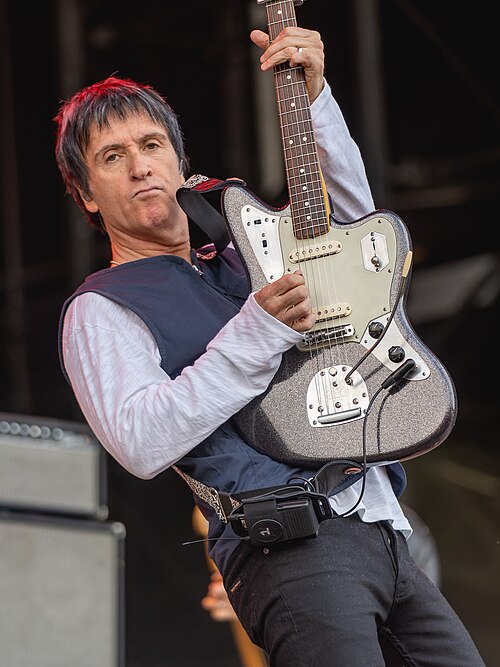
Johnny Marr — £1,000 · Pro-Level Tone
The £1,000 · Pro-Level build for Johnny Marr's textural and introspective sound opens with Fender Player Stratocaster — the tonal foundation that defines the character. Into Boss Katana 50 MkII paired with TC Electronic Flashback 2 and Boss CE-5 Chorus Ensemble, the rig comes to ~£1,097 and delivers the essential elements. Johnny Marr of The Smiths is the architect of the British indie guitar sound — arpeggiated chord voicings, capo use, shimmering clean tones and an intricate right-hand technique that sounds like multiple guitarists at once.
Build Johnny Marr's £1,000 · Pro-Level Rig
4 pieces · Total ~£1,097
What guitar does Johnny Marr use?
Johnny Marr is primarily associated with semi hollow style guitars. At a £1,000 budget, Fender Player Stratocaster delivers the essential tonal character.
What to Buy
£1,000 · Pro-Level — Complete Gear List
Why This Rig Works
How Johnny Marr's gear choices create the signature tone
Fender Player Stratocaster
Where the Squier approximates the Strat voice, the Player Strat *is* the Strat voice. Noticeably more articulate and dynamic, responding to every nuance of pick attack.
- Delay Enginestudio-grade digital and tape delay echo
- ChorusBoss CE-5 Chorus Ensemble
Boss Katana 50 MkII
Its 'Brown' amp character at low gain is an excellent approximation of the Fender-style clarity that Hendrix, Mayer, Gilmour and SRV all relied on. Built-in effects mean you're a few knob turns away from the right tone.
The Combined Tone
Rickenbacker 330 or Gibson ES-335 into a Roland JC-120 Jazz Chorus, the cleanest amp available, with a Korg SDD-3000 delay for shimmer. No overdrive — Marr's tone is always pristine clean. The Rickenbacker's jangly character through the JC-120's crystalline solid-state preamp is the foundation of every Smiths record.
Tone Tips
Getting the Sound Right
- Clean amp — always. No overdrive or distortion in The Smiths. The complexity comes from arpeggiation and chord choice, not gain
- Capo at fret 2, 4, or 5 is used extensively — arpeggiated open chord shapes with capo produce the bright, ringing character of "This Charming Man"
- Arpeggiate rather than strum — right-hand technique picks individual strings in sequence rather than sweeping across them
- The Rickenbacker's jangle requires light picks (0.50mm) — heavier picks dull the high-end sparkle essential to the sound
- Two-guitar layering in studio recordings — many Smiths tracks have a rhythm guitar and a lead fill guitar running simultaneously. Live, Marr played both parts simultaneously
- Delay adds shimmer, not echo — the Korg SDD-3000 is set to very short delay times (80-150ms) at low feedback. It widens the sound without creating obvious echoes
- Open chord shapes with the capo provide the ringing open-string quality — bar chords are almost never used
- The Roland JC-120's built-in chorus is often used at subtle settings — the dual speaker stereo spread adds width
Avoid These Pitfalls
Common Mistakes When Chasing This Tone
- Using the same amp EQ as for a solid-body guitar — semi-hollow guitars have natural warmth that makes amp bass and treble settings behave differently. Start flat and adjust from there.
- Using a high-gain distortion pedal instead of amp gain — British crunch amps have a specific harmonic character when driven from their own gain stage. A pedal changes this character.
- Clean amp at too low a volume — even a clean amp provides warmth and tonal character that the pedal sits in. An amp at minimum volume has no character for the pedal to interact with.
- Too many repeats at high mix — more than 3 repeats makes the delay effect accumulate and overwhelm the dry guitar signal. Keep it to 2-3 repeats at a subtle mix level.
- Over-warming the tone — punk guitar benefits from brightness. Too much warmth (low treble, high bass) makes the tone muddy and slow-sounding.
- Complex pedal rigs — punk is deliberately simple. A rack of effects and a complex setup contradicts the genre's philosophy and requires attention that should go on the performance.
Budget Alternatives
Same Tone, Different Budget
FAQ
Johnny Marr Tone — Common Questions
Johnny Marr is primarily associated with semi hollow style guitars. At a £1,000 budget, Fender Player Stratocaster delivers the essential tonal character.
Johnny Marr's amp is british crunch voiced — clean to moderate gain. At the £1,000 level, Boss Katana 50 MkII is the closest match.
The £1,000 tier adds noticeably better build quality and tonal nuance over the £500 rig. This build totals £966 with Fender Player Stratocaster, Boss Katana 50 MkII, 2 effects. This is the tier where the tone becomes genuinely convincing for gigging and recording.
Johnny Marr's essential pedals include Chorus, Delay. At the £1,000 tier: TC Electronic Flashback 2, Boss CE-5 Chorus Ensemble. Chorus is the most important pedal — the others add nuance.
Johnny Marr's tone is defined by jangle, rickenbacker-chime, intricate-rhythm. The combination of semi hollow guitar and british crunch amp creates a sound that is immediately recognisable.
Johnny Marr's gain approach is pedal-driven — distortion pedals into a relatively clean amp. The pedal defines the distortion character. At £1,000, this is replicated through Boss Katana 50 MkII paired with TC Electronic Flashback 2.
Johnny Marr — £1,000 · Pro-Level Complete Rig
~£1,097Guitar
Fender Player Stratocaster
Amp
Boss Katana 50 MkII
Delay
TC Electronic Flashback 2
Chorus
Boss CE-5 Chorus Ensemble
Tone Match
Closest Real-World Tone Match
If you like Johnny Marr's tone, these players use a similar approach — same gear philosophy, comparable sound characteristics.
Related Tones