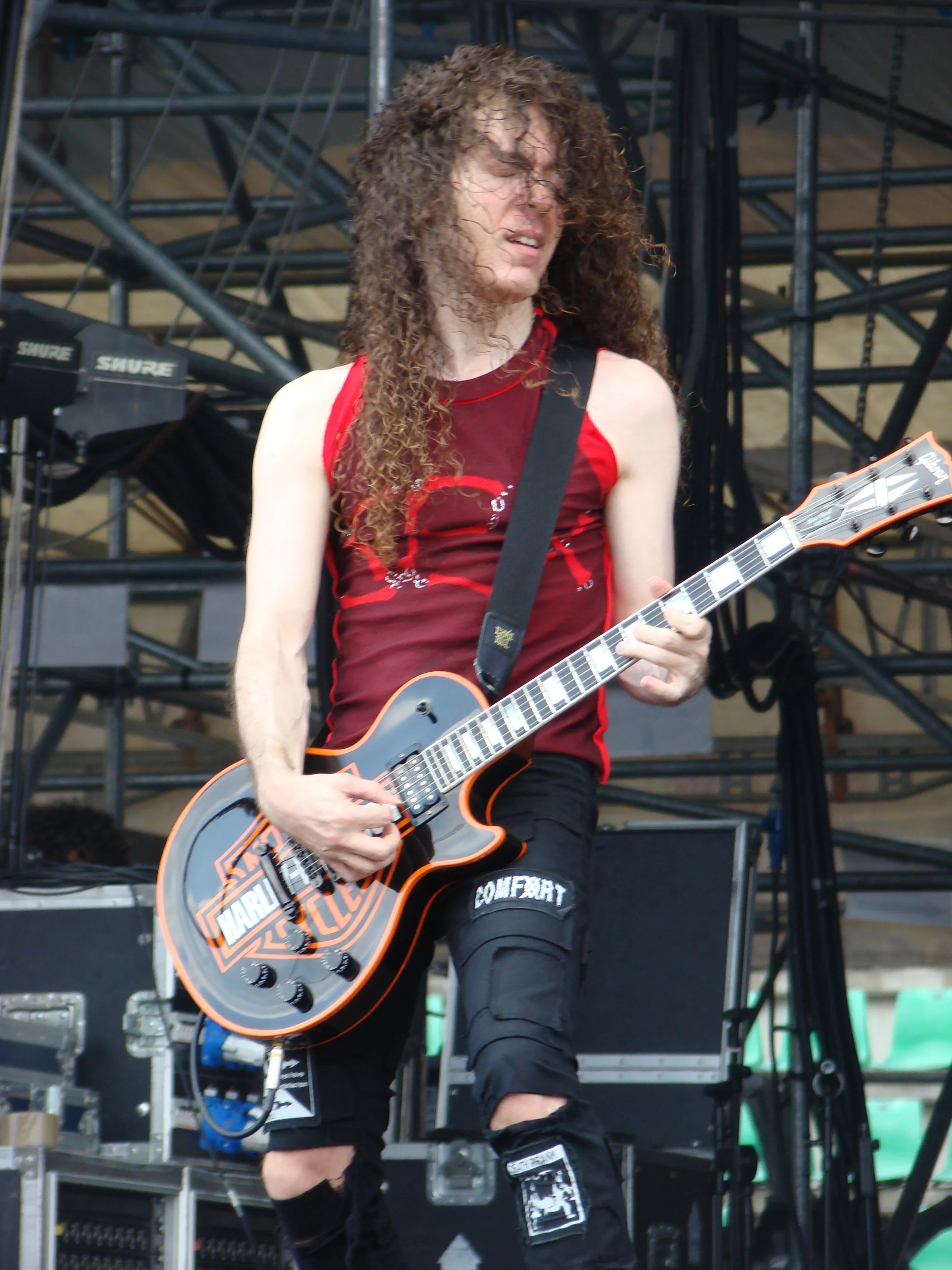
Marty Friedman — £2,500 · Premium Tone
Marty Friedman's crushing and technically demanding tone took shape during the decade of guitar virtuosity and arena rock and remains one of the most sought-after sounds on guitar. Marty Friedman of Megadeth and solo career fame brought a melodic and exotic flavour to heavy metal guitar — using Eastern and Asian scales over metal rhythm sections in a way that was completely unique among shred guitarists of the era. At the £2,500 · Premium mark — a premium build targeting the most accurate recreation possible — the build centres on a Ibanez RG550 Genesis Collection running through a Marshall DSL40CR, with Xotic Effects XW-1 Wah and Strymon Timeline completing the signal chain, totalling ~£2495.
Build Marty Friedman's £2,500 · Premium Rig
5 pieces · Total ~$3,169
What guitar does Marty Friedman use?
Marty Friedman is primarily associated with superstrat style guitars. At a £2,500 budget, Ibanez RG550 Genesis Collection delivers the essential tonal character.
What to Buy
£2,500 · Premium — Complete Gear List
Can't find one? See alternatives:
Why This Rig Works
How Marty Friedman's gear choices create the signature tone
Ibanez RG550 Genesis Collection
The Ibanez RG550 Genesis Collection provides the tonal foundation for the entire rig — its character shapes everything that follows.
- WahXotic Effects XW-1 Wah
- DelayStrymon Timeline
- ReverbStrymon Flint
Marshall DSL40CR
The Marshall DSL40CR converts the guitar signal into audible sound and adds its own tonal character — EQ shaping, natural gain, and the overall feel of the final tone.
The Combined Tone
Jackson or Ibanez signature guitar into a Mesa/Boogie Mark series or similar high-gain amp. The lead tone is smooth and singing with a distinctive vibrato. Unlike many metal players, Friedman deliberately avoids staying inside conventional pentatonic or diatonic scales — exotic modal inflections are the signature.
Tone Tips
Getting the Sound Right
- The Marshall DSL40CR delivers power-tube saturation at master volume 6–7 — this compression and sag is what separates amp-driven tone from pedal tone. Set the master first, then dial back the channel gain to taste rather than the other way around.
- Use exotic scales — Phrygian dominant, Hungarian minor and Japanese modes (In scale) feature prominently. Learn these scales in all positions before attempting Friedman-style phrasing
- Bend to non-target notes intentionally — Friedman bends to pitches outside the standard scale degrees (b9, #4, b6) for the exotic character
- Melody over technique — Friedman has explicitly said that melody and the ability to write a memorable melodic phrase matters more than speed or technical exhibition
- Pentatonic scale with chromatic approach notes from outside creates the 'outside' phrasing — Friedman enters and exits the pentatonic from unexpected angles including approach notes two semitones outside the scale. The note sounds wrong for an instant before resolving, creating tension without conventional music theory violation
- The pick angle is almost perpendicular to the strings — a very shallow picking angle reduces friction and increases speed. Combined with light pick gauge (0.60-0.73mm), this produces the fast, light-touch runs characteristic of the melodic passages on 'Tornado of Souls' and the 'Rust in Peace' album
- Japanese music theory influenced his scale vocabulary — Friedman has cited Japanese pop and traditional Japanese scales as influences on his note choices beyond Western pentatonic. The Hirajoshi scale (D E F A Bb D) with its two-semitone gaps produces the distinctive melodic flavour of his instrumental compositions
Avoid These Pitfalls
Common Mistakes When Chasing This Tone
- Running the Marshall DSL's gain channel at maximum — above 8 on most high-gain channels, palm mutes lose note separation and become an indistinct wall. The target is the minimum gain for the target saturation, not maximum
- Leaving the wah pedal engaged but stationary between rocking it — a cocked wah (fixed position, not moving) acts as a midrange filter that changes the core tone. Either rock it expressively or bypass it completely; a cocked wah changes the sound in ways that are often unintended
- Not setting delay to song tempo — a delay that doesn't match the song tempo creates a rhythmic clash that builds and becomes increasingly obvious. Tap the tempo every time.
- Ignoring down-tuning — trying to achieve dropped-tuning riff character at standard pitch produces a thinner, less aggressive result regardless of EQ.
Budget Alternatives
Same Tone, Different Budget
FAQ
Marty Friedman Tone — Common Questions
Marty Friedman is primarily associated with superstrat style guitars. At a £2,500 budget, Ibanez RG550 Genesis Collection delivers the essential tonal character.
Marty Friedman's amp is high gain voiced — high-gain with significant distortion from the amp itself. At the £2,500 level, Marshall DSL40CR is the closest match.
The £2,500 tier uses Marty Friedman's actual gear choices or direct equivalents. Total: £2,495. The tonal step up from £1,000 is real but diminishing — worth it for regular performers and studio work.
Marty Friedman's essential pedals include Delay, Reverb, Wah. At the £2,500 tier: Xotic Effects XW-1 Wah, Strymon Timeline, Strymon Flint. Delay is the most important pedal — the others add nuance.
Marty Friedman's tone is defined by exotic-scales, vibrato-heavy, sustained-lead. The combination of superstrat guitar and high gain amp creates a sound that is immediately recognisable.
Marty Friedman's gain approach is high-gain — dedicated high-gain amp channels or heavy drive pedals with significant distortion. At £2,500, this is replicated through Marshall DSL40CR paired with Xotic Effects XW-1 Wah.
Marty Friedman — £2,500 · Premium Complete Rig
~£2495Guitar
Ibanez RG550 Genesis Collection
Wah
Xotic Effects XW-1 Wah
Amp
Marshall DSL40CR
Delay
Strymon Timeline
Reverb
Strymon Flint
Tone Match
Closest Real-World Tone Match
If you like Marty Friedman's tone, these players use a similar approach — same gear philosophy, comparable sound characteristics.
Related Tones