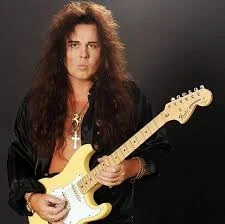
Yngwie Malmsteen — £2,500 · Premium Tone
Yngwie Malmsteen's crushing and technically demanding tone took shape during the decade of guitar virtuosity and arena rock and remains one of the most sought-after sounds on guitar. Yngwie Malmsteen brought Bach and Paganini to the electric guitar, creating neoclassical shred. His combination of extreme speed, scalloped-neck vibrato and harmonic minor vocabulary rewrote what was considered possible on the instrument. At the £2,500 · Premium mark — a premium build targeting the most accurate recreation possible — the build centres on a Fender Player Stratocaster running through a Marshall DSL100H, with Boss GE-7 Graphic EQ and Boss SD-1 Super Overdrive (as boost) completing the signal chain, totalling ~£2480.
Build Yngwie Malmsteen's £2,500 · Premium Rig
6 pieces · Total ~$3,150
What guitar does Yngwie Malmsteen use?
Yngwie Malmsteen is primarily associated with strat style guitars. At a £2,500 budget, Fender Player Stratocaster delivers the essential tonal character.
What to Buy
£2,500 · Premium — Complete Gear List
Can't find one? See alternatives:
Why This Rig Works
How Yngwie Malmsteen's gear choices create the signature tone
Fender Player Stratocaster
Where the Squier approximates the Strat voice, the Player Strat *is* the Strat voice. Noticeably more articulate and dynamic, responding to every nuance of pick attack.
- EQBoss GE-7 Graphic EQ
- OverdriveBoss SD-1 Super Overdrive (as boost)
- Studio Crunchamp-simulating saturation at any volume
- Delay Enginestudio-grade digital and tape delay echo
Marshall DSL100H
The Marshall DSL100H converts the guitar signal into audible sound and adds its own tonal character — EQ shaping, natural gain, and the overall feel of the final tone.
The Combined Tone
Bright Stratocaster (scalloped neck, DiMarzio YJM pickups) into a Marshall boosted by a DOD 250 at minimum gain and maximum volume. The tone is trebly and violin-like — all clarity, no warmth. Everything lives in the upper register.
Tone Tips
Getting the Sound Right
- The Marshall DSL100H delivers power-tube saturation at master volume 6–7 — this compression and sag is what separates amp-driven tone from pedal tone. Set the master first, then dial back the channel gain to taste rather than the other way around.
- Use harmonic minor scale (raised 7th) for the classical Yngwie sound — it creates the Vivaldi/Bach character rather than standard pentatonic blues
- Keep tone control at full and treble on the amp high — his tone is sharp and bright, never warm
- The Marshall runs at medium gain — it's the DOD boost that saturates the input stage, not a high-gain amp setting
- Practice strict inside and outside picking mechanics separately before combining — Yngwie's alternate picking requires that both string-crossing directions (picking toward the guitar body and away from it) are equally clean; most players have a weaker direction that becomes apparent at high speeds
- Learn the Bachiana No. 5 by Heitor Villa-Lobos alongside Malmsteen's compositions — both draw from the same Baroque-influenced counterpoint tradition, and understanding the classical phrasing logic behind the notes makes Malmsteen's solos far easier to internalise and memorise
- Set the amp presence control high (7–8) for the characteristic bright, forward attack — presence controls the very top of the frequency spectrum above treble, and Yngwie's cutting tone depends on this "air" at the top of the EQ curve being fully open
Avoid These Pitfalls
Common Mistakes When Chasing This Tone
- Using a humbucker guitar as a substitute — the quack, string noise, and bright attack of single coils are irreplaceable. No amount of EQ on a humbucker produces the same result.
- Scooping the mids on a Marshall-style amp — the upper midrange emphasis is what makes British amps cut through. Mid-scoop EQ sounds good alone but disappears in a band mix.
- Running gain at maximum — above 8 on most high-gain channels, palm mutes become indistinct and individual notes blur. The right amount of gain is the minimum for the target saturation.
- Scooping mids to "sound heavier" — a guitar with mids removed disappears under bass and drums. Metal tone cuts through a mix, and that requires midrange.
Budget Alternatives
Same Tone, Different Budget
FAQ
Yngwie Malmsteen Tone — Common Questions
Yngwie Malmsteen is primarily associated with strat style guitars. At a £2,500 budget, Fender Player Stratocaster delivers the essential tonal character.
Yngwie Malmsteen's amp is british crunch voiced — clean to moderate gain. At the £2,500 level, Marshall DSL100H is the closest match.
The £2,500 tier uses Yngwie Malmsteen's actual gear choices or direct equivalents. Total: £2,480. The tonal step up from £1,000 is real but diminishing — worth it for regular performers and studio work.
Yngwie Malmsteen's essential pedals include Overdrive, Delay. At the £2,500 tier: Boss GE-7 Graphic EQ, Boss SD-1 Super Overdrive (as boost), Boss DS-2 Turbo Distortion. Overdrive is the most important pedal — the others add nuance.
Yngwie Malmsteen's tone is defined by neoclassical, scalloped-neck, fast. The combination of strat guitar and british crunch amp creates a sound that is immediately recognisable.
Yngwie Malmsteen's gain approach is pedal-driven — distortion pedals into a relatively clean amp. The pedal defines the distortion character. At £2,500, this is replicated through Marshall DSL100H paired with Boss GE-7 Graphic EQ.
Yngwie Malmsteen — £2,500 · Premium Complete Rig
~£2480Guitar
Fender Player Stratocaster
EQ
Boss GE-7 Graphic EQ
Overdrive
Boss SD-1 Super Overdrive (as boost)
Distortion
Boss DS-2 Turbo Distortion
Amp
Marshall DSL100H
Delay
TC Electronic Flashback 2
Tone Match
Closest Real-World Tone Match
If you like Yngwie Malmsteen's tone, these players use a similar approach — same gear philosophy, comparable sound characteristics.
Related Tones