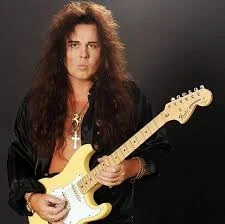
Yngwie Malmsteen — £1,000 · Pro-Level Tone
Yngwie Malmsteen's crushing and technically demanding tone took shape during the decade of guitar virtuosity and arena rock and remains one of the most sought-after sounds on guitar. Yngwie Malmsteen brought Bach and Paganini to the electric guitar, creating neoclassical shred. His combination of extreme speed, scalloped-neck vibrato and harmonic minor vocabulary rewrote what was considered possible on the instrument. At the £1,000 · Pro-Level mark — a serious investment that brings you within touching distance of the real thing — the build centres on a Squier Classic Vibe 60s Stratocaster running through a Marshall DSL20CR, with Boss SD-1 Super Overdrive (as boost) and Boss DS-1 Distortion completing the signal chain, totalling ~£971.
Build Yngwie Malmsteen's £1,000 · Pro-Level Rig
5 pieces · Total ~$1,233
What guitar does Yngwie Malmsteen use?
Yngwie Malmsteen is primarily associated with strat style guitars. At a £1,000 budget, Squier Classic Vibe 60s Stratocaster delivers the essential tonal character.
What to Buy
£1,000 · Pro-Level — Complete Gear List
Can't find one? See alternatives:
Why This Rig Works
How Yngwie Malmsteen's gear choices create the signature tone
Squier Classic Vibe 60s Stratocaster
The alnico V pickups are the real deal — they deliver genuine Strat chime, quack and warmth that responds naturally to pick attack. An ideal foundation for Hendrix, Mayer, Gilmour or SRV tones.
- OverdriveBoss SD-1 Super Overdrive (as boost)
- Crunch Boxraw transistor crunch and rock aggression
- Delay Enginestudio-grade digital and tape delay echo
Marshall DSL20CR
The DSL's crunch channel captures the classic JCM800-era Marshall sound that Slash and Frusciante are built on. At 20 watts you can push the power amp hard enough to get natural tube saturation without needing ear protection.
The Combined Tone
Bright Stratocaster (scalloped neck, DiMarzio YJM pickups) into a Marshall boosted by a DOD 250 at minimum gain and maximum volume. The tone is trebly and violin-like — all clarity, no warmth. Everything lives in the upper register.
Tone Tips
Getting the Sound Right
- The Marshall DSL20CR delivers power-tube saturation at master volume 6–7 — this compression and sag is what separates amp-driven tone from pedal tone. Set the master first, then dial back the channel gain to taste rather than the other way around.
- Use harmonic minor scale (raised 7th) for the classical Yngwie sound — it creates the Vivaldi/Bach character rather than standard pentatonic blues
- Keep tone control at full and treble on the amp high — his tone is sharp and bright, never warm
- Scalloped fretboard vibrato cannot be perfectly replicated on a standard neck. Compensate with wrist-driven wide vibrato and very light fretting pressure
- Vibrato starts immediately and stays fast and wide throughout the note — unlike blues vibrato which is slow and deliberate
- Tune to Eb standard — half step down reduces string tension and enables his aggressive attack without going sharp
- Practise three-notes-per-string scale patterns at very slow tempos before building speed — the picking mechanics must be clean at any tempo
Avoid These Pitfalls
Common Mistakes When Chasing This Tone
- Using a humbucker guitar as a substitute — the quack, string noise, and bright attack of single coils are irreplaceable. No amount of EQ on a humbucker produces the same result.
- Scooping the mids on a Marshall-style amp — the upper midrange emphasis is what makes British amps cut through. Mid-scoop EQ sounds good alone but disappears in a band mix.
- Too many repeats at high mix — more than 3 repeats makes the delay effect accumulate and overwhelm the dry guitar signal. Keep it to 2-3 repeats at a subtle mix level.
- Running gain at maximum — above 8 on most high-gain channels, palm mutes become indistinct and individual notes blur. The right amount of gain is the minimum for the target saturation.
- Scooping mids to "sound heavier" — a guitar with mids removed disappears under bass and drums. Metal tone cuts through a mix, and that requires midrange.
Budget Alternatives
Same Tone, Different Budget
FAQ
Yngwie Malmsteen Tone — Common Questions
Yngwie Malmsteen is primarily associated with strat style guitars. At a £1,000 budget, Squier Classic Vibe 60s Stratocaster delivers the essential tonal character.
Yngwie Malmsteen's amp is british crunch voiced — clean to moderate gain. At the £1,000 level, Marshall DSL20CR is the closest match.
The £1,000 tier adds noticeably better build quality and tonal nuance over the £500 rig. This build totals £971 with Squier Classic Vibe 60s Stratocaster, Marshall DSL20CR, 3 effects. This is the tier where the tone becomes genuinely convincing for gigging and recording.
Yngwie Malmsteen's essential pedals include Overdrive, Delay. At the £1,000 tier: Boss SD-1 Super Overdrive (as boost), Boss DS-1 Distortion, TC Electronic Flashback 2. Overdrive is the most important pedal — the others add nuance.
Yngwie Malmsteen's tone is defined by neoclassical, scalloped-neck, fast. The combination of strat guitar and british crunch amp creates a sound that is immediately recognisable.
Yngwie Malmsteen's gain approach is pedal-driven — distortion pedals into a relatively clean amp. The pedal defines the distortion character. At £1,000, this is replicated through Marshall DSL20CR paired with Boss SD-1 Super Overdrive (as boost).
Yngwie Malmsteen — £1,000 · Pro-Level Complete Rig
~£971Guitar
Squier Classic Vibe 60s Stratocaster
Overdrive
Boss SD-1 Super Overdrive (as boost)
Distortion
Boss DS-1 Distortion
Amp
Marshall DSL20CR
Delay
TC Electronic Flashback 2
Tone Match
Closest Real-World Tone Match
If you like Yngwie Malmsteen's tone, these players use a similar approach — same gear philosophy, comparable sound characteristics.
Related Tones