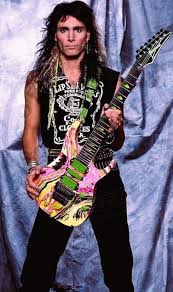
Steve Vai — £1,000 · Pro-Level Tone
Steve Vai's powerful and driving tone took shape during a defining era for electric guitar and remains one of the most sought-after sounds on guitar. Steve Vai is the most technically ambitious guitarist alive — composing, arranging and executing music that pushes the limits of the instrument in every dimension. His Ibanez JEM, with its monkey grip cutaway and floral inlays, is instantly recognisable, as is his ability to make extreme technique sound lyrical and emotional. At the £1,000 · Pro-Level mark — a serious investment that brings you within touching distance of the real thing — the build centres on a Jackson JS22 DKA Dinky running through a Boss Katana 100 MkII, with Wilson Effects MkII Wah and MXR Carbon Copy Analog Delay completing the signal chain, totalling ~£996.
Build Steve Vai's £1,000 · Pro-Level Rig
4 pieces · Total ~£996
What guitar does Steve Vai use?
Steve Vai is primarily associated with superstrat style guitars. At a £1,000 budget, Jackson JS22 DKA Dinky delivers the essential tonal character.
What to Buy
£1,000 · Pro-Level — Complete Gear List
Why This Rig Works
How Steve Vai's gear choices create the signature tone
Jackson JS22 DKA Dinky
The Jackson JS22 DKA Dinky provides the tonal foundation for the entire rig — its character shapes everything that follows.
- WahWilson Effects MkII Wah
- DelayMXR Carbon Copy Analog Delay
Boss Katana 100 MkII
The extra headroom lets you push the clean channel harder before it breaks up, essential for loud-amp technique. More speaker excursion gives a fuller, more three-dimensional clean.
The Combined Tone
Ibanez JEM (DiMarzio Evolution pickups, floating Edge tremolo) into a Carvin Legacy VL100 or Marshall. Very high gain, smooth and compressed on leads with enormous sustain. DigiTech Whammy and Roland VG-8 for pitch effects; the floating trem is used for dramatic whammy bar work and subtle vibrato simultaneously.
Tone Tips
Getting the Sound Right
- Legato technique is the foundation — hammer-ons and pull-offs must be even and musical
- Floating tremolo setup: balanced spring tension allows raises and dips with equal control
- Whammy bar dive bombs followed by immediate harmonic pinches are a signature move
- High-gain amp with pick attack very light — let the gain do the sustain work
- Time feel is everything — Vai's extreme runs land perfectly on the beat
- Lydian mode and chromatic passing tones give his phrasing a sophisticated, jazz-like quality
- Study "For The Love of God" for the definitive sustained, emotional Vai approach
- Artificial harmonics and tapped harmonics add the "whistling" high-register tones
Avoid These Pitfalls
Common Mistakes When Chasing This Tone
- Running the Marshall DSL's gain channel at maximum — above 8 on most high-gain channels, palm mutes lose note separation and become an indistinct wall. The target is the minimum gain for the target saturation, not maximum
- Scooping mids on the Marshall DSL with humbuckers — the mid-forward character of British amps with humbuckers is the central sound of classic rock. A mid scoop removes the fundamental voice of the combination
- Forgetting to adjust technique for the different neck profile — thinner, faster necks require less grip pressure. Playing with the same pressure as on a thicker neck causes note choke.
- Not using a noise gate — self-noise at metal gain levels is continuous between notes. A gate is not stylistic; it is required for professional-sounding silence between riffs.
- Maximum gain on the amp channel — this is the most common mistake in high-gain playing. The clarity and note separation that makes fast playing readable degrades at maximum gain.
- Leaving the wah in a fixed position (cocked) between uses — a cocked wah acts as a midrange filter and changes the tone. If not using the wah expressively, take it out of the chain.
- Too many repeats at high mix — more than 3 repeats makes the delay effect accumulate and overwhelm the dry guitar signal. Keep it to 2-3 repeats at a subtle mix level.
- Setting gain to maximum — above 8 on most amp channels, note separation degrades and riffs lose definition. The loudness feels greater but the clarity goes down.
Budget Alternatives
Same Tone, Different Budget
FAQ
Steve Vai Tone — Common Questions
Steve Vai is primarily associated with superstrat style guitars. At a £1,000 budget, Jackson JS22 DKA Dinky delivers the essential tonal character.
Steve Vai's amp is high gain voiced — high-gain with significant distortion from the amp itself. At the £1,000 level, Boss Katana 100 MkII is the closest match.
The £1,000 tier adds noticeably better build quality and tonal nuance over the £500 rig. This build totals £996 with Jackson JS22 DKA Dinky, Boss Katana 100 MkII, 2 effects. This is the tier where the tone becomes genuinely convincing for gigging and recording.
Steve Vai's essential pedals include Wah, Delay, Modulation. At the £1,000 tier: Wilson Effects MkII Wah, MXR Carbon Copy Analog Delay. Wah is the most important pedal — the others add nuance.
Steve Vai's tone is defined by precise, expressive, saturated. The combination of superstrat guitar and high gain amp creates a sound that is immediately recognisable.
Steve Vai's gain approach is high-gain — dedicated high-gain amp channels or heavy drive pedals with significant distortion. At £1,000, this is replicated through Boss Katana 100 MkII paired with Wilson Effects MkII Wah.
Steve Vai — £1,000 · Pro-Level Complete Rig
~£996Guitar
Jackson JS22 DKA Dinky
Wah
Wilson Effects MkII Wah
Amp
Boss Katana 100 MkII
Delay
MXR Carbon Copy Analog Delay
Tone Match
Closest Real-World Tone Match
If you like Steve Vai's tone, these players use a similar approach — same gear philosophy, comparable sound characteristics.
Related Tones