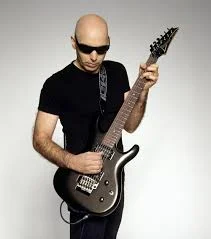
Joe Satriani — £1,000 · Pro-Level Tone
Joe Satriani's powerful and driving tone took shape during the decade of guitar virtuosity and arena rock and remains one of the most sought-after sounds on guitar. Joe Satriani defined the vocabulary of modern instrumental rock guitar — legato, harmonics, whammy bar and a Lydian modal sensibility that made technically demanding music emotionally accessible. His Ibanez JS signature guitar and DigiTech Whammy pedal are tools for a compositional approach that treats the guitar like an orchestra. At the £1,000 · Pro-Level mark — a serious investment that brings you within touching distance of the real thing — the build centres on a Jackson JS22 DKA Dinky running through a Boss Katana 100 MkII, with Wilson Effects MkII Wah and Boss SD-1 Super Overdrive completing the signal chain, totalling ~£975.
Build Joe Satriani's £1,000 · Pro-Level Rig
5 pieces · Total ~$1,238
What guitar does Joe Satriani use?
Joe Satriani is primarily associated with superstrat style guitars. At a £1,000 budget, Jackson JS22 DKA Dinky delivers the essential tonal character.
What to Buy
£1,000 · Pro-Level — Complete Gear List
Can't find one? See alternatives:
Why This Rig Works
How Joe Satriani's gear choices create the signature tone
Jackson JS22 DKA Dinky
The Jackson JS22 DKA Dinky provides the tonal foundation for the entire rig — its character shapes everything that follows.
- WahWilson Effects MkII Wah
- OverdriveBoss SD-1 Super Overdrive
- DelayBoss DD-3T Digital Delay
Boss Katana 100 MkII
The extra headroom lets you push the clean channel harder before it breaks up, essential for loud-amp technique. More speaker excursion gives a fuller, more three-dimensional clean.
The Combined Tone
Ibanez JS (single humbucker, floating trem) into a Marshall JVM or Mesa Boogie Mark IV. High gain but very controlled — Satriani's tone is smooth and singing rather than chaotic. The DigiTech Whammy adds octave effects and divebombs; controlled legato technique produces the fluid, effortless phrasing.
Tone Tips
Getting the Sound Right
- On the Boss Katana 100 MkII: use the Brown channel — the closest model to a Marshall-voiced preamp at this price. Set character to 8, gain to 5. For Joe Satriani's lead volume jump, use the Boost mode rather than adding a separate boost pedal.
- Legato technique: hammer-ons and pull-offs with consistent velocity — every note equally loud
- DigiTech Whammy set to 1 octave up for dive bombs and pitch-shifted leads
- Whammy bar for subtle vibrato between notes (bar never sits still)
- Natural harmonics (12th, 7th, 5th frets) feature heavily — tap lightly for bell-like tones
- Artificial harmonics: pick near the nut while lightly touching at the 12th fret above the fretted note
- Delay: 300–400ms at low feedback — adds depth without cluttering melodic lines
Avoid These Pitfalls
Common Mistakes When Chasing This Tone
- Running the Marshall DSL's gain channel at maximum — above 8 on most high-gain channels, palm mutes lose note separation and become an indistinct wall. The target is the minimum gain for the target saturation, not maximum
- Leaving the wah pedal engaged but stationary between rocking it — a cocked wah (fixed position, not moving) acts as a midrange filter that changes the core tone. Either rock it expressively or bypass it completely; a cocked wah changes the sound in ways that are often unintended
- Maximum gain on the amp channel — this is the most common mistake in high-gain playing. The clarity and note separation that makes fast playing readable degrades at maximum gain.
- Leaving the wah in a fixed position (cocked) between uses — a cocked wah acts as a midrange filter and changes the tone. If not using the wah expressively, take it out of the chain.
- Too many repeats at high mix — more than 3 repeats makes the delay effect accumulate and overwhelm the dry guitar signal. Keep it to 2-3 repeats at a subtle mix level.
Budget Alternatives
Same Tone, Different Budget
FAQ
Joe Satriani Tone — Common Questions
Joe Satriani is primarily associated with superstrat style guitars. At a £1,000 budget, Jackson JS22 DKA Dinky delivers the essential tonal character.
Joe Satriani's amp is british crunch voiced — high-gain with significant distortion from the amp itself. At the £1,000 level, Boss Katana 100 MkII is the closest match.
The £1,000 tier adds noticeably better build quality and tonal nuance over the £500 rig. This build totals £975 with Jackson JS22 DKA Dinky, Boss Katana 100 MkII, 3 effects. This is the tier where the tone becomes genuinely convincing for gigging and recording.
Joe Satriani's essential pedals include Wah, Delay, Reverb. At the £1,000 tier: Wilson Effects MkII Wah, Boss SD-1 Super Overdrive, Boss DD-3T Digital Delay. Wah is the most important pedal — the others add nuance.
Joe Satriani's tone is defined by smooth, legato, singing. The combination of superstrat guitar and british crunch amp creates a sound that is immediately recognisable.
Joe Satriani's gain approach is high-gain — dedicated high-gain amp channels or heavy drive pedals with significant distortion. At £1,000, this is replicated through Boss Katana 100 MkII paired with Wilson Effects MkII Wah.
Joe Satriani — £1,000 · Pro-Level Complete Rig
~£975Guitar
Jackson JS22 DKA Dinky
Wah
Wilson Effects MkII Wah
Overdrive
Boss SD-1 Super Overdrive
Amp
Boss Katana 100 MkII
Delay
Boss DD-3T Digital Delay
Tone Match
Closest Real-World Tone Match
If you like Joe Satriani's tone, these players use a similar approach — same gear philosophy, comparable sound characteristics.
Related Tones