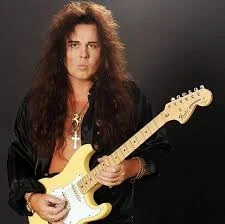
Yngwie Malmsteen — £500 · Sweet Spot Tone
Yngwie Malmsteen's crushing and technically demanding tone took shape during the decade of guitar virtuosity and arena rock and remains one of the most sought-after sounds on guitar. Yngwie Malmsteen brought Bach and Paganini to the electric guitar, creating neoclassical shred. His combination of extreme speed, scalloped-neck vibrato and harmonic minor vocabulary rewrote what was considered possible on the instrument. At the £500 · Sweet Spot mark — the sweet spot — enough to get genuinely close to the sound without breaking the bank — the build centres on a Squier Classic Vibe 60s Stratocaster running through a Boss Katana 50 MkII, with Boss SD-1 Super Overdrive (as boost) completing the signal chain, totalling ~£493.
Build Yngwie Malmsteen's £500 · Sweet Spot Rig
3 pieces · Total ~$626
What guitar does Yngwie Malmsteen use?
Yngwie Malmsteen is primarily associated with strat style guitars. At a £500 budget, Squier Classic Vibe 60s Stratocaster delivers the essential tonal character.
What to Buy
£500 · Sweet Spot — Complete Gear List
Can't find one? See alternatives:
Why This Rig Works
How Yngwie Malmsteen's gear choices create the signature tone
Squier Classic Vibe 60s Stratocaster
The alnico V pickups are the real deal — they deliver genuine Strat chime, quack and warmth that responds naturally to pick attack. An ideal foundation for Hendrix, Mayer, Gilmour or SRV tones.
Boss SD-1 Super Overdrive (as boost)
Boss SD-1 Super Overdrive (as boost) — overdrive coloring added to the signal.
Boss Katana 50 MkII
Its 'Brown' amp character at low gain is an excellent approximation of the Fender-style clarity that Hendrix, Mayer, Gilmour and SRV all relied on. Built-in effects mean you're a few knob turns away from the right tone.
The Combined Tone
Bright Stratocaster (scalloped neck, DiMarzio YJM pickups) into a Marshall boosted by a DOD 250 at minimum gain and maximum volume. The tone is trebly and violin-like — all clarity, no warmth. Everything lives in the upper register.
Tone Tips
Getting the Sound Right
- On the Boss Katana 50 MkII: use the Brown channel — the closest model to a Marshall-voiced preamp at this price. Set character to 8, gain to 5. For Yngwie Malmsteen's lead volume jump, use the Boost mode rather than adding a separate boost pedal.
- Use harmonic minor scale (raised 7th) for the classical Yngwie sound — it creates the Vivaldi/Bach character rather than standard pentatonic blues
- Keep tone control at full and treble on the amp high — his tone is sharp and bright, never warm
- The DOD 250 runs at minimum gain, maximum level — it's a clean push into the amp, not a distortion pedal
- Alternate pick every single note — Yngwie uses no legato. Every note is struck with the pick
- Scalloped fretboard vibrato cannot be perfectly replicated on a standard neck. Compensate with wrist-driven wide vibrato and very light fretting pressure
Avoid These Pitfalls
Common Mistakes When Chasing This Tone
- Using a humbucker guitar as a substitute — the quack, string noise, and bright attack of single coils are irreplaceable. No amount of EQ on a humbucker produces the same result.
- Scooping the mids on a Marshall-style amp — the upper midrange emphasis is what makes British amps cut through. Mid-scoop EQ sounds good alone but disappears in a band mix.
- Using too much gain on the drive pedal — pedal-driven tone works best with the amp providing some character and the pedal adding focus and saturation, not replacing the amp entirely.
- Setting gain too high on the overdrive pedal — most overdrive pedals are most useful at gain settings of 2-5, where they add character without dominating the tone. High gain settings on an OD pedal become a distortion, not an overdrive.
- Too many repeats at high mix — more than 3 repeats makes the delay effect accumulate and overwhelm the dry guitar signal. Keep it to 2-3 repeats at a subtle mix level.
Budget Alternatives
Same Tone, Different Budget
FAQ
Yngwie Malmsteen Tone — Common Questions
Yngwie Malmsteen is primarily associated with strat style guitars. At a £500 budget, Squier Classic Vibe 60s Stratocaster delivers the essential tonal character.
Yngwie Malmsteen's amp is british crunch voiced — clean to moderate gain. At the £500 level, Boss Katana 50 MkII is the closest match.
Yes — £500 covers a real guitar and amp in the right tonal family. This rig totals £493 and captures the essential character. The guitar and amp account for 80% of the tone; pedals are secondary at this budget.
Yngwie Malmsteen's essential pedals include Overdrive, Delay. At the £500 tier: Boss SD-1 Super Overdrive (as boost). Overdrive is the most important pedal — the others add nuance.
Yngwie Malmsteen's tone is defined by neoclassical, scalloped-neck, fast. The combination of strat guitar and british crunch amp creates a sound that is immediately recognisable.
Yngwie Malmsteen's gain approach is pedal-driven — distortion pedals into a relatively clean amp. The pedal defines the distortion character. At £500, this is replicated through Boss Katana 50 MkII paired with Boss SD-1 Super Overdrive (as boost).
Yngwie Malmsteen — £500 · Sweet Spot Complete Rig
~£493Guitar
Squier Classic Vibe 60s Stratocaster
Overdrive
Boss SD-1 Super Overdrive (as boost)
Amp
Boss Katana 50 MkII
Tone Match
Closest Real-World Tone Match
If you like Yngwie Malmsteen's tone, these players use a similar approach — same gear philosophy, comparable sound characteristics.
Related Tones