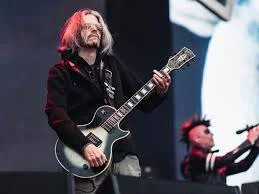
Adam Jones
Adam Jones is the guitarist and primary visual architect of Tool, the Los Angeles progressive metal band whose four studio albums — released at decade-long intervals — have sold over 13 million copies despite almost zero radio airplay. His playing is defined not by speed or flashy technique but by an extraordinary sense of texture, rhythm, and space — riffs that function as hypnotic loops beneath Maynard James Keenan's vocals. Jones is also a professional sculptor and stop-motion animator whose work defines Tool's visual identity.
Gibson Les Paul Custom tuned to Drop D (or C#) into a Mesa Boogie Dual Rectifier — massive, sustained crunch with wide stereo spread and a characteristic mid-forward darkness. Jones plays almost no lead solos; every note is in service of the riff as a total sonic experience. The Diezel Herbert adds surgical precision to the heaviness in later rigs.
Signal Chain Order
Why Adam Jones's Rig Works
Jones's riffs function as hypnotic, repeated loops rather than showcase leads, and the Rectifier's Vintage rectifier mode (rather than the tighter Modern mode) is chosen specifically to support that repetition — the slight power-amp sag it introduces means the riff breathes very subtly with each repetition rather than sounding perfectly identical and mechanical each time, which matters over the extended, meditative riff cycles Tool's songwriting depends on.
Adding the Diezel Herbert in parallel with the Mesa from Lateralus onward addresses a real problem that emerges specifically at Tool's level of gain and complexity: at extreme distortion, individual notes within a chord or fast passage can lose definition against each other. The Diezel's more surgical, clearly defined high-gain voicing running alongside the Mesa's darker, more sustained character lets Jones layer two distinct textures — one for weight and sustain, one for note clarity — rather than relying on a single amp to do both jobs at once.
The Boss NS-2 noise suppressor is functionally load-bearing here, not incidental — Tool's arrangements depend heavily on dynamic contrast, with passages of near-total silence giving way to sudden, massive riffs. At the gain levels this rig runs, uncontrolled noise during the quiet sections would undermine the dramatic silence-to-weight structure that's central to how the band builds tension, which is why the gate is treated as essential infrastructure rather than an optional cleanup tool.
Guitars
Gibson Les Paul Custom
1993–presentPrimary recording and live guitar. Drop D tuning for Undertow, Drop C# for later albums. Modified with a Floyd Rose on some instruments. Duncan Custom pickups on many versions.
Full specs & buy →Manson Guitars Custom
2001–presentBespoke instruments built in Devon UK, used increasingly on Lateralus and later material.
Chandler Custom
1993–1997Used on Undertow-era live performances. Modified to Adam's specs.
Amplifiers
Mesa Boogie Dual Rectifier
1993–presentPrimary amp throughout entire career. Vintage/Modern channel. The foundation of the Tool guitar sound — huge, sustained, and very dark.
Amp guide →Diezel Herbert
2001–presentAdded from Lateralus onwards for additional clarity and surgical EQ definition at extreme gain levels. Run in parallel with the Mesa.
Amp guide →Marshall JCM800
1993–1996Early live use alongside the Mesa on Undertow tour.
Effects Pedals
Dunlop Cry Baby Wah
Used selectively for texture — not aggressive wah sweeps but parked positions and slow movement for tonal colour.
Pedal guide →Diezel VH4 Pedal
2006–presentUsed as preamp boost into the Mesa on Fear Inoculum material.
Digitech Whammy
Pitch shifting used for specific tonal passages — drop tuning simulation and octave effects.
Boss NS-2 Noise Suppressor
Required for the extreme gain levels — keeps the signal silent between riff passages.
Pedal guide →MXR Flanger
Subtle flanger used on specific songs for movement in the sustained riff texture.
Key Albums & Tone
"Sober" and "Prison Sex" — Drop D Les Paul into Mesa Rectifier. The most raw and direct Tool tone.
"Stinkfist" and "Forty Six & 2" — Les Paul crunch at its most refined. The Jones tone fully formed.
"Schism" and "Lateralus" — Diezel added for greater clarity, still Mesa-driven. The most complex riff writing.
23 years of refinement — massive, crushing and impossibly clean simultaneously. "Pneuma" opens with the tone at peak.
Frequently Asked Questions
What guitar does Adam Jones use?
Gibson Les Paul Custom and Manson Guitars Custom. Primary recording and live guitar. Drop D tuning for Undertow, Drop C# for later albums. Modified with a Floyd Rose on some instruments. Duncan Custom pickups on many versions.
What amp does Adam Jones use?
Mesa Boogie Dual Rectifier and Diezel Herbert. Primary amp throughout entire career. Vintage/Modern channel. The foundation of the Tool guitar sound — huge, sustained, and very dark.
What pedals does Adam Jones use?
Adam Jones uses Dunlop Cry Baby Wah, Diezel VH4 Pedal, Digitech Whammy and more.
What is Adam Jones's signature sound?
Gibson Les Paul Custom tuned to Drop D (or C#) into a Mesa Boogie Dual Rectifier — massive, sustained crunch with wide stereo spread and a characteristic mid-forward darkness. Jones plays almost no lead solos; every note is in service of the riff as a total sonic experience. The Diezel Herbert adds surgical precision to the heaviness in later rigs.
About This Data
Gear information for Adam Jones is compiled from live performance footage, rig-rundown interviews, manufacturer and signature-model documentation, and cross-referenced guitar press coverage — not a single source. Where accounts conflict (a common issue with decades-old gear history), we favour the version corroborated by the most independent sources and note genuine ambiguity in the text rather than presenting a guess as settled fact.
This page is maintained by Alex Hall, last reviewed July 2026. Spotted something out of date or inaccurate? Let us know — corrections are usually made within a few days.