Rig Builder
Budget Rig Breakdown
Signal Chain
Essentials
Complete Your Rig
The accessories every serious guitarist needs — cables, strings, and the rest.
Ernie Ball Power Slinky Strings (11-48)
Heavier gauge for drop tunings and tighter pick attack — standard for modern metal.
ISP Decimator II Noise Gate
Essential for high-gain amps and extended-range guitars. No noise gate — no clean metal tone.
Planet Waves American Stage Guitar Cable 10ft
Solderless ends and lifetime warranty. The cable most session guitarists trust.
Boss TU-3 Chromatic Tuner Pedal
The professional standard for live tuning. True bypass, powers other pedals, ultra-accurate.
Levy's M8 Guitar Strap
Quality leather strap used by touring guitarists. Genuine comfort for 3-hour sets.
Technique
Key Tone Tips
- Tune to Eb or D standard — Tool songs exist in a lower register that creates the "baritone without a baritone" quality
- Play behind the beat intentionally — Tool's rhythmic feel is heavy because the notes come slightly after the expected beat, not on it
- The Phase 90 runs very slow and at low mix — it's not obvious but adds movement to sustained notes
- Odd time signatures (7/8, 11/8, 5/4) require counting rather than feeling — practise subdivisions with a metronome at very slow tempos
- The Diezel VH4 is mid-heavy, not scooped — if the amp sounds too bright or too bassy, it's the wrong direction. Mid-forward is the target
- Les Paul bridge pickup for all rhythm work — the humbucker character and sustain are essential. A Stratocaster cannot produce this tone
- Feedback is used structurally — hold sustained notes against the amp and let them feed back naturally rather than cutting them short
- Use a heavier pick (1.0mm or above) and angle it 45 degrees for the distinctive pick attack that leads into each note
- The guitar riffs lock to the bass more than the drums — study how Jones and Justin Chancellor interlock, the guitar is not always on the downbeat
Background
About Adam Jones's Sound
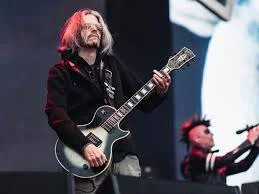
Adam Jones of Tool creates guitar parts that function more like orchestral sections than standard rock guitar — odd time signatures, detuned riffs that breathe like drones, and a vocabulary entirely his own built on texture and space.
Tone History
Adam Jones's Tone Evolution
Adam Jones built one of rock's most distinctive rhythm guitar sounds — a saturated, mid-scooped, drop-D tone using Les Pauls through Mesa/Boogie amps that provided the foundation for Tool's progressive metal. His approach prioritises texture and riff over lead flash.
Full timeline: 3 eras →Song Breakdowns
Adam Jones Song Rigs
Schism
Lateralus · 2001
Mathematical, patient, and thick — Schism opens in 5/4 time with a clean-to…
Sober
Undertow · 1993
Tool's first major statement — a heavy, midrange-forward riff with a clean …
Forty Six & 2
Ænima · 1996
One of the most satisfying heavy riffs ever written — a mid-tempo groove in…