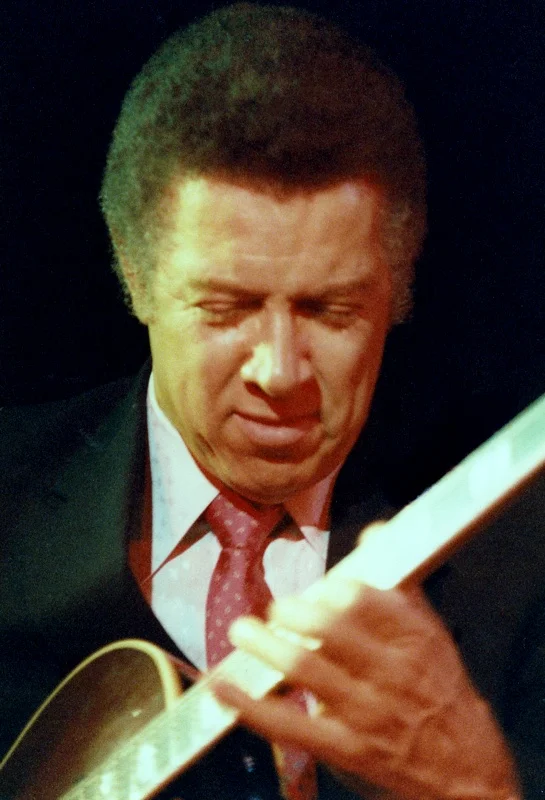
Kenny Burrell
Kenny Burrell is the most consistent and prolific jazz guitarist associated with the Blue Note Records catalog — recording over 70 albums as a leader or co-leader across seven decades. His clean, warm archtop tone and melodically elegant bebop vocabulary made him the most-hired guitarist in New York session work through the 1950s and 1960s, with sessions for John Coltrane, Jimmy Smith, and Billie Holiday alongside his extensive Blue Note catalog. Midnight Blue (1963) is one of the great documents of jazz guitar, combining blues-rooted melody with bebop sophistication in a way that feels effortless.
Warm, clean archtop jazz guitar — the Gibson ES-175 through clean amplification produces the round, sustaining tone of classic jazz guitar. Burrell never plays with significant distortion; the tone comes from the guitar and its acoustic projection rather than amp saturation. His phrasing is cool and deliberate — no rush, no excess notes, every phrase completing its melodic idea.
Signal Chain Order
Why Kenny Burrell's Rig Works
Burrell's decades-long consistency with a single instrument and completely clean amplification reflects the demands of being New York's most-hired session guitarist across the 1950s and 1960s — session work for artists as varied as John Coltrane, Jimmy Smith, and Billie Holiday required a dependable, unobtrusive tone that could sit correctly in radically different musical contexts without needing reconfiguration, and a clean, well-recorded archtop tone is about as universally compatible as electric guitar tone gets.
The ES-175's floating pickup design and warm PAF humbucker produce a rounder, less aggressive tone than a fixed-mount pickup archtop — that roundness suits Burrell's cool, deliberate phrasing philosophy, where every phrase completes its melodic idea without rushing, and a brighter or more cutting tone would work against the unhurried, composed quality that's central to his musical identity.
The blues-rooted melodic vocabulary that runs through Midnight Blue and much of his catalog, layered on top of sophisticated bebop harmony, depends on a warm, clean tone to read as genuinely blues-inflected rather than merely jazz-adjacent — a distorted or more processed tone would push his blues phrases toward blues-rock territory, diluting the specific cool-jazz-meets-blues synthesis that made Midnight Blue such an influential record.
Guitars
Gibson ES-175
1955–presentThe ES-175 is Burrell's definitive guitar — he has played it throughout his seven-decade career. The single-cutaway archtop's warm PAF humbucker and floating pickup design produces the classic New York jazz guitar tone of the Blue Note catalog.
Amplifiers
Polytone Minibrute
1975–presentThe Polytone for later career work — warm, clean solid-state for intimate jazz guitar performance.
Effects Pedals
Key Albums & Tone
Chitlins con Carne, Soul Lament, Mule — the definitive Burrell album. ES-175 through clean amplification in a blues-jazz small group. The guitar tone is warm and round; the blues phrases sit naturally within the bebop harmonic context.
Orchestral collaboration with Gil Evans arrangements — Burrell's guitar as a solo voice alongside full orchestration. The range from intimate duo to full orchestra demonstrates the ES-175's versatility.
Frequently Asked Questions
What guitar does Kenny Burrell use?
Gibson ES-175. The ES-175 is Burrell's definitive guitar — he has played it throughout his seven-decade career. The single-cutaway archtop's warm PAF humbucker and floating pickup design produces the classic New York jazz guitar tone of the Blue Note catalog.
What amp does Kenny Burrell use?
Polytone Minibrute. The Polytone for later career work — warm, clean solid-state for intimate jazz guitar performance.
What pedals does Kenny Burrell use?
Kenny Burrell does not use effects pedals.
What is Kenny Burrell's signature sound?
Warm, clean archtop jazz guitar — the Gibson ES-175 through clean amplification produces the round, sustaining tone of classic jazz guitar. Burrell never plays with significant distortion; the tone comes from the guitar and its acoustic projection rather than amp saturation. His phrasing is cool and deliberate — no rush, no excess notes, every phrase completing its melodic idea.
About This Data
Gear information for Kenny Burrell is compiled from live performance footage, rig-rundown interviews, manufacturer and signature-model documentation, and cross-referenced guitar press coverage — not a single source. Where accounts conflict (a common issue with decades-old gear history), we favour the version corroborated by the most independent sources and note genuine ambiguity in the text rather than presenting a guess as settled fact.
This page is maintained by Alex Hall, last reviewed July 2026. Spotted something out of date or inaccurate? Let us know — corrections are usually made within a few days.