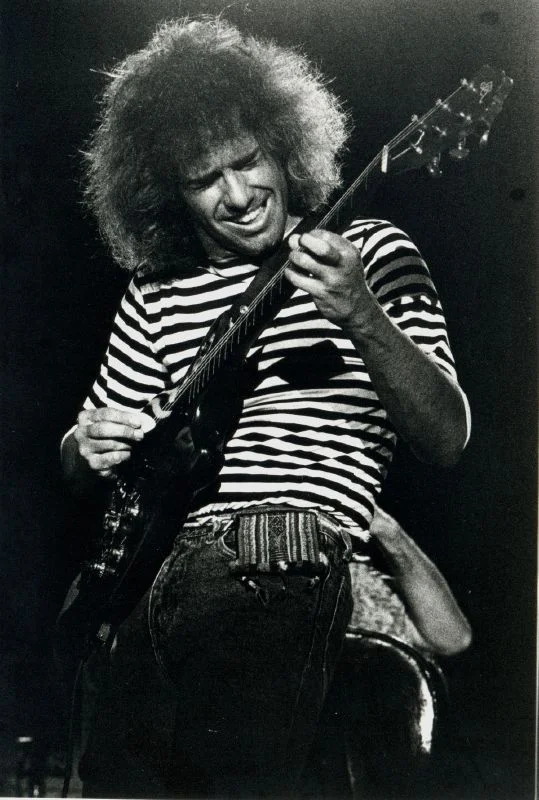
Pat Metheny
Pat Metheny is the most commercially successful jazz guitarist of the last 50 years and one of the most prolific and stylistically adventurous. The Pat Metheny Group, formed in 1977, pioneered a synthesis of jazz harmony with Brazilian music, folk, and ambient soundscapes that reached mainstream audiences without compromising musical sophistication. His tone is immediately recognisable: a warm, singing lead quality through a custom Gibson hollow-body, heavy chorus treatment, and the distinctive pitch-bending of the guitar synthesizer (the Roland GR series) that he pioneered in live jazz performance. His compositional range spans acoustic standards, electric fusion, orchestral work, and solo album recordings on all three approaches.
Luminous, chorus-heavy hollow-body guitar tone — the Gibson ES-175 or custom Metheny model through a Synclavier or conventional clean amp with heavy chorus creates the signature warm, three-dimensional sound. The pitch is always impeccably accurate; the tone always warm and singing rather than bright or aggressive. Guitar synthesizer (Roland GR-300) expands the tonal palette into orchestral territory within live performance.
Signal Chain Order
Why Pat Metheny's Rig Works
Stacking the JC-120's internal chorus with an external Boss CE-1, rather than relying on either alone, produces a deeper, more three-dimensional shimmer than a single chorus stage could achieve — this layered-chorus approach is what gives Metheny's tone its distinctive luminous, almost glowing quality that's immediately recognizable even in a dense, orchestrated Pat Metheny Group arrangement.
The Roland GK pickup and GR-300 guitar synthesizer let Metheny trigger orchestral textures (strings, pads, brass) in real time directly from his guitar playing — this is a fundamentally different signal path from a conventional effect, since the synth is generating genuinely new sonic content based on pitch and playing dynamics rather than processing the guitar's own tone, which is what allows a single guitarist to expand into orchestral territory live without pre-recorded backing tracks.
The JC-120's true stereo output, rather than a mono amp with an added stereo effect, is essential infrastructure for combining the guitar's warm chorus-treated tone with the synth's own textures — routing both through a genuine stereo signal path lets the orchestral synth layers and the acoustic-toned guitar occupy a wide, spacious stereo image together rather than competing for the same narrow mono space.
Guitars
Gibson ES-175 (custom, with GK pickup)
1974–1990Metheny's primary guitar through his early career — an ES-175 modified with a Roland GK interface pickup for guitar synthesizer triggering. The ES-175's warm, projecting archtop tone is the acoustic foundation of his sound; the GK pickup allows him to simultaneously trigger the Roland GR synth for orchestral layers.
Ibanez PM100 Pat Metheny Signature
1995–presentSignature hollow-body built to Metheny's precise specifications — the PM100's warm, full-spectrum archtop tone with custom electronics. A refined version of the ES-175 concept with specific neck profile and pickup voicing.
Martin acoustic guitars
1975–presentVarious Martin acoustics for the Pat Metheny Group's acoustic passages and his solo acoustic recordings — the Martin dreadnought body provides full projection for ensemble acoustic performance.
Amplifiers
Roland JC-120 Jazz Chorus
1977–presentThe Roland JC-120 is central to the Pat Metheny Group sound — its pristinely clean solid-state amplification and built-in stereo chorus provide the spatial, shimmering quality of his clean tone. The stereo output of the JC-120 allows true stereo guitar synthesis routing.
Amp guide →Roland GR-300 Guitar Synthesizer
1979–1986The guitar synthesizer — triggered from the GK pickup on his ES-175. The GR-300's analog synthesis produces orchestral tones (strings, brass, pads) controlled in real-time by guitar performance. Metheny was the most prominent early proponent of guitar synthesis in a jazz context.
Effects Pedals
Boss CE-1 Chorus
1978–1990Additional external chorus layered with the JC-120's internal chorus — the combination of the amp's stereo chorus and the CE-1's warm bucket-brigade circuit creates the characteristic Metheny Group width and shimmer on every note.
Lexicon PCM-70 Reverb
1985–presentStudio-grade digital reverb for adding spatial depth to the guitar and guitar synthesizer signals — Metheny uses the PCM-70 for specific reverb characters on studio recordings.
Key Albums & Tone
Debut album — recorded at 21 years old. The ES-175 through clean amplification in a pure jazz trio context. No synth, no chorus — the acoustic quality of his archtop playing is immediately distinguishable from every contemporary jazz guitarist.
Last Train Home, In Her Family — the Pat Metheny Group's most commercially successful album. ES-175 with GR-300 synthesis, JC-120 chorus, layered in a Brazilian-influenced production. The guitar-synth combination creates the characteristic orchestral warmth.
Entirely solo acoustic guitar — Metheny alone with a baritone acoustic guitar. The most direct demonstration of his melodic and harmonic vocabulary without amplification, synth, or effects.
Frequently Asked Questions
What guitar does Pat Metheny use?
Gibson ES-175 (custom, with GK pickup) and Ibanez PM100 Pat Metheny Signature. Metheny's primary guitar through his early career — an ES-175 modified with a Roland GK interface pickup for guitar synthesizer triggering. The ES-175's warm, projecting archtop tone is the acoustic foundation of his sound; the GK pickup allows him to simultaneously trigger the Roland GR synth for orchestral layers.
What amp does Pat Metheny use?
Roland JC-120 Jazz Chorus and Roland GR-300 Guitar Synthesizer. The Roland JC-120 is central to the Pat Metheny Group sound — its pristinely clean solid-state amplification and built-in stereo chorus provide the spatial, shimmering quality of his clean tone. The stereo output of the JC-120 allows true stereo guitar synthesis routing.
What pedals does Pat Metheny use?
Pat Metheny uses Boss CE-1 Chorus, Lexicon PCM-70 Reverb.
What is Pat Metheny's signature sound?
Luminous, chorus-heavy hollow-body guitar tone — the Gibson ES-175 or custom Metheny model through a Synclavier or conventional clean amp with heavy chorus creates the signature warm, three-dimensional sound. The pitch is always impeccably accurate; the tone always warm and singing rather than bright or aggressive. Guitar synthesizer (Roland GR-300) expands the tonal palette into orchestral territory within live performance.
About This Data
Gear information for Pat Metheny is compiled from live performance footage, rig-rundown interviews, manufacturer and signature-model documentation, and cross-referenced guitar press coverage — not a single source. Where accounts conflict (a common issue with decades-old gear history), we favour the version corroborated by the most independent sources and note genuine ambiguity in the text rather than presenting a guess as settled fact.
This page is maintained by Alex Hall, last reviewed July 2026. Spotted something out of date or inaccurate? Let us know — corrections are usually made within a few days.