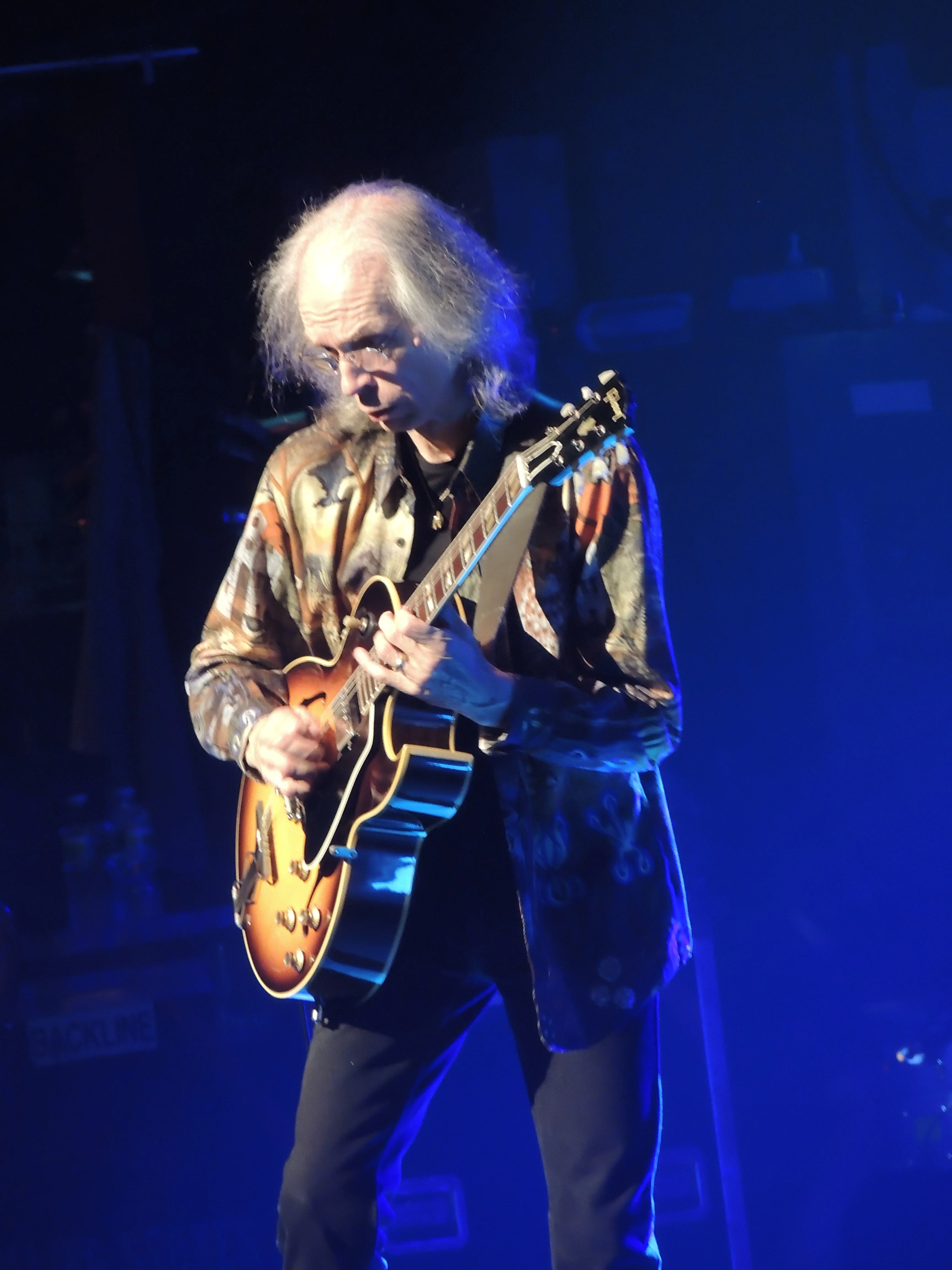
Steve Howe
Steve Howe joined Yes in 1970 and became the defining progressive rock guitarist: technically accomplished, stylistically omnivorous, and fundamentally oriented toward ensemble playing rather than solo showmanship. His guitar work encompasses jazz archtop, country chicken-picking, classical fingerpicking, and full-band rock electric — often within a single Yes track. His 1971 showcase 'Clap' (an acoustic fingerpicked piece recorded live at the Royal Festival Hall) demonstrated that rock concert audiences would listen to solo acoustic guitar performance with the attention normally reserved for classical recitals. The Gibson ES-175 is his most associated instrument, and his clean, jazz-inflected archtop tone through a small Marshall combo defines a significant thread of progressive rock guitar.
Eclectic, clean-to-moderately-driven guitar spanning jazz archtop, country telecaster, and classical acoustic — Howe is fundamentally a clean player who uses overdrive as a specific colour rather than a default setting. The ES-175 through a Marshall produces a bright, articulate jazz tone with surprisingly cutting projection for an archtop. Stylistic range is the defining characteristic: no other rock guitarist of the era commanded jazz, country, and classical vocabularies simultaneously.
Signal Chain Order
Why Steve Howe's Rig Works
Choosing an 18-watt Marshall combo over a full 100-watt stack directly serves the stylistic breadth Howe needs within Yes's compositions — a smaller amp reaches natural breakup and character at far more controllable, moderate volumes than a full stack, which matters when a single song might move from delicate archtop jazz comping to a fuller rock passage; a small amp lets that transition happen through picking dynamics rather than requiring a completely different, louder rig.
The ES-175's laminated construction and dual humbuckers give it more projection and cut than a typical hollow archtop while retaining genuine acoustic-adjacent warmth — that's essential for Howe's jazz-influenced chord voicings to be heard clearly within Yes's dense, multi-instrumental progressive rock arrangements, where a more delicate, purely acoustic-toned archtop might get lost against keyboards, bass, and drums.
Switching instruments entirely — Telecaster for country-inflected chicken-picking, ES-175 for jazz, Les Paul Custom for heavier rock passages — rather than trying to coax all these styles from a single guitar reflects a genuine belief that each vocabulary depends on its instrument's specific physical and tonal character; a Telecaster's bright, snappy bridge pickup is part of what makes country picking sound authentic, not simply a stylistic reference achievable on any guitar with the right technique.
Guitars
Gibson ES-175
1964–presentHowe's most associated guitar and the one he uses most extensively with Yes — the ES-175's single cutaway, laminated spruce top, and dual humbuckers produce a warm, projecting archtop jazz tone. He uses it for the jazz-influenced chord work and melodic passages that give Yes's progressive rock its harmonic sophistication.
Gibson L-4CES
1970–presentAn additional archtop for specific tonal contexts — the L-4 provides a somewhat darker, fuller tone than the ES-175 for specific arrangements.
Gibson Les Paul Custom
1972–1980Used for heavier rock passages where archtop sustain is insufficient — the Les Paul Custom provides the thicker, more sustained electric tone needed for the heavier sections of epics like 'Starship Trooper' and 'Close to the Edge'.
Fender Telecaster
1968–presentUsed for country-inflected passages — the Tele's bridge pickup and bright attack suit the Chet Atkins-influenced fingerpicking that appears in Howe's solo acoustic performances and within Yes material.
Amplifiers
Marshall 1974X 18W Combo
1970–presentHowe's primary Yes amp — a small-wattage Marshall combo that provides a warm, musical breakup at achievable volumes. The 18W EL84-powered combo has a different character from the 100W Plexi: more restrained, cleaner at moderate volumes, and better-suited to the controlled dynamic range of studio recording.
Roland JC-120 Jazz Chorus
1978–1988The solid-state Roland JC-120 for pristine clean tones where the Marshall's natural saturation would colour the sound inappropriately — the JC-120's built-in stereo chorus provides a spatial quality to clean arpeggios.
Amp guide →Effects Pedals
Boss CE-2 Chorus
1980–1990CE-2 for clean chord shimmer on specific passages — adds three-dimensional quality to the ES-175's sustained chords in the dense Yes ensemble context.
Echoplex EP-3
1972–1980Tape delay for atmospheric sustain on lead passages — the Echoplex's warm tape repeat adds a vintage, organic echo character quite different from digital delay.
Key Albums & Tone
"Roundabout", "Heart of the Sunrise", "Long Distance Runaround" — Howe's most famous Yes work. "Roundabout" opens with his acoustic 12-string intro before the full band enters. The ES-175 through the Marshall is throughout: warm, articulate, and serving the compositional complexity rather than leading it.
The title suite — 18 minutes of continuous music. Howe's guitar spans the entire Yes tonal range: archtop jazz, country acoustic, and Les Paul-driven rock, all within the single epic composition.
"Yours Is No Disgrace", "Starship Trooper", "I've Seen All Good People" — the debut with Howe. His eclectic style immediately gives Yes a tonal breadth that no previous rock band had achieved from a single guitarist.
Frequently Asked Questions
What guitar does Steve Howe use?
Gibson ES-175 and Gibson L-4CES. Howe's most associated guitar and the one he uses most extensively with Yes — the ES-175's single cutaway, laminated spruce top, and dual humbuckers produce a warm, projecting archtop jazz tone. He uses it for the jazz-influenced chord work and melodic passages that give Yes's progressive rock its harmonic sophistication.
What amp does Steve Howe use?
Marshall 1974X 18W Combo and Roland JC-120 Jazz Chorus. Howe's primary Yes amp — a small-wattage Marshall combo that provides a warm, musical breakup at achievable volumes. The 18W EL84-powered combo has a different character from the 100W Plexi: more restrained, cleaner at moderate volumes, and better-suited to the controlled dynamic range of studio recording.
What pedals does Steve Howe use?
Steve Howe uses Boss CE-2 Chorus, Echoplex EP-3.
What is Steve Howe's signature sound?
Eclectic, clean-to-moderately-driven guitar spanning jazz archtop, country telecaster, and classical acoustic — Howe is fundamentally a clean player who uses overdrive as a specific colour rather than a default setting. The ES-175 through a Marshall produces a bright, articulate jazz tone with surprisingly cutting projection for an archtop. Stylistic range is the defining characteristic: no other rock guitarist of the era commanded jazz, country, and classical vocabularies simultaneously.
About This Data
Gear information for Steve Howe is compiled from live performance footage, rig-rundown interviews, manufacturer and signature-model documentation, and cross-referenced guitar press coverage — not a single source. Where accounts conflict (a common issue with decades-old gear history), we favour the version corroborated by the most independent sources and note genuine ambiguity in the text rather than presenting a guess as settled fact.
This page is maintained by Alex Hall, last reviewed July 2026. Spotted something out of date or inaccurate? Let us know — corrections are usually made within a few days.