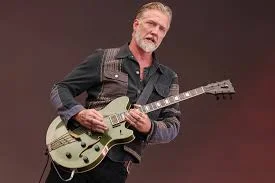
Sound Like Josh Homme
During an era of reinvention, grunge, and raw expression, Josh Homme redefined what powerful and driving electric guitar could sound like — and their influence on rock has never faded. Josh Homme of Queens of the Stone Age creates some of modern rock's most hypnotic, locked-in riffs — baritone-ish tuned-down tones, drone-based single-note riffs, and a commitment to groove that makes QOTSA impossible to stand still to. Whether you're starting out or ready to invest, the rig guides below cover every budget from £200 to £2,500.
Quick Answer
To sound like Josh Homme, start with a Squier Classic Vibe 70s Stratocaster into a Boss Katana 50 MkII, with a Dunlop Fuzz Face Mini as your key effect.
Tone Analysis
Josh Homme's Guitar Tone — In Depth
Tone Philosophy
Josh Homme's approach to guitar tone is built on deliberate understatement of the lowest frequencies. He tunes his guitars a step and a half down (to Eb or lower in some contexts) but uses the standard string tension of higher tunings, creating a specific tension and resonance character. He plays through amplifiers high up in the signal chain, often using Ampeg bass amplifiers for guitar, which adds a specific low-mid character different from conventional guitar amplifiers.
The Signature Sound
The Queens of the Stone Age Songs for the Deaf and Era Vulgaris era tone — No One Knows, Go with the Flow, 3's & 7's — is a Fender Jazzmaster or Mosrite through an Ampeg bass amp and a Marshall, creating a specific combination of low-mid weight and treble clarity. The tone is different from conventional rock guitar precisely because the amplifier choice is unusual.
Key Gear
Fender Jazzmasters and Mosrite guitars are primary. Ampeg Reverb Rocket and SVT bass amplifiers are central to his setup — using bass amplifiers for guitar is the most distinctive element. A Marshall provides treble complement.
Playing Approach
Homme's rhythm playing emphasises groove and space over density. His compositions often leave deliberate gaps in the guitar part that the bass and drums fill. His lead playing is bluesy and economical.
Legacy
QOTSA's influence on 2000s rock and the desert rock genre is complete. Homme's unconventional amplifier choices — using bass amps for guitar — produced a distinctive tonal signature that is identifiable immediately.
Budget Comparison
Pick Your Budget Level
£500 · Sweet Spot
~£517
- GuitarSquier Classic Vibe 70s Stratocaster
- AmpBoss Katana 50 MkII
- FuzzDunlop Fuzz Face Mini
£1,000 · Pro-Level
~£995
- GuitarEpiphone Les Paul Special
- WahDunlop GCB95 Cry Baby Wah
- OverdriveAnalogman Modded TS9
- FuzzDunlop Fuzz Face Mini
- AmpFender Blues Junior IV
£2,500 · Premium
~£2436
- GuitarGibson Les Paul Junior
- OverdriveKing Tone Duellist OD
- FuzzDunlop Fuzz Face Mini
- AmpFender Blues DeVille
Shop Now
Buy the Key Gear — £500 Sweet Spot
Guitar, amp and essential effects for the authentic Josh Homme sound. The guitar and amp together account for 80% of the tone.
Complete the Rig
Essentials Every Guitarist Needs
These aren't exciting — but every rig needs them. Buy once, sorted forever.
Tone Profile
Josh Homme's Sound
Fender Jazzmaster or Telecaster into an Orange or Ampeg amp, often tuned to C or B standard. The tone is thick and warm rather than aggressive — the heaviness comes from the low tuning and the locked-in groove, not from distortion. A fuzz pedal appears on some tracks for additional harmonic saturation.
Modeling Amps
Get Josh Homme's Tone on Your Modeler
Targeting Hiwatt DR103. Use these amp models and IRs as your starting point — dial in from there using the knob settings above.
Master high, preamp low — Hiwatt is a power amp voicing
Low gain, high volume — Hiwatt cleans are extremely loud
Song Match
Which Josh Homme Songs Suit Your Amp
Tone Match
Closest Real-World Tone Match
If you like Josh Homme's tone, these players use a similar approach — same gear philosophy, comparable sound characteristics.
Weekly Tone Tips
One setting, one artist insight, one gear pick. No noise.