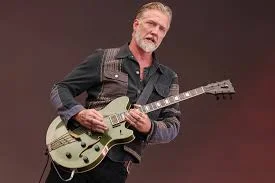
Josh Homme — £2,500 · Premium Tone
The £2,500 · Premium build for Josh Homme's powerful and driving sound opens with Gibson Les Paul Junior — the tonal foundation that defines the character. Into Fender Blues DeVille paired with King Tone Duellist OD and Dunlop Fuzz Face Mini, the rig comes to ~£2436 and delivers the essential elements. Josh Homme of Queens of the Stone Age creates some of modern rock's most hypnotic, locked-in riffs — baritone-ish tuned-down tones, drone-based single-note riffs, and a commitment to groove that makes QOTSA impossible to stand still to.
Build Josh Homme's £2,500 · Premium Rig
4 pieces · Total ~$3,094
What guitar does Josh Homme use?
Josh Homme is primarily associated with lp style guitars. At a £2,500 budget, Gibson Les Paul Junior delivers the essential tonal character.
What to Buy
£2,500 · Premium — Complete Gear List
Can't find one? See alternatives:
Why This Rig Works
How Josh Homme's gear choices create the signature tone
Gibson Les Paul Junior
The Gibson Les Paul Junior delivers warm humbucker thickness and singing sustain — the classic foundation for rock and blues tones.
- OverdriveKing Tone Duellist OD
- FuzzDunlop Fuzz Face Mini
Fender Blues DeVille
The Fender Blues DeVille converts the guitar signal into audible sound and adds its own tonal character — EQ shaping, natural gain, and the overall feel of the final tone.
The Combined Tone
Fender Jazzmaster or Telecaster into an Orange or Ampeg amp, often tuned to C or B standard. The tone is thick and warm rather than aggressive — the heaviness comes from the low tuning and the locked-in groove, not from distortion. A fuzz pedal appears on some tracks for additional harmonic saturation.
Tone Tips
Getting the Sound Right
- The Fender Blues DeVille stays cleaner longer than a Marshall-style amp — push it with a low-gain overdrive (gain at 2–3, level up) rather than cranking its own gain. Set treble at 6, bass at 4, and let the guitar's volume knob handle the dynamics.
- Tune to C or B standard — QOTSA's heaviness is almost entirely tuning-based. In standard tuning, the same riffs sound thin
- Heavy strings (.12s or .13s) are required for the low tunings to stay in tune and have the right tension and articulation
- Jazzmaster pickups have a distinctive single-coil character — warmer and less bright than a Strat, which contributes to the less aggressive quality
- The palm-muted dropped-tuning riff is the core QOTSA structural element — 'No One Knows,' 'Go with the Flow,' and 'Little Sister' all use this as the rhythmic foundation. The heavier the palm muting, the more mechanical and hypnotic the groove becomes
- Homme's vocal phrasing and guitar melody occupy deliberately separate rhythmic layers — the guitar riff and vocal melody often avoid landing on the same beats, creating polyrhythmic tension without complex notation. Analysing the rhythm of each independently reveals the offset relationship
- The cranked-amp character comes from the amp working at the edge of breakup — the guitar's volume knob controls whether the amp pushes over into overdrive. Rolling back the volume cleans up completely; full volume drives the amp into its natural overdrive, which is the QOTSA recording sound
Avoid These Pitfalls
Common Mistakes When Chasing This Tone
- Stacking a second overdrive after the TS9 with single coils — the combined mid emphasis of two stacked ODs into single-coil pickups produces a congested, nasal sound that struggles to sit in a mix
- Placing a tuner or buffered pedal before the Fuzz Face — most fuzz circuits (especially germanium ones) are sensitive to the impedance of the signal feeding them. A buffered pedal before the fuzz changes how the guitar volume knob responds. Run fuzz first in the chain
- Setting gain too high on the overdrive pedal — most overdrive pedals are most useful at gain settings of 2-5, where they add character without dominating the tone. High gain settings on an OD pedal become a distortion, not an overdrive.
- Putting fuzz after other pedals (especially wah or overdrive) — most fuzz circuits are sensitive to input impedance. Wah before fuzz is fine; overdrive into fuzz creates unpredictable gating.
- Scooping mids to "sound heavier" — a guitar with mids removed disappears under bass and drums. Metal tone cuts through a mix, and that requires midrange.
Budget Alternatives
Same Tone, Different Budget
FAQ
Josh Homme Tone — Common Questions
Josh Homme is primarily associated with lp style guitars. At a £2,500 budget, Gibson Les Paul Junior delivers the essential tonal character.
Josh Homme's amp is vintage blues voiced — the amp running hot, providing natural tube saturation. At the £2,500 level, Fender Blues DeVille is the closest match.
The £2,500 tier uses Josh Homme's actual gear choices or direct equivalents. Total: £2,436. The tonal step up from £1,000 is real but diminishing — worth it for regular performers and studio work.
Josh Homme's essential pedals include Overdrive, Fuzz. At the £2,500 tier: King Tone Duellist OD, Dunlop Fuzz Face Mini. Overdrive is the most important pedal — the others add nuance.
Josh Homme's tone is defined by qotsa-desert-rock, slinky-heavy, baritone-vibes. The combination of lp guitar and vintage blues amp creates a sound that is immediately recognisable.
Josh Homme's gain approach is amp-driven — natural tube saturation from pushing the amp hard, not from distortion pedals. At £2,500, this is replicated through Fender Blues DeVille paired with King Tone Duellist OD.
Josh Homme — £2,500 · Premium Complete Rig
~£2436Guitar
Gibson Les Paul Junior
Overdrive
King Tone Duellist OD
Fuzz
Dunlop Fuzz Face Mini
Amp
Fender Blues DeVille
Tone Match
Closest Real-World Tone Match
If you like Josh Homme's tone, these players use a similar approach — same gear philosophy, comparable sound characteristics.
Related Tones