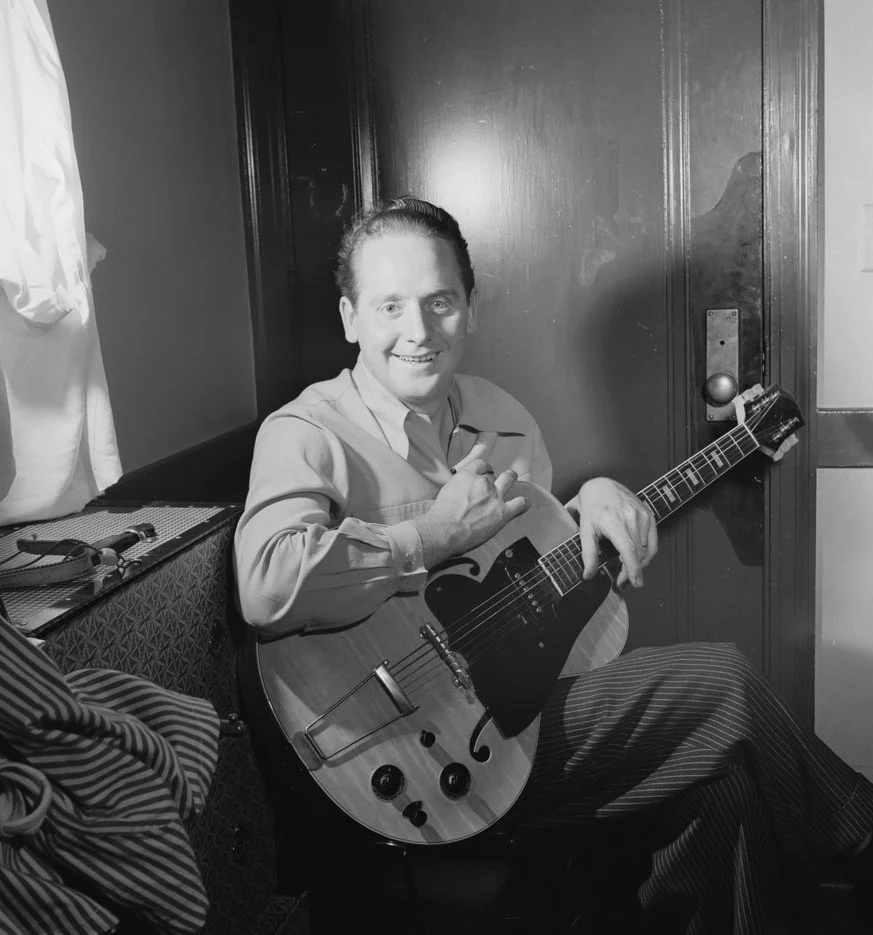
Les Paul — £200 · Beginner Rig
Les Paul's own guitar tone is clean, warm and bright — his black "Black Beauty" Les Paul Custom or his early Log prototype into a clean Ampex or broadcast amplifier chain, often with his self-invented tape echo for rhythmic slap-back effects. Multi-tracking allowed him to harmonise with himself in layers, creating a sound that was fuller than any live band could produce. His clean single-note runs have a glass-clear articulation that owes more to jazz guitar tradition than rock. The overdubs create a shimmering, prismatic stereo spread that was decades ahead of its time.
Signal Path
Signal Chain
Full signal path
Full Gear List
£200 · Beginner — Complete Rig

Tone Tips
Getting the Sound Right
- Use clean amp settings and rely on multiple harmonised guitar parts for fullness
- Tape slap-back echo (80–120ms) adds depth without obscuring the melody
- Harmonise guitar lines a third above — Les Paul's layered method
- A solid-body guitar has more sustain than a hollow archtop — the foundation of the Les Paul design
- Practice "Les Paulverisation": recording layer upon layer of guitar until the track is complete
- The signature Les Paul model uses an angled bridge pickup (the treble side tilted toward the bridge) — this deliberate engineering creates a brighter response on the treble strings and a warmer response on the bass strings within the same pickup, giving the characteristic tonal balance
- Guitar tracking in pairs builds the characteristic doubled-guitar thickness — Les Paul pioneered recording the same part twice and combining them slightly out of phase. The modern equivalent is two recorded takes panned left and right with a 5-10ms timing offset
- Tape speed manipulation was used to record guitar slowly and play back at full speed — this octave-transposition technique was used on 'How High the Moon' to create impossible rapid guitar parts. The modern equivalent is recording at half speed and pitch-correcting on playback
Avoid These Pitfalls
Common Mistakes When Chasing This Tone
- Using high-gain distortion — hollowbody guitars are designed for clean and light-drive use. High gain causes uncontrollable acoustic resonance that the pickup amplifies as noise.
- Using the amp's volume at less than 4 — boutique clean amps are designed to be played at certain output levels. At very low volumes the tone is compressed and flat compared to full-level operation.
- Expecting a clean tone to cover all playing dynamics — clean tone requires picking technique to do all the work. Lazy picking dynamics become very audible on a clean signal.
- Too many repeats at high mix — more than 3 repeats makes the delay effect accumulate and overwhelm the dry guitar signal. Keep it to 2-3 repeats at a subtle mix level.
- Keeping the tone knob at 10 — full treble on a jazz guitar gives a nasal, honky quality that sounds nothing like the warm round jazz ideal.
- Using round-wound strings — they are brighter, last longer, and have more sustain, but they also sound more "electric" and less woody than flat-wounds for jazz.
Tone Profile
Les Paul's Sound
Les Paul's own guitar tone is clean, warm and bright — his black "Black Beauty" Les Paul Custom or his early Log prototype into a clean Ampex or broadcast amplifier chain, often with his self-invented tape echo for rhythmic slap-back effects. Multi-tracking allowed him to harmonise with himself in layers, creating a sound that was fuller than any live band could produce. His clean single-note runs have a glass-clear articulation that owes more to jazz guitar tradition than rock. The overdubs create a shimmering, prismatic stereo spread that was decades ahead of its time.