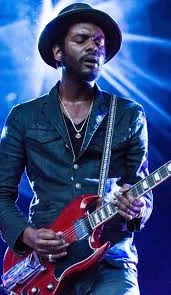
Gary Clark Jr — £1,000 · Pro-Level Tone
Gary Clark Jr's raw and emotionally charged tone took shape during a generation pushing the boundaries of modern guitar and remains one of the most sought-after sounds on guitar. Gary Clark Jr bridges the electric blues tradition and modern rock with a tone that spans pristine clean to wall-of-fuzz. His Epiphone Casino or ES-335 through a Fender Super Reverb and Vox AC30 delivers an expressive, wah-soaked blues-rock vocabulary that references Hendrix, SRV and BB King simultaneously. At the £1,000 · Pro-Level mark — a serious investment that brings you within touching distance of the real thing — the build centres on a Epiphone ES-335 Dot running through a Fender Blues Junior IV, with Electro-Harmonix Big Muff Pi and Dunlop GCB95 Cry Baby Wah completing the signal chain, totalling ~£1065.
Build Gary Clark Jr's £1,000 · Pro-Level Rig
5 pieces · Total ~$1,378
What guitar does Gary Clark Jr use?
Gary Clark Jr is primarily associated with semi hollow style guitars. At a £1,000 budget, Epiphone ES-335 Dot delivers the essential tonal character.
What to Buy
£1,000 · Pro-Level — Complete Gear List
Can't find one? See alternatives:
Why This Rig Works
How Gary Clark Jr's gear choices create the signature tone
Epiphone ES-335 Dot
The Epiphone ES-335 Dot provides the tonal foundation for the entire rig — its character shapes everything that follows.
- Lead Fuzzenormous four-transistor sustain wall
- Expression Filtervocal mid-sweep with Fasel resonance
- ReverbBoss RV-6 Reverb
Fender Blues Junior IV
This is where the magic happens for Mayer and SRV tones. The EL84 power section breaks up beautifully when pushed, and the bright, clean headroom is exactly what Tube Screamer boost tones are built on.
The Combined Tone
Epiphone Casino or Gibson ES-335 into a Fender Super Reverb (clean channel) and Vox AC30 (breakup), blended. A Cry Baby wah and Electro-Harmonix Big Muff Pi add texture and fuzz. Clark's tone is wide-ranging — from clean jangle to full-bore fuzz — controlled by guitar volume and pick attack.
Tone Tips
Getting the Sound Right
- The Fender Blues Junior IV stays cleaner longer than a Marshall-style amp — push it with a low-gain overdrive (gain at 2–3, level up) rather than cranking its own gain. Set treble at 6, bass at 4, and let the guitar's volume knob handle the dynamics.
- Two-amp setup: clean Fender and breaking-up Vox blended gives width and harmonic complexity
- Wah pedal rocked slowly mid-phrase — Clark uses it as a filter, not a wah-wah effect
- Big Muff gain around 7–8, tone at 5 — enough fuzz without losing mid presence
- Thumb attack (no pick for some phrases) produces a rounder, warmer note on the low strings
- Vibrato is slow and wide, applied after the initial attack — Texan blues phrasing
- Study "Bright Lights" and "Numb" for the range from clean funk to heavy fuzz
Avoid These Pitfalls
Common Mistakes When Chasing This Tone
- Placing a tuner or buffered pedal before the Big Muff — most fuzz circuits (especially germanium ones) are sensitive to the impedance of the signal feeding them. A buffered pedal before the fuzz changes how the guitar volume knob responds. Run fuzz first in the chain
- Using the Big Muff into a driven amp with the sustain above 8 — at high sustain into a driven amp the signal becomes a thick, undefined wall of fuzz with no note definition. Keep the amp channel clean
- Using a distortion pedal to replace amp saturation — amp-driven tone has a specific feel (dynamics, touch sensitivity, natural compression) that pedal distortion cannot replicate. The source of gain matters.
- Putting fuzz after other pedals (especially wah or overdrive) — most fuzz circuits are sensitive to input impedance. Wah before fuzz is fine; overdrive into fuzz creates unpredictable gating.
- Moving the wah too fast — wah is a filter effect that needs time to sweep through its range musically. Fast rocking produces a quacking sound; musical use is slower and more deliberate.
Budget Alternatives
Same Tone, Different Budget
FAQ
Gary Clark Jr Tone — Common Questions
Gary Clark Jr is primarily associated with semi hollow style guitars. At a £1,000 budget, Epiphone ES-335 Dot delivers the essential tonal character.
Gary Clark Jr's amp is vintage blues voiced — the amp running hot, providing natural tube saturation. At the £1,000 level, Fender Blues Junior IV is the closest match.
The £1,000 tier adds noticeably better build quality and tonal nuance over the £500 rig. This build totals £1,085 with Epiphone ES-335 Dot, Fender Blues Junior IV, 3 effects. This is the tier where the tone becomes genuinely convincing for gigging and recording.
Gary Clark Jr's essential pedals include Fuzz, Wah. At the £1,000 tier: Electro-Harmonix Big Muff Pi, Dunlop GCB95 Cry Baby Wah, Boss RV-6 Reverb. Fuzz is the most important pedal — the others add nuance.
Gary Clark Jr's tone is defined by feedback, modern-blues, dynamic. The combination of semi hollow guitar and vintage blues amp creates a sound that is immediately recognisable.
Gary Clark Jr's gain approach is amp-driven — natural tube saturation from pushing the amp hard, not from distortion pedals. At £1,000, this is replicated through Fender Blues Junior IV paired with Electro-Harmonix Big Muff Pi.
Gary Clark Jr — £1,000 · Pro-Level Complete Rig
~£1065Guitar
Epiphone ES-335 Dot
Amp
Fender Blues Junior IV
Fuzz
Electro-Harmonix Big Muff Pi
Wah
Dunlop GCB95 Cry Baby Wah
Reverb
Boss RV-6 Reverb
Tone Match
Closest Real-World Tone Match
If you like Gary Clark Jr's tone, these players use a similar approach — same gear philosophy, comparable sound characteristics.
Related Tones