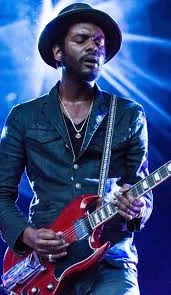
Gary Clark Jr — £500 · Sweet Spot Tone
Gary Clark Jr's raw and emotionally charged tone took shape during a generation pushing the boundaries of modern guitar and remains one of the most sought-after sounds on guitar. Gary Clark Jr bridges the electric blues tradition and modern rock with a tone that spans pristine clean to wall-of-fuzz. His Epiphone Casino or ES-335 through a Fender Super Reverb and Vox AC30 delivers an expressive, wah-soaked blues-rock vocabulary that references Hendrix, SRV and BB King simultaneously. At the £500 · Sweet Spot mark — the sweet spot — enough to get genuinely close to the sound without breaking the bank — the build centres on a Squier Classic Vibe 60s Jaguar running through a Boss Katana 50 MkII, totalling ~£498.
Build Gary Clark Jr's £500 · Sweet Spot Rig
2 pieces · Total ~$632
What guitar does Gary Clark Jr use?
Gary Clark Jr is primarily associated with semi hollow style guitars. At a £500 budget, Squier Classic Vibe 60s Jaguar delivers the essential tonal character.
What to Buy
£500 · Sweet Spot — Complete Gear List
Why This Rig Works
How Gary Clark Jr's gear choices create the signature tone
Squier Classic Vibe 60s Jaguar
The Squier Classic Vibe 60s Jaguar provides the tonal foundation for the entire rig — its character shapes everything that follows.
Boss Katana 50 MkII
Its 'Brown' amp character at low gain is an excellent approximation of the Fender-style clarity that Hendrix, Mayer, Gilmour and SRV all relied on. Built-in effects mean you're a few knob turns away from the right tone.
The Combined Tone
Epiphone Casino or Gibson ES-335 into a Fender Super Reverb (clean channel) and Vox AC30 (breakup), blended. A Cry Baby wah and Electro-Harmonix Big Muff Pi add texture and fuzz. Clark's tone is wide-ranging — from clean jangle to full-bore fuzz — controlled by guitar volume and pick attack.
Tone Tips
Getting the Sound Right
- On the Boss Katana 50 MkII: use the Brown channel — the closest model to a Marshall-voiced preamp at this price. Set character to 8, gain to 5. For Gary Clark Jr's lead volume jump, use the Boost mode rather than adding a separate boost pedal.
- Two-amp setup: clean Fender and breaking-up Vox blended gives width and harmonic complexity
- Wah pedal rocked slowly mid-phrase — Clark uses it as a filter, not a wah-wah effect
- Semi-hollow body resonance is essential — a solid body won't breathe the same way
- Guitar volume at 7 for clean; open at 10 for fuzz — the pedals respond to your volume knob
- Big Muff gain around 7–8, tone at 5 — enough fuzz without losing mid presence
- Try both wah positions (before and after the Big Muff) before committing to your board layout — the tonal difference is fundamental, not subtle. The "correct" position depends on the musical character you want, not a general rule
- Angle the semi-hollow body so the f-holes face away from the amp speaker — this reduces the acoustic energy entering the body cavity and delays the onset of feedback. Even a 45° rotation makes a noticeable difference
Avoid These Pitfalls
Common Mistakes When Chasing This Tone
- Placing a tuner or buffered pedal before the Big Muff — most fuzz circuits (especially germanium ones) are sensitive to the impedance of the signal feeding them. A buffered pedal before the fuzz changes how the guitar volume knob responds. Run fuzz first in the chain
- Using the Big Muff into a driven amp with the sustain above 8 — at high sustain into a driven amp the signal becomes a thick, undefined wall of fuzz with no note definition. Keep the amp channel clean
- Running high-gain settings on a semi-hollow — the resonant body cavity feeds back uncontrollably at high gain levels. These guitars require lower gain and benefit from the natural resonance.
- Using a distortion pedal instead of pushing the amp — vintage-voiced amps create better overdrive by being pushed hard than by a pedal circuit. Let the amp do the work.
- Using a distortion pedal to replace amp saturation — amp-driven tone has a specific feel (dynamics, touch sensitivity, natural compression) that pedal distortion cannot replicate. The source of gain matters.
Budget Alternatives
Same Tone, Different Budget
FAQ
Gary Clark Jr Tone — Common Questions
Gary Clark Jr is primarily associated with semi hollow style guitars. At a £500 budget, Squier Classic Vibe 60s Jaguar delivers the essential tonal character.
Gary Clark Jr's amp is vintage blues voiced — the amp running hot, providing natural tube saturation. At the £500 level, Boss Katana 50 MkII is the closest match.
Yes — £500 covers a real guitar and amp in the right tonal family. This rig totals £498 and captures the essential character. The guitar and amp account for 80% of the tone; pedals are secondary at this budget.
Gary Clark Jr's tone is defined by feedback, modern-blues, dynamic. The combination of semi hollow guitar and vintage blues amp creates a sound that is immediately recognisable.
Gary Clark Jr's gain approach is amp-driven — natural tube saturation from pushing the amp hard, not from distortion pedals. At £500, this is replicated through Boss Katana 50 MkII.
Gary Clark Jr — £500 · Sweet Spot Complete Rig
~£498Guitar
Squier Classic Vibe 60s Jaguar
Amp
Boss Katana 50 MkII
Tone Match
Closest Real-World Tone Match
If you like Gary Clark Jr's tone, these players use a similar approach — same gear philosophy, comparable sound characteristics.
Related Tones