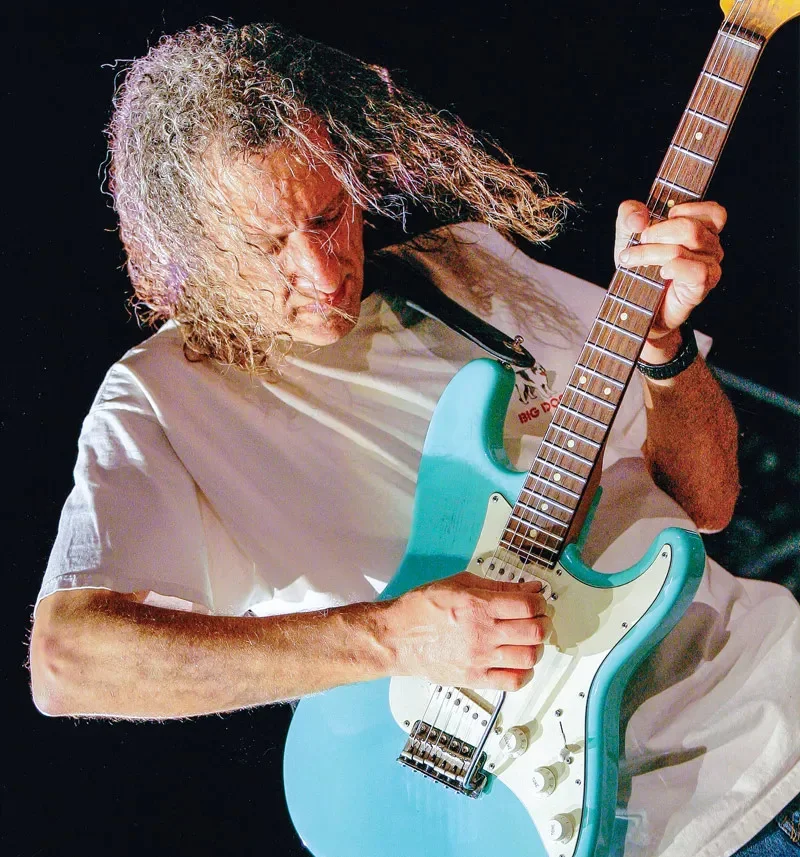
Scott Henderson — £2,500 · Premium Tone
Scott Henderson's soulful and deeply expressive tone took shape during the decade of guitar virtuosity and arena rock and remains one of the most sought-after sounds on guitar. Scott Henderson leads Tribal Tech and has developed a uniquely ferocious style that blends screaming blues-rock with jazz harmonic sophistication — a sound that has made him a favourite among fusion guitarists and a perennial Guitarist magazine poll winner. At the £2,500 · Premium mark — a premium build targeting the most accurate recreation possible — the build centres on a Ibanez RG550 Genesis Collection running through a Marshall DSL40CR, with Wilson Effects MkII Wah and King Tone Duellist OD completing the signal chain, totalling ~£2495.
Build Scott Henderson's £2,500 · Premium Rig
5 pieces · Total ~$3,169
What guitar does Henderson use?
Henderson is primarily associated with superstrat style guitars. At a £2,500 budget, Ibanez RG550 Genesis Collection delivers the essential tonal character.
What to Buy
£2,500 · Premium — Complete Gear List
Can't find one? See alternatives:
Why This Rig Works
How Scott Henderson's gear choices create the signature tone
Ibanez RG550 Genesis Collection
The Ibanez RG550 Genesis Collection provides the tonal foundation for the entire rig — its character shapes everything that follows.
- WahWilson Effects MkII Wah
- OverdriveKing Tone Duellist OD
- DelayWalrus Audio Fundamental Delay
Marshall DSL40CR
The Marshall DSL40CR converts the guitar signal into audible sound and adds its own tonal character — EQ shaping, natural gain, and the overall feel of the final tone.
The Combined Tone
Scott Henderson's tone is loud, raw and emotional: a Fender Stratocaster with hot vintage pickups running into a Dumble amplifier (or close clone) pushed into glorious natural overdrive. The Dumble's clean channel is pushed hard so it cooks into creamy overdrive without losing clarity — every note retains its articulation even at high gain. He adds an Ibanez TS808 as a mild boost to add density and focus. His vibrato is wide and aggressive, inspired by Albert King, and he bends far beyond pitch for effect. No modulation effects — just guitar, Tube Screamer, and Dumble.
Tone Tips
Getting the Sound Right
- The Marshall DSL40CR delivers power-tube saturation at master volume 6–7 — this compression and sag is what separates amp-driven tone from pedal tone. Set the master first, then dial back the channel gain to taste rather than the other way around.
- Use the middle pickup or neck+middle blend for that Dumble Strat texture
- Set the TS808 with volume up, gain at 9 o'clock — use it as a clean boost
- Bends are wide — a minor third bend (three semitones) appears regularly and requires significant left-hand strength built through regular conditioning. Most rock players use whole-step bends; Henderson's frequent minor-third bends produce a wider, more expressive vocal quality
- Semi-hollow body guitars create feedback at lower volume than solid bodies — this characteristic is used deliberately as a sustain and textural element in Tribal Tech recordings. Position the guitar near the amp speaker at performing volume to engage the feedback musically
- Modes beyond the major scale are used contextually rather than as patterns — Henderson uses Lydian augmented, altered, and whole-tone scales at specific harmonic moments when the underlying chord calls for those specific altered colour notes
- The Stratocaster's quacky middle-pickup tone is used for clean funk rhythm sections — Henderson is an equally accomplished rhythm player. Study the funk rhythm parts on Tribal Tech recordings to hear how position 4 (neck+middle out-of-phase) creates the light, percussive chord texture
Avoid These Pitfalls
Common Mistakes When Chasing This Tone
- Setting the TS808 gain above 5 into a clean amp — at high gain settings the TS becomes a distortion pedal that colours the tone heavily. Below 4, it's a boost and focus pedal. Single coils into a TS above 5 gets nasal and harsh
- Not using a gate on the Dumble-style's high-gain channel — self-noise at this gain level is continuous and audible between notes. A noise gate is not a style choice; it is functional equipment for this gain level
- Setting gain too high on the overdrive pedal — most overdrive pedals are most useful at gain settings of 2-5, where they add character without dominating the tone. High gain settings on an OD pedal become a distortion, not an overdrive.
- Moving the wah too fast — wah is a filter effect that needs time to sweep through its range musically. Fast rocking produces a quacking sound; musical use is slower and more deliberate.
- Choosing a pick that is too heavy — thin to medium picks give edge noise and articulation that heavier picks smooth away. That edge is part of the sound.
Budget Alternatives
Same Tone, Different Budget
FAQ
Scott Henderson Tone — Common Questions
Henderson is primarily associated with superstrat style guitars. At a £2,500 budget, Ibanez RG550 Genesis Collection delivers the essential tonal character.
Henderson's amp is high gain voiced — high-gain with significant distortion from the amp itself. At the £2,500 level, Marshall DSL40CR is the closest match.
The £2,500 tier uses Henderson's actual gear choices or direct equivalents. Total: £2,495. The tonal step up from £1,000 is real but diminishing — worth it for regular performers and studio work.
Henderson's essential pedals include Overdrive, Wah. At the £2,500 tier: Wilson Effects MkII Wah, King Tone Duellist OD, Walrus Audio Fundamental Delay. Overdrive is the most important pedal — the others add nuance.
Henderson's tone is defined by jazz-rock-metal, aggressive-fusion, superstrat-precision. The combination of superstrat guitar and high gain amp creates a sound that is immediately recognisable.
Henderson's gain approach is high-gain — dedicated high-gain amp channels or heavy drive pedals with significant distortion. At £2,500, this is replicated through Marshall DSL40CR paired with Wilson Effects MkII Wah.
Scott Henderson — £2,500 · Premium Complete Rig
~£2495Guitar
Ibanez RG550 Genesis Collection
Wah
Wilson Effects MkII Wah
Overdrive
King Tone Duellist OD
Amp
Marshall DSL40CR
Delay
Walrus Audio Fundamental Delay
Tone Match
Closest Real-World Tone Match
If you like Scott Henderson's tone, these players use a similar approach — same gear philosophy, comparable sound characteristics.
Related Tones