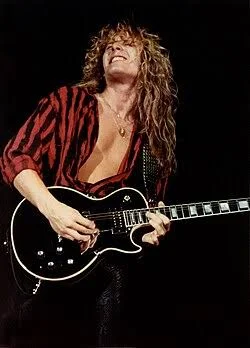
John Sykes
John Sykes is one of the most respected but underappreciated heavy metal guitarists of the 1980s. He joined Thin Lizzy in 1982 and played on their final studio album Thunder and Lightning, then became the lead guitarist and co-writer of Whitesnake's self-titled 1987 album — the best-selling rock album of that year — though he had left the band before its release. His work on 'Still of the Night', 'Is This Love', and 'Here I Go Again' defined the polished-but-powerful melodic metal guitar sound that dominated the late 1980s. His Les Paul Custom through a Marshall Super Lead produces one of the most immediately recognisable heavy metal tones of the era.
Thick, sustaining heavy metal lead guitar through a cranked Marshall — the Les Paul Custom's three humbuckers provide enormous output that drives the Super Lead into creamy, harmonic saturation. Sykes's phrasing is influenced by Gary Moore: blisteringly fast when required but fundamentally melodic and blues-rooted. Wide, fast vibrato is a defining characteristic. The tone is warm and full-spectrum despite the high gain — never ice-pick bright.
Signal Chain Order
Why John Sykes's Rig Works
The Les Paul Custom's three humbuckers (compared to the more common two on a Standard) give Sykes considerably more available output to drive the Plexi's front end hard — that extra output is a large part of why his tone reaches the Marshall's natural power-stage saturation without needing a distortion pedal to add gain, keeping the tone's harmonic character rooted in genuine amp saturation rather than a pedal's own clipping signature.
Keeping the presence control moderate rather than maxed is a deliberate choice against the more common instinct to push presence for maximum cutting power — Sykes's tone stays warm and full-spectrum specifically because that restraint avoids the piercing, thin quality an over-boosted presence control can introduce at high gain, which matters directly for his Gary Moore-influenced melodic phrasing that depends on warmth to sound expressive rather than merely aggressive.
Using the Boss OD-1 purely as a mild input boost, rather than reaching for a higher-gain pedal, follows the same boost-not-overdrive logic found throughout blues-rock and hard rock rigs on this site — it pushes the already-hot Les Paul Custom's signal even harder into the Marshall's front end without introducing a second, competing distortion character, preserving the singular, unified sound of "guitar driving amp" that defines his tone.
Guitars
Gibson Les Paul Custom (Black Beauty)
1982–presentSykes's defining guitar — a black Les Paul Custom with three humbucking pickups. The Custom's ebony fretboard, longer sustain, and higher-output pickups push the Marshall harder than a Standard. He uses the bridge pickup exclusively for lead; the middle and neck positions for rhythm variety.
Gibson Les Paul Standard
1982–1988Various LP Standards used alongside the Custom — the Standard's slightly brighter tone provides contrast for specific songs within the Whitesnake and Thin Lizzy contexts.
Amplifiers
Marshall Super Lead 100W "Plexi"
1982–presentThe Plexi is non-negotiable for Sykes — the natural power stage saturation at performance volume provides the harmonic bloom and singing sustain his lead style requires. He runs it loud enough to push the EL34s into saturation without master-volume attenuation. The result is the warm, full-frequency Marshall tone at its best.
Marshall JCM800
1984–1990Used alongside the Plexi for studio work — the JCM800's preamp gain supplements the Plexi's power-stage saturation for specific tonal characteristics in the studio.
Effects Pedals
Boss OD-1 Overdrive
1982–1990Used as a mild boost into the Marshall — the OD-1 pushes the Plexi's input harder without dramatically changing the character of the amp's own gain. Set for minimal drive with full output.
MXR Phase 90
1982–presentPhase 90 for atmospheric movement on slower passages and ballads — adds a subtle shimmer to sustained notes on material like 'Is This Love'.
Pedal guide →Key Albums & Tone
"Still of the Night", "Is This Love", "Here I Go Again ('87)" — the 1987 Whitesnake album. Sykes co-wrote all the guitar parts and recorded them before leaving the band. "Still of the Night" is his defining moment: a Zeppelin-influenced riff with a soaring melodic lead that demonstrates his full Les Paul/Plexi combination at peak.
Thin Lizzy's final studio album — Sykes joins the band and immediately contributes the heaviest guitar tones in Lizzy's history. The Plexi-driven Les Paul contrast with the earlier twin-guitar Lizzy sound.
Debut of Sykes's own band — his most guitar-forward album. The Les Paul Custom/Plexi combination is fully unleashed without the pop-production constraints of the Whitesnake album.
Frequently Asked Questions
What guitar does John Sykes use?
Gibson Les Paul Custom (Black Beauty) and Gibson Les Paul Standard. Sykes's defining guitar — a black Les Paul Custom with three humbucking pickups. The Custom's ebony fretboard, longer sustain, and higher-output pickups push the Marshall harder than a Standard. He uses the bridge pickup exclusively for lead; the middle and neck positions for rhythm variety.
What amp does John Sykes use?
Marshall Super Lead 100W "Plexi" and Marshall JCM800. The Plexi is non-negotiable for Sykes — the natural power stage saturation at performance volume provides the harmonic bloom and singing sustain his lead style requires. He runs it loud enough to push the EL34s into saturation without master-volume attenuation. The result is the warm, full-frequency Marshall tone at its best.
What pedals does John Sykes use?
John Sykes uses Boss OD-1 Overdrive, MXR Phase 90.
What is John Sykes's signature sound?
Thick, sustaining heavy metal lead guitar through a cranked Marshall — the Les Paul Custom's three humbuckers provide enormous output that drives the Super Lead into creamy, harmonic saturation. Sykes's phrasing is influenced by Gary Moore: blisteringly fast when required but fundamentally melodic and blues-rooted. Wide, fast vibrato is a defining characteristic. The tone is warm and full-spectrum despite the high gain — never ice-pick bright.
About This Data
Gear information for John Sykes is compiled from live performance footage, rig-rundown interviews, manufacturer and signature-model documentation, and cross-referenced guitar press coverage — not a single source. Where accounts conflict (a common issue with decades-old gear history), we favour the version corroborated by the most independent sources and note genuine ambiguity in the text rather than presenting a guess as settled fact.
This page is maintained by Alex Hall, last reviewed July 2026. Spotted something out of date or inaccurate? Let us know — corrections are usually made within a few days.