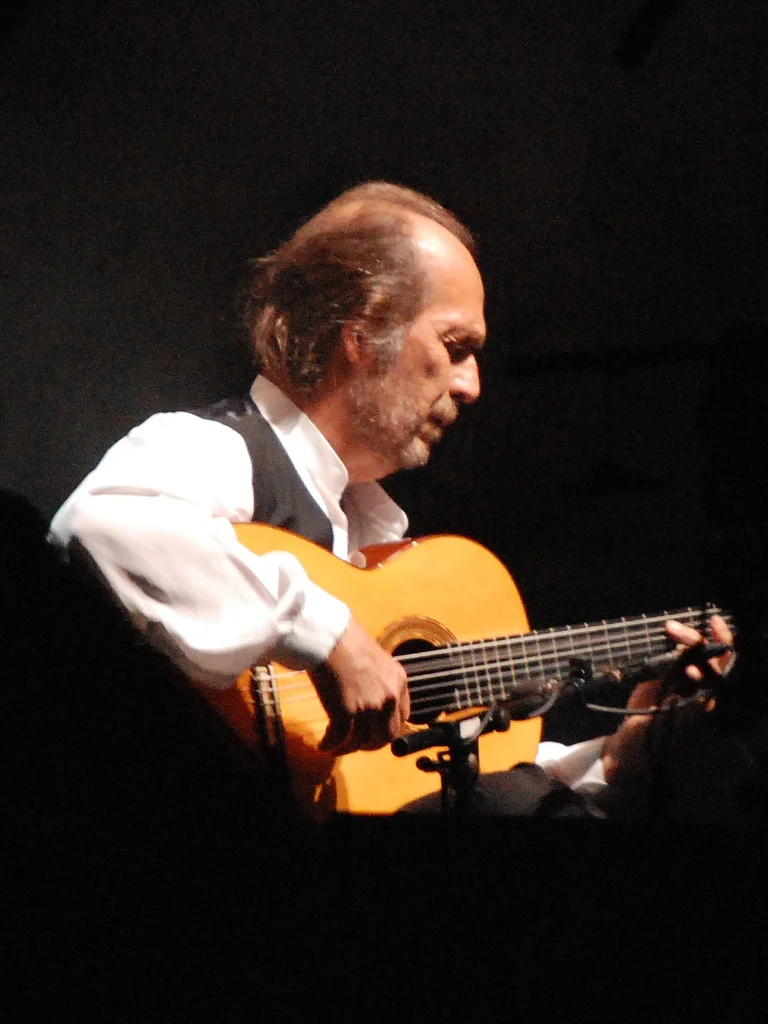
Paco de Lucía
Francisco Sánchez Gómez — Paco de Lucía — was the most technically accomplished and musically innovative flamenco guitarist of the 20th century. He modernised the flamenco tradition by synthesising it with jazz harmony and Brazilian music, working with Al Di Meola and John McLaughlin on the legendary Friday Night in San Francisco live album (1980), and creating a bridge between the flamenco tradition and the world music audience. His right-hand picado technique — alternate single-string picking with the index and middle fingers — achieved speeds and consistency that define the upper limit of acoustic guitar technique. He played exclusively on nylon-string Spanish guitars, rejecting the steel string entirely.
Explosive, rhythmically precise flamenco guitar on a handbuilt Conde Hermanos — the nylon string's attack and decay is sharper and faster than a steel string, enabling the rhythmic density of rasgueado strumming and the velocity of picado single-note runs. The tone is dry and percussive, with the body's tap (golpe) providing rhythmic punctuation. No amplification in traditional contexts; miked acoustically for recordings.
Signal Chain Order
Why Paco de Lucía's Rig Works
The Conde Hermanos's traditional cypress back and sides, rather than the rosewood common on classical concert guitars, produce a drier, brighter, more percussive tone with faster note decay — that quicker decay is essential to flamenco's rhythmic density, since the style depends on rapid picado runs and rasgueado strums remaining individually articulate rather than blurring together the way a longer-sustaining rosewood guitar's notes might.
The picado technique's strict alternation between index and middle fingers is functionally the acoustic-guitar equivalent of electric alternate picking, and it achieves comparable speed and evenness — but nylon strings respond differently to finger attack than steel strings do under a pick, requiring an entirely separate physical technique refined specifically for the nylon-string context rather than simply transferring electric guitar technique to acoustic.
On Friday Night in San Francisco, Paco's unamplified nylon-string guitar had to hold its own against two amplified steel-string electrics (McLaughlin and Di Meola) — this worked specifically because of the guitar's percussive, cutting acoustic projection and the golpe (rhythmic tapping on the guitar body) adding additional audible attack, giving the acoustic instrument enough presence and rhythmic bite to compete rather than being drowned out by amplification.
Guitars
Conde Hermanos (handbuilt flamenco guitar)
1967–2014Paco de Lucía's preferred instruments were handbuilt by the Conde Hermanos luthier family in Madrid — the gold standard of flamenco guitar construction. The cypress back and sides (traditional flamenco construction) produce a drier, more percussive tone than the rosewood classical guitar.
Amplifiers
Effects Pedals
Key Albums & Tone
Entre Dos Aguas — the track that introduced flamenco to mainstream Spanish pop audiences. Paco de Lucía's Conde Hermanos guitar unaccompanied: the full vocabulary of flamenco technique, from slow melodic falsetas to explosive picado runs.
Live trio with John McLaughlin and Al Di Meola — the definitive world music guitar album. Three guitar masters improvising simultaneously in flamenco, jazz fusion, and fusion styles. Paco's nylon-string cuts through despite competing with two amplified steel-strings.
Frequently Asked Questions
What guitar does Paco de Lucía use?
Conde Hermanos (handbuilt flamenco guitar). Paco de Lucía's preferred instruments were handbuilt by the Conde Hermanos luthier family in Madrid — the gold standard of flamenco guitar construction. The cypress back and sides (traditional flamenco construction) produce a drier, more percussive tone than the rosewood classical guitar.
What amp does Paco de Lucía use?
.
What pedals does Paco de Lucía use?
Paco de Lucía does not use effects pedals.
What is Paco de Lucía's signature sound?
Explosive, rhythmically precise flamenco guitar on a handbuilt Conde Hermanos — the nylon string's attack and decay is sharper and faster than a steel string, enabling the rhythmic density of rasgueado strumming and the velocity of picado single-note runs. The tone is dry and percussive, with the body's tap (golpe) providing rhythmic punctuation. No amplification in traditional contexts; miked acoustically for recordings.
About This Data
Gear information for Paco de Lucía is compiled from live performance footage, rig-rundown interviews, manufacturer and signature-model documentation, and cross-referenced guitar press coverage — not a single source. Where accounts conflict (a common issue with decades-old gear history), we favour the version corroborated by the most independent sources and note genuine ambiguity in the text rather than presenting a guess as settled fact.
This page is maintained by Alex Hall, last reviewed July 2026. Spotted something out of date or inaccurate? Let us know — corrections are usually made within a few days.