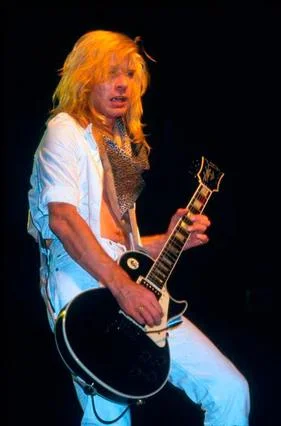
Sound Like Steve Clark
Getting Steve Clark's heavy and assertive sound is within reach at any budget. Steve Clark was one half of Def Leppard's twin-guitar attack — alongside Phil Collen, Clark's combination of blues feeling and hard rock power helped create the polished, harmony-drenched sound of Pyromania (1983) and Hysteria (1987). His Les Paul and ES-335 tones added a warmth and personality that balanced Collen's more precise superstrat approach. The guides below cover the full range — from the £200 entry point to the £2,500 premium build. Compare tiers and choose the level that suits you.
Quick Answer
To sound like Steve Clark, start with a Epiphone Les Paul Standard into a Boss Katana 50 MkII.
Tone Analysis
Steve Clark's Guitar Tone — In Depth
Tone Philosophy
Steve Clark was one half of Def Leppard's twin guitar attack alongside Phil Collen, and his contribution to the band's tone was the warmer, more Les Paul-oriented counterpart to Collen's brighter, more Stratocaster-influenced sound. The combination produced the "wall of guitars" approach that characterised Hysteria's production.
The Signature Sound
The Def Leppard Hysteria-era tone — Pour Some Sugar on Me, Animal, Love Bites — combines Clark's Les Paul warmth with massive multi-tracked layering under Bob Rock's production. Clark's specific tone was a Gibson Les Paul through a Marshall amplifier with relatively conventional gain settings; the elaborate sound heard on the record is as much a product of the studio processing and layering as of the live signal.
Key Gear
Gibson Les Paul Standards and various custom models were his primary guitars. Marshall amplifiers appeared throughout his work. His setup was straightforward by 1980s hard rock standards.
Playing Approach
Clark's playing within Def Leppard was divided between precise rhythm work for the multi-tracked studio approach and melodic lead lines that served the song's hook-focused compositions. His melodic sensibility suited Def Leppard's pop-oriented hard rock better than a technically complex approach would have.
Legacy
Hysteria is one of the best-selling albums in hard rock history. Clark's contribution to the twin-guitar approach and the emotional quality of the album's lead work is significant though often overshadowed by the production's external elements.
Budget Comparison
Pick Your Budget Level
£500 · Sweet Spot
~£478
£1,000 · Pro-Level
~£976
- GuitarEpiphone Les Paul Special
- ChorusTC Electronic Corona Chorus
- AmpBoss Katana 100 MkII
- DelayStrymon Timeline
£2,500 · Premium
~£2495
- GuitarGibson Les Paul Junior
- ChorusStrymon Ola Chorus
- AmpMarshall DSL40CR
- DelayStrymon Timeline
- ReverbBoss RV-6 Reverb
Shop Now
Buy the Key Gear — £500 Sweet Spot
Guitar, amp and essential effects for the authentic Steve Clark sound. The guitar and amp together account for 80% of the tone.
Complete the Rig
Essentials Every Guitarist Needs
These aren't exciting — but every rig needs them. Buy once, sorted forever.
Tone Profile
Steve Clark's Sound
Gibson Les Paul Standard and Gibson ES-335 into Marshall and Rockman amp units (on the Hysteria sessions). Clark's tone is warmer and bluesier than Collen's — the Les Paul provides mid-range emphasis and natural compression that suits his more feel-based playing style. On recordings, the guitar sounds were heavily processed through the Rockman headphone amp, which contributed to the distinctive 1980s Def Leppard compression.
Modeling Amps
Get Steve Clark's Tone on Your Modeler
Targeting Marshall (Plexi / JCM800). Use these amp models and IRs as your starting point — dial in from there using the knob settings above.
Low master, drive at 6–7 for Plexi crunch; Brit 2204 for JCM800 lead
Keep presence at 5, let the amp breathe — avoid over-EQing
Song Match
Which Steve Clark Songs Suit Your Amp
Tone Match
Closest Real-World Tone Match
If you like Steve Clark's tone, these players use a similar approach — same gear philosophy, comparable sound characteristics.
Weekly Tone Tips
One setting, one artist insight, one gear pick. No noise.