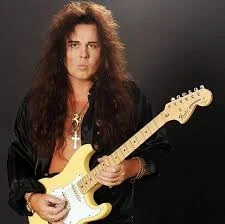
Sound Like Yngwie Malmsteen
Yngwie Malmsteen is one of the most recognisable voices in metal — a crushing and technically demanding player who shaped the sound of the decade of guitar virtuosity and arena rock. Yngwie Malmsteen brought Bach and Paganini to the electric guitar, creating neoclassical shred. His combination of extreme speed, scalloped-neck vibrato and harmonic minor vocabulary rewrote what was considered possible on the instrument. Below are complete rig guides at four budget levels, so you can start building their sound whether you're just starting out or ready to invest in the full setup.
Quick Answer
To sound like Yngwie Malmsteen, start with a Squier Classic Vibe 60s Stratocaster into a Boss Katana 50 MkII, with a Boss SD-1 Super Overdrive (as boost) as your key effect.
Tone Analysis
Yngwie Malmsteen's Guitar Tone — In Depth
Tone Philosophy
Yngwie Malmsteen arrived in the United States in 1983 with a fully formed musical vision: Baroque counterpoint applied to heavy metal guitar at maximum speed and volume. His primary influences were Ritchie Blackmore and Jimi Hendrix, but his synthesis drew also from Paganini, Bach, and Vivaldi in a way that created an entirely new genre. He has maintained this vision without significant modification for forty years, which is either the most admirable consistency or the most frustrating limitation depending on the listener.
The Signature Sound
The Rising Force-era tone — Far Beyond the Sun, Black Star, Little Savage — is a vintage 1970s Fender Stratocaster (scalloped fretboard, scalloped by Malmsteen himself to reduce string contact) through a Marshall JMP Super Lead or a modified Marshall Plexi, with a DOD Overdrive 250 as a boost. The scalloped fretboard enables his specific vibrato and bend character: the finger never contacts the wood between frets, producing extremely fast, precise vibrato and very light touch on bent notes.
Key Gear
His vintage 1970s Stratocasters (he collected them extensively) with Dimarzio YJM pickups are his primary instruments. The scalloped fretboard is the primary modification — no other guitarist uses this setup so consistently at this level. The DOD 250 or the MXR Distortion+ provides boost into the Marshall.
Playing Approach
Malmsteen's picking technique is unique: he holds the pick with only the tip exposed (the rest of the pick is inside the closed fist) and uses a sweeping or alternate picking motion described as "economy picking" or "inside-outside picking" depending on the phrase direction. This produces exceptional speed with a specific attack character.
Legacy
Malmsteen created neo-classical shred guitar as a genre and remains its most extreme practitioner. His influence on technical metal guitar playing from the 1980s onward is total.
Budget Comparison
Pick Your Budget Level
£500 · Sweet Spot
~£493
- GuitarSquier Classic Vibe 60s Stratocaster
- OverdriveBoss SD-1 Super Overdrive (as boost)
- AmpBoss Katana 50 MkII
£1,000 · Pro-Level
~£971
- GuitarSquier Classic Vibe 60s Stratocaster
- OverdriveBoss SD-1 Super Overdrive (as boost)
- DistortionBoss DS-1 Distortion
- AmpMarshall DSL20CR
- DelayTC Electronic Flashback 2
£2,500 · Premium
~£2480
- GuitarFender Player Stratocaster
- EQBoss GE-7 Graphic EQ
- OverdriveBoss SD-1 Super Overdrive (as boost)
- DistortionBoss DS-2 Turbo Distortion
- AmpMarshall DSL100H
- DelayTC Electronic Flashback 2
Shop Now
Buy the Key Gear — £500 Sweet Spot
Guitar, amp and essential effects for the authentic Yngwie Malmsteen sound. The guitar and amp together account for 80% of the tone.
Complete the Rig
Essentials Every Guitarist Needs
These aren't exciting — but every rig needs them. Buy once, sorted forever.
Tone Profile
Yngwie Malmsteen's Sound
Bright Stratocaster (scalloped neck, DiMarzio YJM pickups) into a Marshall boosted by a DOD 250 at minimum gain and maximum volume. The tone is trebly and violin-like — all clarity, no warmth. Everything lives in the upper register.
Modeling Amps
Get Yngwie Malmsteen's Tone on Your Modeler
Targeting Marshall (Plexi / JCM800). Use these amp models and IRs as your starting point — dial in from there using the knob settings above.
Low master, drive at 6–7 for Plexi crunch; Brit 2204 for JCM800 lead
Keep presence at 5, let the amp breathe — avoid over-EQing
Song Match
Which Yngwie Malmsteen Songs Suit Your Amp
Tone Match
Closest Real-World Tone Match
If you like Yngwie Malmsteen's tone, these players use a similar approach — same gear philosophy, comparable sound characteristics.
Weekly Tone Tips
One setting, one artist insight, one gear pick. No noise.