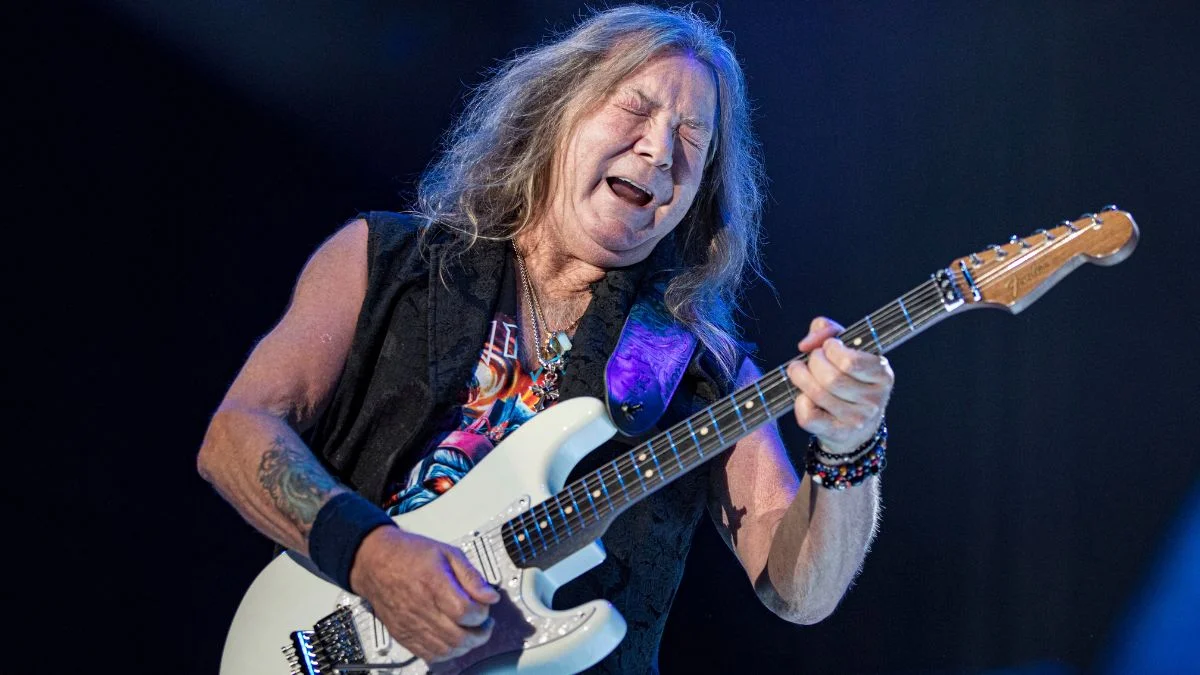
Dave Murray — £2,500 · Premium Tone
The £2,500 · Premium build for Dave Murray's aggressive and precise sound opens with Fender Player Stratocaster — the tonal foundation that defines the character. Into Marshall DSL40CR paired with Strymon Timeline and Strymon BigSky, the rig comes to ~£2466 and delivers the essential elements. Dave Murray is the founding lead guitarist of Iron Maiden — one of the most melodically gifted metal guitarists of the NWOBHM era, whose fluid, vibrato-rich soloing style over galloping bass lines and twin-guitar harmonies helped define British heavy metal.
Build Dave Murray's £2,500 · Premium Rig
4 pieces · Total ~$3,132
What guitar does Murray use?
Murray is primarily associated with strat style guitars. At a £2,500 budget, Fender Player Stratocaster delivers the essential tonal character.
What to Buy
£2,500 · Premium — Complete Gear List
Can't find one? See alternatives:
Why This Rig Works
How Dave Murray's gear choices create the signature tone
Fender Player Stratocaster
Where the Squier approximates the Strat voice, the Player Strat *is* the Strat voice. Noticeably more articulate and dynamic, responding to every nuance of pick attack.
- DelayStrymon Timeline
- ReverbStrymon BigSky
Marshall DSL40CR
The Marshall DSL40CR converts the guitar signal into audible sound and adds its own tonal character — EQ shaping, natural gain, and the overall feel of the final tone.
The Combined Tone
Dave Murray's tone is a model of clarity in a high-gain context: a Fender Stratocaster with a DiMarzio Super Distortion in the bridge position (replacing the standard single coil) running into a Marshall JCM800 or JMP head, pushed into natural tube saturation at stage volume. There is no scooped mid-range — Murray's tone has a full, vocal midrange that allows his melodic lines to cut through the band. His Strat's neck and middle pickups provide the singing lead tone; the bridge humbucker gives the crunch rhythm tone. The combination is unmistakably Iron Maiden.
Tone Tips
Getting the Sound Right
- The Marshall DSL40CR delivers power-tube saturation at master volume 6–7 — this compression and sag is what separates amp-driven tone from pedal tone. Set the master first, then dial back the channel gain to taste rather than the other way around.
- Install a humbucker in the bridge position of a Strat for the classic Murray crunch
- Set the JCM800 presence high (7–8) for the characteristic upper-mid bite
- Vibrato is applied to every sustained note — develop a fast, wide vibrato that activates within the first beat of any held note. This vibrato style is physically demanding and requires dedicated conditioning exercises separate from regular scale practice
- The clean intro of 'Fear of the Dark' demonstrates Murray's chord vocabulary beyond lead playing — minor-key arpeggiated patterns using open strings and barre chord combinations create the acoustic-style dynamic contrast before the full distorted arrangement arrives
- Solos follow a melodic statement, development section, and return structure — most Murray solos on Maiden albums use A-B-A architecture where the final section revisits the opening theme rather than continuously escalating. This creates a sense of compositional resolution
- The Floyd Rose tremolo is used conservatively — unlike many 80s rock players who dive-bombed extensively, Murray uses the tremolo only at phrase endings for a controlled pitch descend or at specific structural moments. Overuse dilutes its expressive impact
Avoid These Pitfalls
Common Mistakes When Chasing This Tone
- Leaving the guitar volume at 10 — single coil brightness at full volume can be harsh. Rolling back to 8-9 tames the top end without killing output.
- Using a high-gain distortion pedal instead of amp gain — British crunch amps have a specific harmonic character when driven from their own gain stage. A pedal changes this character.
- Too many repeats at high mix — more than 3 repeats makes the delay effect accumulate and overwhelm the dry guitar signal. Keep it to 2-3 repeats at a subtle mix level.
- Ignoring down-tuning — trying to achieve dropped-tuning riff character at standard pitch produces a thinner, less aggressive result regardless of EQ.
- Running gain at maximum — above 8 on most high-gain channels, palm mutes become indistinct and individual notes blur. The right amount of gain is the minimum for the target saturation.
Budget Alternatives
Same Tone, Different Budget
FAQ
Dave Murray Tone — Common Questions
Murray is primarily associated with strat style guitars. At a £2,500 budget, Fender Player Stratocaster delivers the essential tonal character.
Murray's amp is british crunch voiced — the amp running hot, providing natural tube saturation. At the £2,500 level, Marshall DSL40CR is the closest match.
The £2,500 tier uses Murray's actual gear choices or direct equivalents. Total: £2,466. The tonal step up from £1,000 is real but diminishing — worth it for regular performers and studio work.
Murray's essential pedals include Delay. At the £2,500 tier: Strymon Timeline, Strymon BigSky. Delay is the most important pedal — the others add nuance.
Murray's tone is defined by iron-maiden, dual-harmony-leads, british-crunch. The combination of strat guitar and british crunch amp creates a sound that is immediately recognisable.
Murray's gain approach is amp-driven — natural tube saturation from pushing the amp hard, not from distortion pedals. At £2,500, this is replicated through Marshall DSL40CR paired with Strymon Timeline.
Dave Murray — £2,500 · Premium Complete Rig
~£2466Guitar
Fender Player Stratocaster
Amp
Marshall DSL40CR
Delay
Strymon Timeline
Reverb
Strymon BigSky
Tone Match
Closest Real-World Tone Match
If you like Dave Murray's tone, these players use a similar approach — same gear philosophy, comparable sound characteristics.
Related Tones