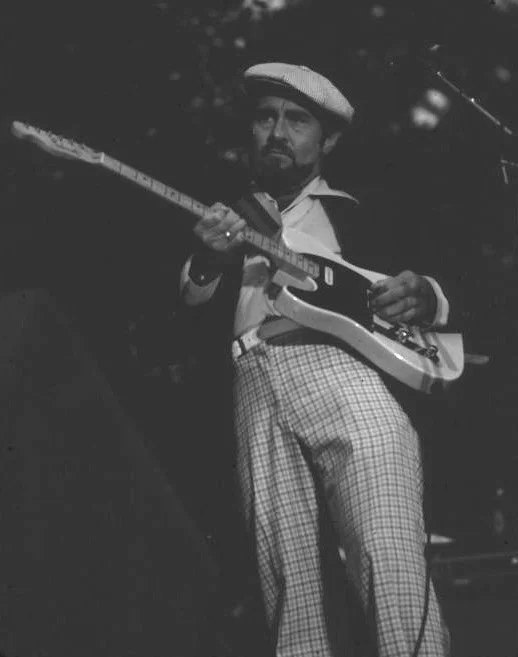
Roy Buchanan — £2,500 · Premium Tone
At £2,500 · Premium, Roy Buchanan's soulful and deeply expressive tone is more accessible than most players expect. Rooted in the golden age of electric guitar innovation, their sound — Roy Buchanan was one of the most technically gifted and emotionally devastating guitarists of his era — his Telecaster tone and volume-knob expressiveness influenced Jeff Beck, Robbie Robertson and a generation of blues players who admired his ability to make a single note tell a complete story. — starts with Fender Player Telecaster and Fender Blues DeVille, totalling ~£2417. That combination captures the defining characteristics without the premium price tag.
Build Roy Buchanan's £2,500 · Premium Rig
3 pieces · Total ~$3,070
What guitar does Roy Buchanan use?
Roy Buchanan is primarily associated with tele style guitars. At a £2,500 budget, Fender Player Telecaster delivers the essential tonal character.
What to Buy
£2,500 · Premium — Complete Gear List
Can't find one? See alternatives:
Why This Rig Works
How Roy Buchanan's gear choices create the signature tone
Fender Player Telecaster
Where the Squier approximates the Tele voice, the Player Telecaster *is* the Tele voice. Noticeably more articulate and dynamic, with the bridge pickup delivering the iconic snap and cut that defines the instrument.
Strymon BigSky
Strymon BigSky — reverb coloring added to the signal.
Fender Blues DeVille
The Fender Blues DeVille converts the guitar signal into audible sound and adds its own tonal character — EQ shaping, natural gain, and the overall feel of the final tone.
The Combined Tone
Fender Telecaster (1953) into a clean Fender amplifier. Almost no effects — the entire expression comes from the volume knob, the tone knob and the pick position. Pinch harmonics, volume swells and artificial harmonics are produced entirely through technique, not pedals.
Tone Tips
Getting the Sound Right
- The Fender Blues DeVille stays cleaner longer than a Marshall-style amp — push it with a low-gain overdrive (gain at 2–3, level up) rather than cranking its own gain. Set treble at 6, bass at 4, and let the guitar's volume knob handle the dynamics.
- The volume knob is a continuous expression tool — not just "on" and "off." Buchanan constantly varied guitar volume to produce swells, fade-ins and dynamic contour
- Telecaster bridge pickup for leads — the bright, cutting Telecaster bridge tone is what Buchanan's sound depends on
- The approach is vocal — every phrase has an emotional intent, a direction and a resolution. Play lines as if singing them
- Volume swell technique uses the guitar's volume knob rolled from zero to full after picking — pick the note hard at the bridge with the volume at zero, then roll the volume to full with the little finger of the picking hand. The result is a violin-like attack-free swell. This was Buchanan's primary expressive technique on ballads
- The Telecaster neck pickup at moderate volume gives the horn-like, round lead tone — the neck pickup's lower output forces more amp volume, which produces natural compression and evening of the dynamic range. Buchanan's clean Fender with the neck pickup creates a voice-like sustained tone with minimal pick attack transient
- Pinch harmonics at specific positions along the string produce named harmonic pitches — touching the thumb flesh against the string at the harmonic node immediately after the pick strikes the string generates an overtone. Practice finding the 12th, 7th, and 5th harmonic positions (one octave, one octave + fifth, two octaves) at each fret
Avoid These Pitfalls
Common Mistakes When Chasing This Tone
- Using a heavy pick with chicken-picking technique — hybrid picking (pick and fingers) on a Tele requires the pick to be thin enough not to interfere with the finger attack.
- Playing a vintage-voiced amp at low volume — the warmth and bloom of these amps comes from the power tubes working. At low volume the tone is flat and uninspiring compared to the amp's potential.
- Playing at bedroom volume expecting amp-driven tone — the power-tube saturation that defines this gain structure only occurs when the amp is working at substantial output. This is not replicable at low volumes.
- Using a humbucker where single coils are needed — the quack, string definition, and high-frequency air of single coils cannot be EQ'd into a humbucker
- Adding a compressor before the amp "for more tone" — it kills the natural attack variation that defines the style. Blues tone is uncompressed and dynamic.
Budget Alternatives
Same Tone, Different Budget
FAQ
Roy Buchanan Tone — Common Questions
Roy Buchanan is primarily associated with tele style guitars. At a £2,500 budget, Fender Player Telecaster delivers the essential tonal character.
Roy Buchanan's amp is vintage blues voiced — the amp running hot, providing natural tube saturation. At the £2,500 level, Fender Blues DeVille is the closest match.
The £2,500 tier uses Roy Buchanan's actual gear choices or direct equivalents. Total: £2,417. The tonal step up from £1,000 is real but diminishing — worth it for regular performers and studio work.
Roy Buchanan's tone is defined by pinch-harmonics, volume-swells, tele-twang. The combination of tele guitar and vintage blues amp creates a sound that is immediately recognisable.
Roy Buchanan's gain approach is amp-driven — natural tube saturation from pushing the amp hard, not from distortion pedals. At £2,500, this is replicated through Fender Blues DeVille paired with Strymon BigSky.
Roy Buchanan — £2,500 · Premium Complete Rig
~£2417Guitar
Fender Player Telecaster
Amp
Fender Blues DeVille
Reverb
Strymon BigSky
Tone Match
Closest Real-World Tone Match
If you like Roy Buchanan's tone, these players use a similar approach — same gear philosophy, comparable sound characteristics.
Related Tones