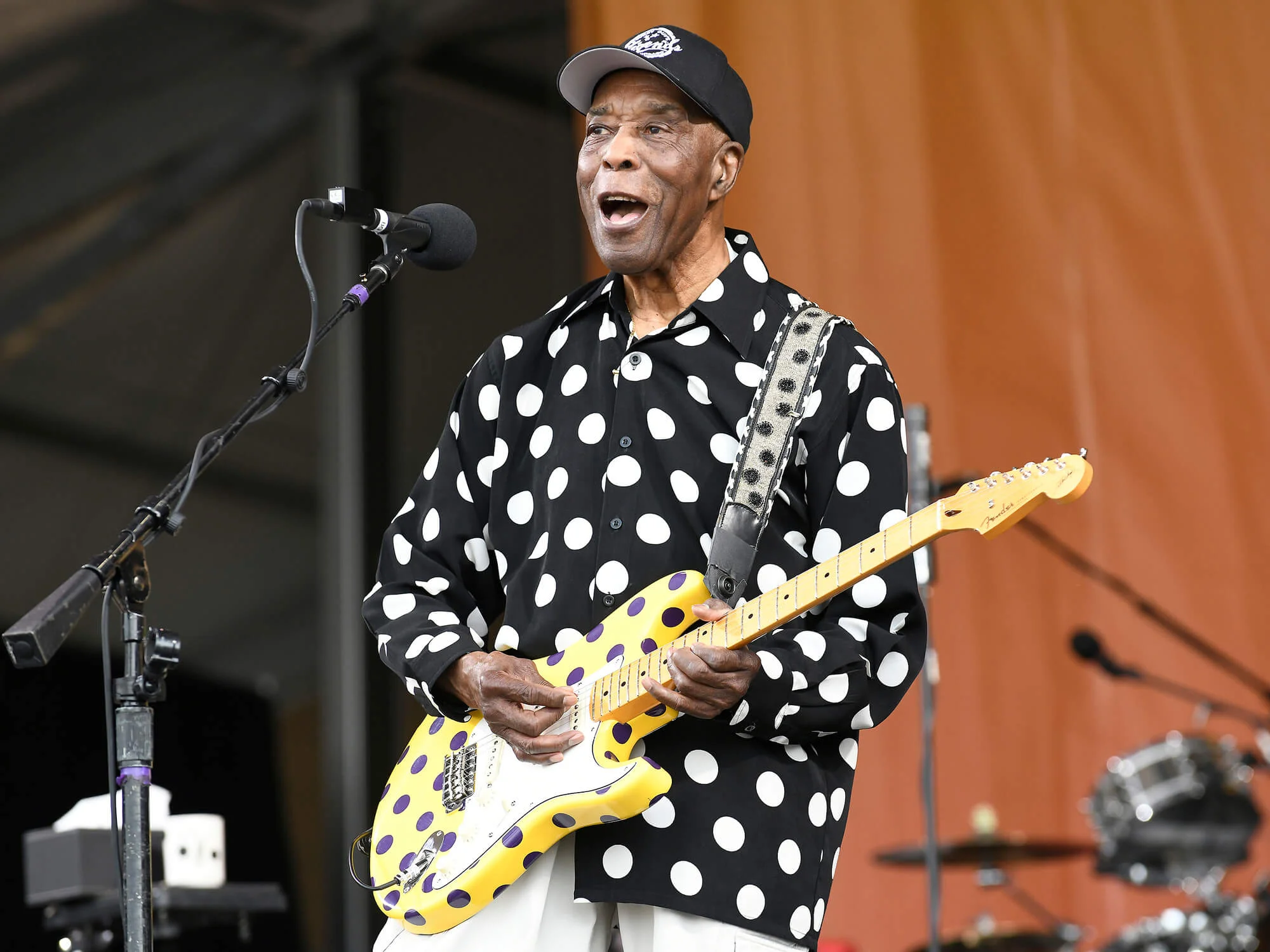
Buddy Guy — £2,500 · Premium Tone
Buddy Guy's soulful and deeply expressive tone took shape during the dawn of rock and roll and remains one of the most sought-after sounds on guitar. Buddy Guy is the most electrifying live blues performer alive — his polka-dot Stratocaster through a Fender Super Reverb delivers raw Chicago blues with extreme string bends, feedback and technique that influenced Jimi Hendrix, Eric Clapton and Stevie Ray Vaughan before they ever played a note. At the £2,500 · Premium mark — a premium build targeting the most accurate recreation possible — the build centres on a Fender Player Stratocaster running through a Fender Blues DeVille, with Xotic Effects XW-1 Wah and King Tone Duellist OD completing the signal chain, totalling ~£2496.
Build Buddy Guy's £2,500 · Premium Rig
4 pieces · Total ~$3,170
What guitar does Buddy Guy use?
Buddy Guy is primarily associated with strat style guitars. At a £2,500 budget, Fender Player Stratocaster delivers the essential tonal character.
What to Buy
£2,500 · Premium — Complete Gear List
Why This Rig Works
How Buddy Guy's gear choices create the signature tone
Fender Player Stratocaster
Where the Squier approximates the Strat voice, the Player Strat *is* the Strat voice. Noticeably more articulate and dynamic, responding to every nuance of pick attack.
- WahXotic Effects XW-1 Wah
- OverdriveKing Tone Duellist OD
Fender Blues DeVille
The Fender Blues DeVille converts the guitar signal into audible sound and adds its own tonal character — EQ shaping, natural gain, and the overall feel of the final tone.
The Combined Tone
Fender Stratocaster (polka-dot, with middle pickup or bridge) into a Fender Super Reverb (4×10) or Bassman. Clean to barely-breaking-up amp; all dirt comes from the guitar's physical attack and occasional use of a Boss DS-1. Guy's technique involves extreme bends — sometimes 3 whole steps — and dramatic use of the entire fretboard.
Tone Tips
Getting the Sound Right
- The Fender Blues DeVille stays cleaner longer than a Marshall-style amp — push it with a low-gain overdrive (gain at 2–3, level up) rather than cranking its own gain. Set treble at 6, bass at 4, and let the guitar's volume knob handle the dynamics.
- Extreme string bends: Guy bends 2–3 whole steps — use .009s and build finger strength gradually
- Play up the neck (above the 12th fret) more than most blues players — high register wails
- Study "Stone Crazy" and "Damn Right I've Got The Blues" for the full spectrum
- Guy plays at aggressive volume by design — his dynamic approach requires a loud amp to produce the natural harmonic complexity and sustain. At bedroom volumes, use a compressor before the amp to simulate the sustain that stage volume creates, then remove the compressor when playing loud
- The Stratocaster bridge pickup at full tone creates the intentional stinging edge — do not roll the tone knob. The almost harsh upper-mid content is what cuts through a band. Rolling it off removes the defining character in the name of smoothness
- Behind-the-nut bends create a pitch-raise that the tremolo bridge cannot — grabbing the strings between the nut and the headstock and pulling produces a wide pitch rise that sounds like a full-body string deflection. It was part of Guy's vocabulary before floating tremolo guitars became standard
Avoid These Pitfalls
Common Mistakes When Chasing This Tone
- Setting the TS9 gain above 5 into a clean amp — at high gain settings the TS becomes a distortion pedal that colours the tone heavily. Below 4, it's a boost and focus pedal. Single coils into a TS above 5 gets nasal and harsh
- Leaving the wah pedal engaged but stationary between rocking it — a cocked wah (fixed position, not moving) acts as a midrange filter that changes the core tone. Either rock it expressively or bypass it completely; a cocked wah changes the sound in ways that are often unintended
- Setting gain too high on the overdrive pedal — most overdrive pedals are most useful at gain settings of 2-5, where they add character without dominating the tone. High gain settings on an OD pedal become a distortion, not an overdrive.
- Moving the wah too fast — wah is a filter effect that needs time to sweep through its range musically. Fast rocking produces a quacking sound; musical use is slower and more deliberate.
- Using a large amp at low volume — the character of this style comes from a small amp working hard. A 100W amp at 2 doesn't give the same result as a 15W amp at 8.
Budget Alternatives
Same Tone, Different Budget
FAQ
Buddy Guy Tone — Common Questions
Buddy Guy is primarily associated with strat style guitars. At a £2,500 budget, Fender Player Stratocaster delivers the essential tonal character.
Buddy Guy's amp is vintage blues voiced — clean with headroom, pushed by an overdrive pedal. At the £2,500 level, Fender Blues DeVille is the closest match.
The £2,500 tier uses Buddy Guy's actual gear choices or direct equivalents. Total: £2,496. The tonal step up from £1,000 is real but diminishing — worth it for regular performers and studio work.
Buddy Guy's essential pedals include Overdrive, Wah. At the £2,500 tier: Xotic Effects XW-1 Wah, King Tone Duellist OD. Overdrive is the most important pedal — the others add nuance.
Buddy Guy's tone is defined by chicago-blues, flamboyant, expressive-bends. The combination of strat guitar and vintage blues amp creates a sound that is immediately recognisable.
Buddy Guy's gain approach is clean-boosted — a clean amp pushed by an overdrive pedal. The pedal adds colour; the amp adds body. At £2,500, this is replicated through Fender Blues DeVille paired with Xotic Effects XW-1 Wah.
Buddy Guy — £2,500 · Premium Complete Rig
~£2496Guitar
Fender Player Stratocaster
Wah
Xotic Effects XW-1 Wah
Overdrive
King Tone Duellist OD
Amp
Fender Blues DeVille
Tone Match
Closest Real-World Tone Match
If you like Buddy Guy's tone, these players use a similar approach — same gear philosophy, comparable sound characteristics.
Related Tones