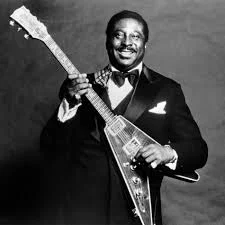
Albert King — £2,500 · Premium Tone
Albert King's soulful and deeply expressive tone took shape during the dawn of rock and roll and remains one of the most sought-after sounds on guitar. Albert King was left-handed but played a right-handed guitar upside down and unstrung in reverse — meaning his bends went downward rather than upward. This physical quirk gave his string bends a unique, scooped sound that seemed to pull notes down toward the floor, influencing SRV, Hendrix and virtually every blues player who heard it. At the £2,500 · Premium mark — a premium build targeting the most accurate recreation possible — the build centres on a Gibson Flying V Tribute running through a Fender Blues DeVille, with Walrus Audio Fundamental Reverb completing the signal chain, totalling ~£2497.
Build Albert King's £2,500 · Premium Rig
3 pieces · Total ~$3,171
What guitar does Albert King use?
Albert King is primarily associated with explorer style guitars. At a £2,500 budget, Gibson Flying V Tribute delivers the essential tonal character.
What to Buy
£2,500 · Premium — Complete Gear List
Can't find one? See alternatives:
Why This Rig Works
How Albert King's gear choices create the signature tone
Gibson Flying V Tribute
The Gibson Flying V Tribute provides the tonal foundation for the entire rig — its character shapes everything that follows.
Walrus Audio Fundamental Reverb
Walrus Audio Fundamental Reverb — reverb coloring added to the signal.
Fender Blues DeVille
The Fender Blues DeVille converts the guitar signal into audible sound and adds its own tonal character — EQ shaping, natural gain, and the overall feel of the final tone.
The Combined Tone
Gibson Flying V (played upside down) into a Fender Super Reverb or Acoustic 360 bass amp. The upside-down string configuration means the wound strings are on top — bends go downward toward the floor. The tone is warm, thick and mid-forward with a distinctively wide, slow vibrato that seems to groan rather than shimmer.
Tone Tips
Getting the Sound Right
- The Fender Blues DeVille stays cleaner longer than a Marshall-style amp — push it with a low-gain overdrive (gain at 2–3, level up) rather than cranking its own gain. Set treble at 6, bass at 4, and let the guitar's volume knob handle the dynamics.
- Albert's bends go downward (pulling the string toward the floor) — practise this specifically
- His neck position (thumb over the top) adds a warmer tone from dampening the neck resonance
- SRV studied Albert King obsessively — the cross-hand bend technique is clearly inherited
- Albert King tuned to an open minor variant and played a left-handed Flying V without reversing the strings — the string order is inverted, creating unique tension characteristics. His bends feel and sound different from standard tuning because the physical mechanics of pulling the string are reversed
- Vibrato comes from pulling the string toward the floor rather than pushing it sideways — King's downward pull vibrato is physically the opposite of most blues players' upward push, producing a wide, slow wobble with a distinctive weight that influenced SRV's entire technique
- The bent note is held at the top of the bend for a full beat before releasing — King's slow, deliberate releases are as musically important as the bends themselves. Rushing the release removes the tension and the characteristic crying quality of his lead lines
Avoid These Pitfalls
Common Mistakes When Chasing This Tone
- Expecting the same access to lower frets as on a conventional guitar — explorer and V shapes limit lower-body contact, which changes the natural picking position. Allow for this in technique.
- Using a distortion pedal instead of pushing the amp — vintage-voiced amps create better overdrive by being pushed hard than by a pedal circuit. Let the amp do the work.
- Adding compression to fix flat clean tone — a flat, lifeless clean tone usually means the amp gain or presence is wrong, not that compression is needed. Compression on a flat tone just makes it louder.
- Ignoring the guitar volume knob — rolling back to 6-7 is your rhythm setting; 10 is for leads. Most players leave it at 10 and miss the entire dynamic vocabulary.
- Using a humbucker where single coils are needed — the quack, string definition, and high-frequency air of single coils cannot be EQ'd into a humbucker
Budget Alternatives
Same Tone, Different Budget
FAQ
Albert King Tone — Common Questions
Albert King is primarily associated with explorer style guitars. At a £2,500 budget, Gibson Flying V Tribute delivers the essential tonal character.
Albert King's amp is vintage blues voiced — clean to moderate gain. At the £2,500 level, Fender Blues DeVille is the closest match.
The £2,500 tier uses Albert King's actual gear choices or direct equivalents. Total: £2,497. The tonal step up from £1,000 is real but diminishing — worth it for regular performers and studio work.
Albert King's tone is defined by flying-v, string-bending, soulful-blues. The combination of explorer guitar and vintage blues amp creates a sound that is immediately recognisable.
Albert King's gain approach is very clean — minimal distortion even at volume. The tone comes from the amp's natural warmth. At £2,500, this is replicated through Fender Blues DeVille paired with Walrus Audio Fundamental Reverb.
Albert King — £2,500 · Premium Complete Rig
~£2497Guitar
Gibson Flying V Tribute
Amp
Fender Blues DeVille
Reverb
Walrus Audio Fundamental Reverb
Tone Match
Closest Real-World Tone Match
If you like Albert King's tone, these players use a similar approach — same gear philosophy, comparable sound characteristics.
Related Tones